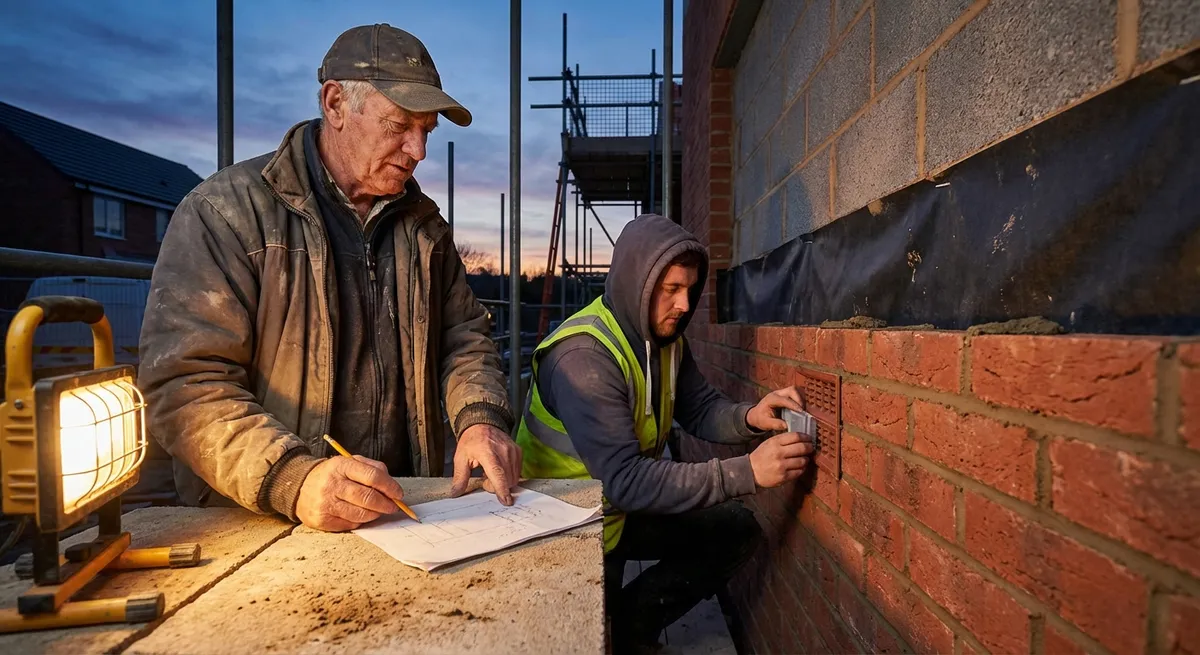
This guide focuses on practical, field-ready masonry tips that protect against common failures, improve build quality, and make your work easier to maintain. Each section walks through specific, repeatable techniques you can use on real jobs, not just in theory.
Start With the Right Units and Layout, Not Just What’s in Stock
Masonry problems often begin before a single course is laid—at the moment someone decides which brick, block, or stone to use. Choosing units strictly based on price or convenience can create expensive headaches in layout, cutting, and long-term performance.
First, confirm the nominal and actual dimensions of your units and build your layout around those numbers. For example, standard concrete masonry units (CMUs) are often listed as 8x8x16 nominal, but actual dimensions are typically 7-5/8" x 7-5/8" x 15-5/8". That 3/8" joint is designed into the system so courses stack cleanly without constant cutting and rework. If you substitute a different unit after layout is done, your bond pattern, openings, and reinforcement locations can all shift out of alignment.
Second, match the unit to the exposure and structural demands. Freeze-thaw conditions, deicing salts, and high moisture zones require brick and block with proper durability ratings (such as ASTM C216 for brick or ASTM C90 for load-bearing CMU in the U.S.). Ignoring this can lead to spalling faces, cracking, and premature deterioration—even when the workmanship is solid.
Finally, coordinate layout with openings and structural elements early. Centering window and door openings on full or half units reduces on-site cutting, maintains structural continuity, and improves the appearance of the finished wall. Lintels, bond beams, and vertical reinforcement should be designed to land in cells or joints that actually exist in the field, not just on paper.
Control Moisture Paths Before They Become Leak Paths
Most masonry failures are water failures in disguise. Even strong, well-bonded masonry will age poorly if it traps or channels water where it shouldn’t go. The goal isn’t to make a wall “waterproof”; it’s to control how water enters, moves, and exits.
Start with the basics: proper flashing and weeps. At any point where water can collect—over openings, at shelf angles, at the base of cavity walls—flashings should be continuous, correctly lapped, and turned up against backup walls or substrates to form a pan. Weep holes must be frequent enough (commonly 24" to 32" on center in many standards) and kept clear during construction so they can actually drain. Blocking weeps with mortar droppings is a fast way to turn a ventilated cavity into a wet sponge.
Next, protect the top of walls and parapets. These are prime water entry points. Copings should overhang and include properly sealed joints, drip edges, and compatible sealants. Without this, water can enter the core of the wall, freeze, and slowly push units apart from the inside.
On the face of the masonry, use compatible water-repellent systems when appropriate, and only after understanding the wall’s ability to dry. Some penetrating sealers allow vapor to move while shedding bulk water; others can trap moisture if misused. Always verify that the sealer is suitable for your specific brick, block, or stone, and test a small, inconspicuous area first.
Treat Mortar as a System Component, Not an Afterthought
Mortar does more than stick units together—it manages movement, transfers loads, and allows the assembly to accommodate stress. Using the wrong mortar type or mixing inconsistently can create rigid joints that crack or soft joints that erode prematurely.
Match mortar type to the masonry unit and structural demand. For example, stronger is not always better. Many clay bricks work best with a more flexible mortar (like Type N) that can absorb minor movement without cracking the brick itself. Overly strong mortars (like some Type S or M mixes) can force stress into the masonry units, causing spalling or cracking under load or during thermal cycling.
Maintain tight control over mix proportions and water content. On site, this means using consistent batch sizes, proper measuring (not shovels guessed by eye), and adding only enough water to achieve workable but not soupy mortar. Overwatering weakens the final joint, increases shrinkage, and can wash out cement paste, leading to a chalky surface and reduced durability.
Joint finishing also matters. Tooling joints at the right time—when the mortar is thumbprint hard—helps compress the surface, tighten the bond, and improve water resistance. Concave or V-joints are generally more weather-resistant than raked or flush joints in exposed conditions. On interior or less exposed work, aesthetic preferences can guide the profile, but performance in wet or windy exposures should always take priority.
Plan for Movement Instead of Fighting It
Every masonry assembly moves—due to temperature changes, moisture expansion, settlement, and structural loading. Trying to “lock it in place” without movement planning guarantees cracking and distress over time. The goal is to pre-plan where movement will be allowed and where it will be controlled.
Include properly designed and located control or expansion joints. For concrete masonry, control joints are typically used to manage shrinkage cracking; for clay brick, expansion joints help accommodate brick growth. The spacing and detailing of these joints should follow relevant standards or engineering guidance for your climate, exposure, and wall configuration, rather than rough rules of thumb alone.
Detail joints so they actually perform. Joints should be continuous through all finishes, correctly sized, and cleaned out before installing backer rod and sealant. A well-installed joint has a uniform depth, the right width for the selected sealant, and a bond-breaker or backer rod to maintain a proper hourglass sealant profile that can stretch and compress without tearing.
Don’t neglect connections to other materials. Where masonry meets steel, wood framing, or concrete slabs, allow for differential movement using slip connections, soft joints, or flexible sealants as appropriate. This is especially important at the tops of walls, at floor lines, and where masonry abuts structural frames. A small amount of planning for movement detailing will eliminate many of the hairline cracks that frustrate owners and spark unnecessary “repair” work later.
Protect and Cure Masonry in Real Jobsite Conditions
Even well-designed masonry can underperform if it’s not protected during construction. Jobsite realities—heat, cold, wind, rain—affect how mortar cures, how units bond, and how the assembly behaves in the first days and weeks of its life.
In hot, dry, or windy weather, mortar can lose water too quickly, leading to weak bonds and increased shrinkage cracking. Shade walls where possible, pre-dampen high-absorption units (without leaving standing water), and consider using retarders or adjusted mix designs if approved. Avoid laying masonry on units that are scorching hot from sun exposure; it accelerates water loss from the mortar and can cause premature stiffening.
In cold weather, protect masonry from freezing until it has gained sufficient strength. This may require heated enclosures, warm mixing water, and using materials stored above freezing temperatures. Frozen mortar or units contaminated with snow and ice can result in poor bond, reduced strength, and surface scaling later. Follow local codes and standards for allowable temperature ranges and protection requirements.
After the wall is up, keep it protected from direct saturation during early curing. Use temporary coverings or cap walls to limit water infiltration before flashings, copings, sealants, or roofing are complete. Early saturation followed by freeze-thaw cycles is a common cause of surface damage that shows up in the first few seasons.
Conclusion
High-performing masonry is built from a series of deliberate choices: selecting the right units, controlling moisture, matching mortar to the job, planning for movement, and respecting jobsite conditions. None of these details are flashy, but collectively they are what separate masonry that looks good for a few years from masonry that works quietly and reliably for decades.
Whether you’re managing a commercial project or upgrading a residential property, treating masonry as a coordinated system—not just stacked units and mortar—will reduce callbacks, protect your reputation, and deliver better value to the owner. The time invested in planning and execution now is the time you won’t spend chasing avoidable problems later.
Sources
- The Masonry Society – Technical Resources – Guidance on masonry design, construction details, and technical notes from a leading professional organization.
- NCMA (National Concrete Masonry Association) TEK Resources – Technical documents on CMU selection, control joints, reinforcement, and moisture management.
- Brick Industry Association – Technical Notes – Detailed information on brick durability, mortar selection, movement joints, and water management.
- Portland Cement Association – Masonry Construction – Practical resources on mortar, construction practices, and environmental considerations.
- U.S. General Services Administration – Masonry (CSI Division 4) Guide Specifications – Federal-level guidance on performance requirements, materials, and installation standards for masonry.