Understand Your Mix Before You Touch Water
Concrete performance starts long before it comes out of the truck or mixer. Knowing what’s in your mix lets you adjust methods on site instead of guessing.
For ready-mix deliveries, read the ticket carefully. It should list strength (e.g., 3,000 or 4,000 psi), slump, air entrainment, and any admixtures (like accelerators, water reducers, or fibers). If you’re mixing bagged concrete, note the manufacturer’s recommended water range and yield, and confirm whether it’s structural concrete or just for patches or non-structural use.
Respect the water-cement ratio: adding extra water for “workability” weakens the concrete, increases shrinkage, and raises the risk of cracking and surface dusting. If the mix feels very stiff, first confirm that it matches the specified slump and that it hasn’t started to set in the truck. When possible, use plasticizers or water-reducing admixtures instead of simply dumping in more water.
Match the mix to the environment: in freeze-thaw climates, air-entrained concrete helps resist scaling and spalling. In hot climates or on large slabs, ask about retarders to slow set and reduce cold joints. For exterior slabs exposed to de-icers, consider higher strength concrete and proper air content to improve durability.
Clarify intended use with your supplier or engineer: is the concrete for a footing, driveway, garage slab, or patio? Load expectations, exposure conditions, and building code requirements all affect the correct mix choice. Taking 10 minutes to confirm mix design can save days of rework and thousands in repairs.
Site Prep and Formwork That Prevents Future Failures
Even a perfect mix will fail if placed over poor subgrade or in weak forms. Solid preparation is non-negotiable for long-term performance.
Start with the subgrade. Strip organic material, soft soil, and debris; then compact the base with a plate compactor or jumping jack. On most small slabs, a 4" compacted gravel base (like crushed stone) improves drainage, reduces frost heave, and limits settlement. Uneven base thickness leads to stress points and cracking, so check depth in multiple locations.
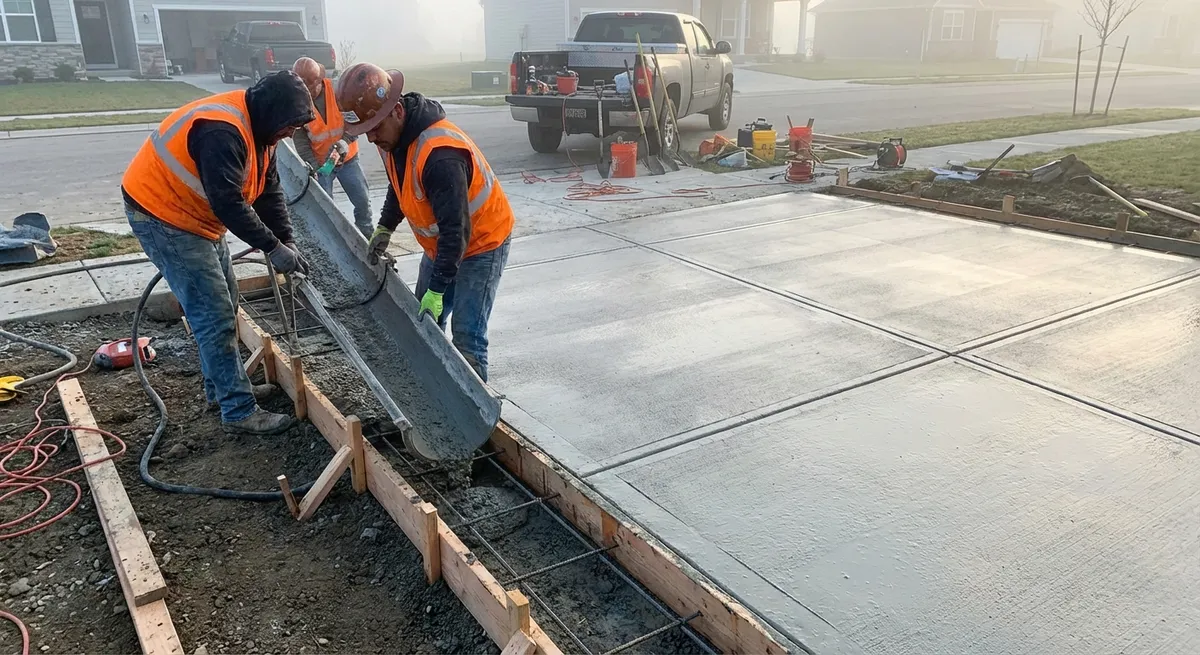
Formwork must be straight, rigid, and well-braced. Use quality lumber or metal forms and ensure stakes are driven outside the concrete line, not inside the slab where they interfere with finishing. Align forms with string lines or laser levels, and double-check elevation at corners and mid-spans. A small mis-level at one form can create ponding or visible slopes after the pour.
Apply a light coat of form oil or a form release agent to prevent sticking and honeycombing. Avoid diesel or motor oil; they can contaminate the surface and are environmentally unsafe. Ensure all form gaps are sealed—use foam strips, backer rod, or taped joints to stop paste leakage, which weakens edges and creates messy feathering.
Plan control joints and reinforcement before the pour. Mark joint locations on the forms and verify spacing and depth targets (typically one-quarter of the slab thickness). For rebar or mesh, support it on chairs instead of placing it directly on the ground and “hooking” it up during the pour; that shortcut often leaves steel too low for structural benefit.
Finally, consider access: can the truck reach? Do you need a pump or chute extensions? Will wheelbarrow routes be stable and safe? Managing logistics ahead of time keeps the crew focused on placement and finishing when timing matters most.
Placement and Consolidation That Reduce Hidden Weak Spots
How you place and consolidate concrete determines whether you end up with voids, honeycombing, or weak interfaces that only show up when cracks or spalls appear.
Place concrete as close to its final position as possible. Avoid dropping the mix from excessive heights, which can cause segregation (coarse aggregate separating from the paste). When using chutes or pumps, keep them close to the surface and move methodically rather than swinging wide arcs that separate aggregate and paste.
Work in manageable sections. On slabs, place and strike off in strips you can easily reach with a screed without overreaching or stepping into fresh concrete. Overreaching tends to bow screeds, creating waves, low spots, and inconsistent thickness. Use boards or kneeboards when necessary to reach into areas without damaging the surface profile.
Consolidate to remove trapped air and ensure good bond around reinforcement and at corners. For most flatwork, internal vibration is used on thicker slabs and around rebar. Insert the vibrator vertically, let it work until air bubbles stop rising, then withdraw slowly. Over-vibration can cause segregation or draw paste to the surface, so stay within manufacturer guidelines.
For smaller DIY projects like post bases or small pads, simple rodding or tapping the forms with a hammer can be sufficient consolidation. Still, the goal is the same: eliminate voids, especially at corners, edges, and around embedded items (anchors, sleeves, conduits).
Maintain a continuous workflow. Avoid long breaks that allow one section to set while another is still plastic, which creates cold joints. If a delay is unavoidable, create a neatly defined joint and roughen the edge to improve mechanical bond when you resume.
Watch the weather and adjust your placement tactics. In hot, dry, or windy conditions, protect fresh concrete from rapid moisture loss during placement and early finishing with windbreaks, sunshades, or light fogging of the air above the surface (never add water directly on the plastic surface except as a carefully controlled part of curing).
Finishing Timing and Techniques That Protect the Surface
Finishing is where many otherwise solid jobs are compromised. The goal is to achieve the required flatness and texture without trapping bleed water, weakening the surface, or overworking the paste.
After screeding, use a bull float to embed aggregate slightly and even out surface imperfections. Keep the bull float passes minimal and avoid overworking; repeated passes can draw excess paste to the top, which later dusts or scales. Maintain a slight upward tilt on the leading edge to avoid dragging aggregate and creating ridges.
Allow bleed water to rise and evaporate naturally before any steel trowel or hard finishing passes. Never trowel bleed water back into the surface. Doing so dilutes the cement paste at the top, raising the water-cement ratio, and often leads to weak, flaky, or scaled surfaces—especially in freeze-thaw climates or where de-icing salts are used.
Time finishing based on the concrete, not the clock. In cooler, humid conditions, initial set may take much longer. In hot or windy conditions, it may come quickly. Test by pressing your fingers lightly into the surface: if you leave only slight indentation and no water sheen, the surface is ready for further finishing.
Select the right finish for the application. Exterior slabs like driveways and walkways typically need a broom finish for slip resistance; drag a broom lightly perpendicular to main traffic direction to create uniform, shallow grooves. Interior or sheltered slabs may get a steel-troweled finish, but be cautious: over-troweling or burnishing can trap moisture and cause later delamination, especially on air-entrained mixes.
Edge and joint at the right time. Use an edger to slightly round slab edges to reduce chipping, and run joint tools along your marked layout to create clean control joints at the proper depth. Cutting joints too shallow or too late increases the risk of random cracking instead of controlled cracking where you intend.
If you plan a decorative overlay, coating, or sealer later, follow the product’s surface profile requirements. Some coatings require a lightly scarified or shot-blasted surface instead of a glass-smooth trowel finish. Planning that ahead prevents extra prep work later.
Curing and Early Protection That Add Years of Service Life
What happens in the first 7 days after the pour often matters more than everything you’ve done before. Proper curing is one of the most cost-effective ways to improve durability, strength, and crack resistance.
Concrete gains strength through hydration, a chemical reaction between cement and water. If the concrete dries out too quickly, hydration stops, leaving the surface weak and prone to cracking and dusting. Keep the slab moist and at a stable temperature, especially in the first critical 48–72 hours.
Choose a curing method suited to your project and climate. For flatwork, curing compounds (sprayed membrane-forming products) are convenient and widely used; apply as soon as the surface can be walked on without marking, following coverage rates carefully. For smaller DIY slabs, continuous wet curing—using wet burlap, curing blankets, or a soaker hose under plastic sheeting—can be very effective, provided you maintain constant moisture and avoid washing away paste.
Protect edges and corners rigorously; they dry out first and carry higher stress. Insulating blankets or foam edge protection can help in colder weather to prevent freeze damage while the concrete is still green. In hot weather, use sunshades or covers to reduce surface temperature and evaporation.
Don’t place heavy loads or equipment on the slab too early. While you can often walk on light-use slabs in 24–48 hours, full design strength isn’t reached for 28 days or more. Follow engineer or product recommendations for vehicle traffic, machinery, or structural loading, and be conservative where failure would be costly.
If you plan to saw-cut control joints instead of tooling them during finishing, time your cuts carefully—typically within 6–18 hours after placement, depending on the mix and weather. Cutting too early can cause raveling; cutting too late increases random cracking. Many professionals perform “early-entry” saw cutting with specialty blades and saws designed for that window.
Finally, schedule sealers, coatings, or overlays with proper cure time. Many products require the concrete to reach a certain age (often 28 days) and moisture level before application. Rushing this step can trap moisture and lead to blistering, delamination, or discoloration that is difficult to repair later.
Conclusion
Concrete rewards preparation, disciplined timing, and small adjustments made at the right moment. By understanding your mix, building solid subgrade and forms, placing and consolidating methodically, finishing with restraint, and curing with intent, you dramatically increase the odds that your work will stay strong, flat, and clean for years. Whether you’re a contractor managing multiple pours or a homeowner tackling a single slab, treating each step as essential—not optional—turns concrete from a gamble into a controlled process.
Sources
- Portland Cement Association – Concrete Basics - Overview of concrete materials, mixing, placing, finishing, and curing fundamentals
- American Concrete Institute (ACI) – Concrete in Practice Guides - Field-oriented practice guides on topics like curing, finishing, and hot/cold weather concreting
- U.S. Department of Transportation – Concrete Pavement Handbook (FHWA) - Detailed guidance on mix selection, placement, finishing, and curing for durable concrete pavements
- National Ready Mixed Concrete Association – Curing of Concrete - Practical recommendations for on-site curing methods and timing
- Cement.org – Placing and Finishing Concrete Slabs - Step-by-step reference for slab placement, consolidation, finishing, and jointing practices