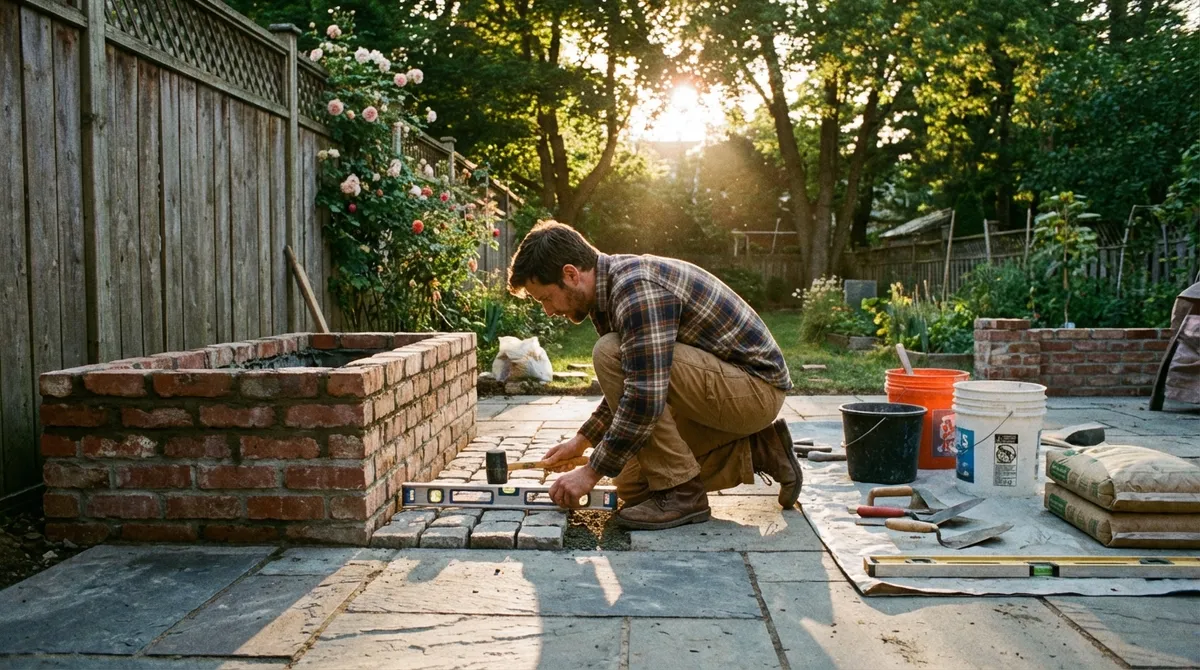
This guide focuses on small-scale masonry projects—think garden borders, short retaining walls, steps, and hardscape accents—that a careful homeowner can execute safely. Along the way, you’ll find five field-tested tips that working masons use to keep projects straight, solid, and durable.
Start with a Project That Matches Your Site and Skill Level
Before you buy a single bag of mortar, decide exactly what you’re building and where it will live. Masonry is unforgiving: once the mortar cures, changes are slow and messy.
Begin by walking your site and taking a few notes:
- Function first. Are you guiding foot traffic, holding back soil, defining a planting bed, or creating a small seating area? The purpose will dictate height, width, and material.
- Measure realities, not guesses. Use a tape measure and mark out the footprint with string or spray paint. Sketch a simple plan with dimensions and elevations.
- Check grade and drainage. Water must go somewhere. Observe how water flows when it rains and avoid creating dams or pockets where water will sit against foundations or steps.
- Verify codes and utilities. Even for small projects, call your local “call before you dig” service and check municipal or HOA rules on height, setbacks, and materials.
- Choose materials appropriate to your project. For low garden edging, dry-stacked stone or interlocking blocks may suffice. For steps or anything carrying real load, concrete block or poured concrete with proper base and reinforcement are safer.
Professionals rarely jump straight to mortar; they invest time in site assessment and layout. Treat this planning step as part of the build, not a preliminary chore.
Lay Out Like a Pro: Strings, Levels, and Reference Points
Clean layout is the foundation of professional-looking work. Instead of “eyeballing it,” use the same simple tools the trades rely on: string lines, stakes, levels, and a tape measure.
Work through layout in a deliberate sequence:
- Establish fixed reference points. Find or create at least one stable reference—such as a building corner, existing slab, or permanent stake—that won’t move during the project.
- Run string lines for straight work. Drive stakes at corners, pull mason’s string tight, and keep it at the exact height you want the top of your finished course (or at a consistent offset). Check string lines with a level.
- Use batter boards for flexibility. For larger layouts, attach strings to horizontal batter boards set a bit away from the work area. You can adjust strings without disrupting your stakes.
- Check square, not just level. Use the 3-4-5 rule (a simple Pythagorean triple: 3 ft by 4 ft should create a 5 ft diagonal) to confirm that corners are actually 90 degrees.
- Dry-lay a test course. Before you mix mortar, set your first course of units (bricks, blocks, or stones) in place without adhesive. Adjust spacing, cuts, and alignment while changes are quick.
Experienced masons think in terms of lines and planes. Your string lines represent those invisible planes that your finished project must honor. If the layout is true, everything that follows becomes easier.
Build from the Ground Up: Base, Compaction, and First Course
If there’s a single place where DIY projects commonly fail, it’s the base. Even the best block will shift or crack if it’s resting on soft, unprepared soil.
Approach your base the way a contractor would:
- Excavate to undisturbed subgrade. Remove organic soil, roots, and loose material to reach firm ground. For small walls or borders, this may be 6–12 inches; for steps or taller walls, more may be needed depending on local conditions.
- Use the right base material. Crushed stone or gravel (often labeled as “road base,” “crusher run,” or “3/4-inch minus”) compacts well and drains. Avoid round river rock for base; it won’t lock together properly.
- Compact in lifts. Place base material in 2–3 inch layers (“lifts”), compact each layer with a hand tamper or plate compactor, then add the next layer. This step directly impacts long-term stability.
- Establish a slight slope. For horizontal surfaces like patios or landings, a slope of about 1/8" to 1/4" per foot away from structures helps shed water safely.
- Set the first course perfectly. Take extra time to get the first row of units dead level and aligned along your string line. Tap units into place with a rubber mallet instead of forcing them with extra mortar.
Professionals know that fixing a wavy first course later is almost impossible without ripping out work. If something looks off at this stage, correct it now—even if it means relaying a few pieces.
Control Your Mortar: Consistency, Timing, and Joint Quality
Mortar is both adhesive and cushion. Controlling its behavior gives you clean joints, strong bonds, and fewer callbacks—whether you’re building a short wall, a set of steps, or a small veneer.
Adopt these expert practices:
- Mix in small, repeatable batches. Follow the manufacturer’s water ratios and mix only what you can place within the working time (often 30–60 minutes, depending on conditions).
- Aim for peanut-butter consistency. Mortar should hold its shape on a trowel but still be workable. Too wet reduces strength and causes sagging joints; too dry makes bonding unreliable.
- Use the right mortar type. Type N is common for above-grade walls and veneers; Type S is stronger and often used below grade or where more load is expected. Match mortar to your application and local code requirements.
- Tool joints at the right moment. Let mortar “thumbprint hard” (firm but not fully cured) before striking or tooling joints. This reduces smearing and improves weather resistance.
- Keep units and tools clean as you go. Immediately remove excess mortar and splatter using a brush or damp sponge. It’s much harder to clean once cured, and stains are one of the biggest giveaways of amateur work.
On hot, dry, or windy days, professional crews adjust by working in shaded sections, using slightly cooler water, or lightly dampening masonry units (if appropriate) so they don’t suck the moisture out of the mortar too quickly.
Think Long-Term: Drainage, Movement, and Maintenance
Construction pros plan for the project’s “life after photos.” That means anticipating how water, temperature changes, and normal use will affect your work over years, not just weeks.
Integrate durability into your design:
- Provide a clear path for water. Behind small retaining walls, use a granular backfill (like gravel) and consider adding perforated drain pipe with an outlet, especially in wet climates or clay soils.
- Respect expansion and control joints. For concrete slabs or long masonry runs, include control joints at proper intervals to manage cracking. Check local standards or manufacturer guidance for spacing.
- Keep soil and mulch away from joints. Burying masonry in wet soil accelerates deterioration and encourages frost damage in cold climates. Maintain a small gap or use gravel at the base for drainage.
- Seal only when appropriate. Some projects benefit from breathable sealers, while others perform better unsealed. If you use a sealer, choose one designed for your material and climate, and follow prep and application instructions carefully.
- Schedule quick inspections. Once or twice a year, walk your project. Look for minor movement, mortar joint hairline cracks, and blocked drains. Address small issues early with spot repointing or cleaning rather than waiting for a full rebuild.
Professionals view every completed project as a system interacting with weather, soil, and use. Adopting that mindset keeps your DIY work looking “freshly installed” far longer than average.
Conclusion
Professional-looking masonry isn’t about having a crew and a trailer full of tools; it’s about applying disciplined habits at each step. Selecting a realistic project, laying out with precision, building from a stable base, managing your mortar like a craftsperson, and planning for drainage and movement will elevate even modest DIY builds.
Start small, treat each project as a chance to refine these five expert habits, and resist the urge to rush past layout and base work. Over time, your results will stop looking “DIY” and start resembling what you see in well-executed professional work—and they’ll still be performing long after the first season.
Sources
- Portland Cement Association – Mortar Types and Uses – Technical overview of mortar types (N, S, M) and where each is appropriate
- NCMA (National Concrete Masonry Association) – Segmental Retaining Wall Installation Guide – Professional guidance on base preparation, drainage, and construction details
- University of Minnesota Extension – Planning and Building Patios and Walkways – Practical instructions on layout, base compaction, slope, and materials
- Concrete Network – Control Joints in Concrete – Explains the purpose, spacing, and detailing of control joints to manage cracking
- U.S. DOT FHWA – Residential Drainage and Erosion Control – Background on drainage principles around structures and hardscape areas