Below are five expert-level tactics you can plug into almost any DIY project, from hanging cabinets to forming a small concrete pad or framing a partition wall.
Build a One-Page Scope Before You Touch a Tool
Professionals don’t start with tools—they start with scope. A simple, one-page scope of work clears up what you’re actually doing and what you’re not.
Write this out before you buy a single item:
- Objective in one sentence: “Replace the failing deck steps with code-compliant stringers and treads” or “Add a 12' × 8' storage wall with adjustable shelving.”
- Existing conditions: Note framing type, wall construction (stud, masonry, etc.), access, and potential hazards (electrical lines, plumbing, gas, asbestos/lead concerns).
- Performance requirements: Load support, moisture resistance, fire rating, sound control, or insulation needs.
- Finish level: Rough utility grade, paint-ready, stain-grade, or trim-level finish.
- Constraints: Budget limit, time window, noise restrictions, and weather exposures.
Why it matters:
- It reveals hidden steps (for example, patching drywall after moving an outlet).
- It prevents scope creep, where you casually “add a few things” mid-project and double your cost.
- It helps you decide whether you’re missing permits or inspections before you begin.
Treat this document as your on-site contract with yourself. Tape it to the wall or keep it open on a tablet so every decision can be checked against it.
Use Trade-Grade Layout Habits, Not Eyeballing
Construction pros spend more time on layout than on first cuts. Clean layout is what makes doors close square, tiles line up, and shelving look intentional rather than improvised.
Adopt these habits:
- Establish a reference line.
Snap a chalk line or draw a long pencil line that becomes your “zero.” For flooring or tile, this might be the centerline of a room. For framing, it’s often the top or bottom plate reference.
- Work from fixed, not flexible, points.
Measure from immovable elements: an exterior wall, a structural column, or a corner that is known to be plumb and square. Avoid “daisy-chain” measuring from other new work you just built.
- Square with 3-4-5 (or its multiples).
Use the Pythagorean triple: measure 3 ft along one line, 4 ft on another, and adjust until the diagonal is 5 ft. For larger work, use 6-8-10 or 9-12-15. This is standard practice on concrete and framing crews.
- Mark cut and fastener locations with consistent symbols.
Use different marks (X for studs, V for centerline, a tick mark for cuts) and stay consistent. It prevents mistakes when you come back the next day.
- Test layout with a dry run.
Lay out tile, decking, or panels without adhesive or fasteners to confirm you won’t end with a 1" sliver against the wall or an awkward joint in a high-visibility spot.
The payoff is simple: good layout makes your project forgiving—small errors are absorbed without being obvious to the eye.
Standardize Your Fasteners and Hardware Up Front
Pros rarely buy fasteners at random. They standardize on a few go-to types and sizes, then build their details around what those fasteners are meant to do. This prevents pull-outs, rust stains, and cracked workpieces.
Before you start:
- Select for material and environment.
- Interior framing: coated or bright framing nails/screws.
- Exterior or wet areas: hot-dip galvanized or stainless screws/nails.
- Masonry: proper masonry anchors (sleeve anchors, wedge anchors, or screw anchors like Tapcons) with the right drill bit.
- Match length to embedment, not just thickness.
- Use the manufacturer’s system.
Aim for at least 1–1¼ inches of solid embedment in wood framing on structural attachments (more for decking and ledger connections). In masonry, follow the manufacturer’s minimum embedment depth.
For structural connectors (joist hangers, post bases, etc.), use the specified nails or screws. Mixing fasteners can void the load rating and lead to failure.
On site, organize like a pro:
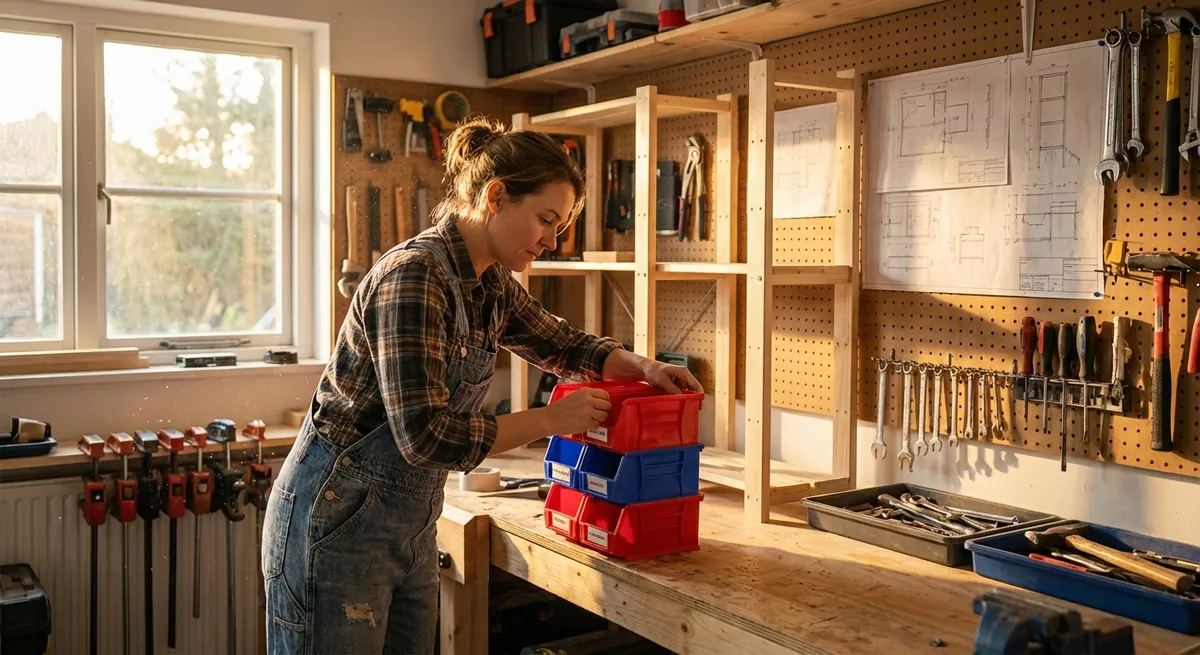
- Keep fasteners in labeled bins (size, type, material, and use).
- Maintain a standard kit: a small assortment of the fasteners you use most, in a dedicated box that travels with you.
- Write on your one-page scope which fasteners go with which assembly: example, “Cabinet rails to studs: #10 × 3" structural screws, minimum 2 per stud.”
This approach makes your work more predictable and dramatically reduces weak connections, stripped holes, and the common “I used whatever was around” failures.
Control Dust, Noise, and Debris Like a Real Jobsite
In professional work, jobsite control is not optional—it protects workers, clients, and the structure. Doing the same at home keeps projects safer, cleaner, and easier to finish properly.
Build in controls from the start:
- Dust containment:
- Use plastic sheeting and zipper doors to separate the work area from living spaces.
- Pair dust-producing tools with a shop vacuum or dust extractor and HEPA bags where possible.
- If cutting masonry or concrete, use wet-cut methods or outdoors with proper PPE and local containment.
- Noise planning:
- Schedule loud work for daylight hours only.
- Group noisy tasks together: demo, drilling, nailing, and cutting in one block, so you minimize repeated disruptions.
- Debris management:
- Set up dedicated zones: scrap wood, clean recyclables, and general waste.
- Cut long material on a designated station to keep offcuts from piling up in walking paths.
- Clear trip hazards at every break; pros follow “clean as you go” because a cluttered site is where injuries happen.
This isn’t just about comfort. Dust can affect ventilation systems, create fire hazards, and ruin finishes. Debris piles and cords in walkways are common sources of falls. Clean control makes the final stages—priming, painting, caulking—much smoother and more professional looking.
Close Out Your Project with a Punch List, Not Just a “Done” Photo
Professionals end jobs with a punch list—a short, targeted list of everything that still needs attention before the work is truly complete. Adopting this last step separates “good enough” DIY from work that actually holds up and looks right.
Create your punch list by walking the job systematically:
- Start with function, then move to appearance.
- Doors: Do they latch smoothly? Are gaps even? Do they clear flooring?
- Shelving and cabinets: Are they level, plumb, and properly anchored?
- Electrical and plumbing (where permitted): Do fixtures operate correctly with no leaks, flicker, or heat issues?
- Inspect from user height and angles.
- Sit, stand, and walk through the space as you would day to day.
- Look horizontally along surfaces to catch bows, ridges, or uneven grout/filler.
- Check the edges and transitions.
- Caulk lines, trim joints, flooring transitions, and corner beads: these are where rushed work shows.
- Confirm gaps at windows/doors are properly sealed to reduce drafts and moisture intrusion.
- Record, then resolve.
- Write down each issue, no matter how small.
- Group fixes by tool and material: one pass for paint/caulk, one pass for sanding/filling, one for hardware and fasteners.
Only after all punch-list items are closed out should you pack away site protection and announce the project complete. That final 5–10% of effort is where the work separates itself from an obvious weekend project—and where small touch-ups prevent larger repairs later.
Conclusion
The difference between a weekend project that quietly fails and one that holds up for years usually comes down to process, not talent. A one-page scope, disciplined layout, standardized hardware, jobsite control, and a proper punch list are all habits borrowed from professional contractors—but sized to fit the DIY context.
Apply these five tactics consistently and you’ll see your projects become easier to manage, more predictable, and noticeably more “trade-level” in both function and finish.
Sources
- Occupational Safety and Health Administration (OSHA) – Construction Industry Standards - Provides guidelines on jobsite safety practices, including housekeeping, debris, and hazard control that DIYers can adapt.
- U.S. Department of Energy – Air Sealing Your Home - Explains the importance of sealing gaps and transitions, relevant to punch-list inspections and finish work.
- Simpson Strong-Tie – Fastening Systems Technical Information - Details proper selection and use of structural fasteners and connectors for wood and masonry.
- The Family Handyman – Layout Tips for Building and Remodeling - Offers practical layout strategies that align with professional framing and finish practices.
- Centers for Disease Control and Prevention (CDC) – Controlling Silica Dust in Construction - Covers safe methods for controlling dust when cutting or grinding masonry and concrete, applicable to DIY dust-management planning.