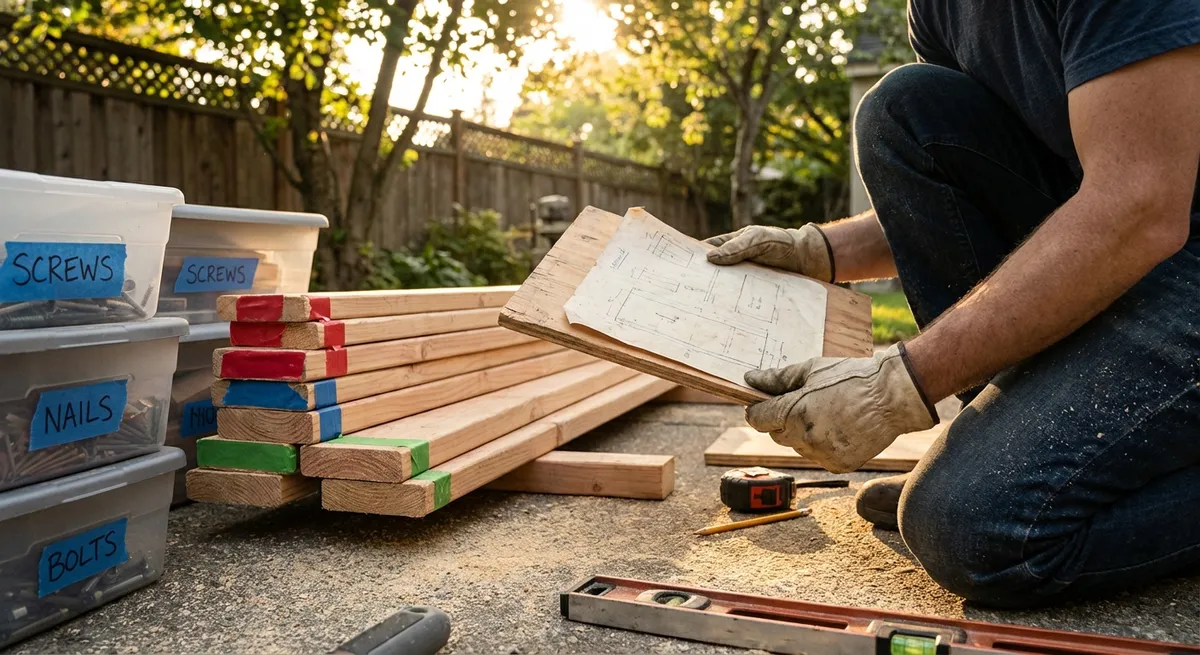
This guide focuses on field-ready planning moves you can bring to any DIY project—whether you’re building a small slab, setting pavers, or renovating part of your home—so the work goes smoother and the finish holds up.
Tip 1: Start With a Reality-Checked Scope, Not Just an Idea
Professionals don’t plan from inspiration; they plan from constraints. Before you price materials or rent tools, define your project in practical terms.
Begin by writing a simple scope statement: what you’re building, where it goes, and what “done” actually means. Include size, location, performance expectations (load, weather, traffic), and any code or HOA limitations. Then convert that description into measurable details: length, width, thickness, slope, and clearances around existing structures or utilities.
Next, reality-check that scope against four resources: time, budget, skills, and tools. Time includes not just installation but demolition, prep, curing, and cleanup. Budget should account for waste, extras like fasteners or anchors, and at least a 10–15% contingency. Skills assessment is about being honest: if you’ve never cut masonry or mixed mortar, plan for a learning curve and simplify details where possible. For tools, list what you own, what you can borrow, and what you’ll rent; then check rental availability and cost before you finalize your timeline.
Turning an idea into a scoped, constrained plan keeps projects from ballooning mid-stream and makes every later decision—materials, methods, scheduling—simpler and more confident.
Tip 2: Map Your Worksite Like a Small Jobsite, Not a Garage Project
Construction pros think in terms of site logistics. Even on small projects, where you stage materials and how you move around the site can decide whether the day is productive or chaotic.
Start with a scaled sketch of your work area. Mark fixed features: doors, gates, slopes, trees, utilities, and any areas that must remain accessible (like walkways or driveways). Then designate zones: material staging, cutting or mixing, assembly or installation, waste/cleanup, and safe walk paths. Place heavy materials as close as possible to their final location without blocking access or creating trip hazards. For dusty or noisy work, choose a cutting/mixing zone that’s downwind from doors and windows and away from neighbors when possible.
Plan traffic patterns. Avoid crossing paths where people will carry heavy loads or long materials. Keep extension cords and hoses to the perimeter and route them perpendicular to walkways, not along them. If working on slopes, think about where materials might roll or water might flow, and place items to avoid downhill movement into your workspace.
Finally, have a wet-weather fallback: where tools can be quickly covered, where fresh concrete or mortar is protected, and how people will enter and exit without tracking mud across finished surfaces. That level of site thinking makes your DIY project operate more like a controlled jobsite and less like a cluttered experiment.
Tip 3: Build a Task Sequence That Respects Curing, Weather, and Fatigue
Professionals schedule tasks to align with material behavior, environmental conditions, and human endurance. DIYers often underestimate all three.
Start by listing every task in order, from prep to final cleanup. Include inspection points: checking base compaction, verifying dimensions, confirming slopes with a level, and dry-fitting parts before fastening or setting in mortar. Next, assign dependencies—what must be fully done before something else starts. For example, base prep must be complete and inspected before you set pavers; formwork must be secure before concrete arrives; underlayment must be installed before tile is laid.
Overlay this plan with curing and drying requirements from manufacturers. Adhesives, coatings, concrete, mortar, and sealants all have minimum and ideal cure times and temperature ranges. Note these in your schedule so you don’t plan to load a slab or grout a tiled surface earlier than recommended. Build in “light work” tasks—tool maintenance, material cutting, layout marks—for periods when you’re waiting on cure or drying but still want to make progress.
Finally, schedule around fatigue and daylight. Heavy lifting, cutting, and critical layout are best handled earlier in the day when you’re fresh and light is best. Reserve less critical or less demanding tasks—cleanup, fastener checks, simple assembly—for later. This approach mirrors professional sequencing: the tough, high-precision work happens when people are sharp; the risk of errors and accidents drops, and the project advances more predictably.
Tip 4: Standardize Your Setup: Tools, Materials, and Quality Checks
Pros rarely start from zero; they use standard setups and checklists. You can do the same on a smaller scale and dramatically reduce mistakes.
Begin by creating a repeatable “site-ready kit” that lives in a single box or bag and comes out on every project: layout tools (tape, 25–30 ft; pencils or lumber crayons; permanent marker; chalk line), measuring and checking tools (2–4 ft level; square; small torpedo level; line level if you work outside), personal safety gear (gloves, eye protection, hearing protection, dust mask or respirator appropriate to your work), and fast problem solvers (utility knife, pliers, small pry bar, multi-bit screwdriver).
Next, develop a short pre-work checklist for each project type you do more than once (concrete pad, paver path, wall repair, deck work, etc.). That checklist should confirm: all materials are on-site and inspected; substrate or base prep is complete and compacted where needed; any required primers, bonding agents, or moisture barriers are available; power and water access are set; and weather looks compatible with the work window.
Just as important, create a few “in-process” quality checks. For example, on a small slab you might verify form dimensions and diagonal measurements to confirm squareness, check form elevation at multiple points, and confirm reinforcement placement before you mix or pour. For a masonry or paver project, you might check bed depth and compaction, then pull a few units after setting to verify contact and alignment. These habits borrow directly from professional QA/QC routines and keep small problems from becoming baked-in defects.
Tip 5: Document As You Go to Protect Your Work and Future Projects
Construction professionals document for accountability and future reference. DIYers can benefit just as much—especially when projects tie into utilities, structural elements, or future renovations.
Start with simple photo documentation. Before you open walls, dig, or cover anything, take clear photos from multiple angles. Capture locations of buried utilities, drain routes, rebar placement, anchors, fasteners, and any transitions between materials. Include a tape measure in some shots so dimensions are obvious later. For slabs, walls, and built-ins, mark key dimensions (depth of footings, rebar spacing, reinforcement type) directly on a sketch and store that with your photos.
Keep a basic project log: dates of major tasks, products used (with brand, type, and batch or lot number if available), and weather conditions for critical operations like pours, coatings, or adhesive work. Note any deviations from manufacturer instructions and why you made them. This written record is invaluable if you need to troubleshoot performance later, match materials for repairs, or explain work to a future contractor, inspector, or buyer.
Finally, store your documents in a labeled, backed-up folder—both digital and, for key sketches and receipts, physical. Treat your DIY projects with the same traceability that professionals use. It takes minutes while you’re working and can save hours and significant cost down the line when you (or someone else) need to understand what’s behind the finished surface.
Conclusion
Effective DIY work is less about heroic effort on install day and more about how you plan, stage, and manage the project from the start. By tightening your scope, mapping your worksite, sequencing with curing and fatigue in mind, standardizing your setup, and documenting as you go, you’re borrowing the same habits that keep professional jobs on schedule and performing for years.
These planning moves don’t require advanced tools or training—just a more intentional approach. The payoff is straightforward: fewer surprises, cleaner execution, and projects that are easier to build, maintain, and proudly show off.
Sources
- OSHA: Construction Industry Safety and Health - Federal guidance on safe construction practices, including jobsite setup and hazard control
- Portland Cement Association – Concrete in Practice - Practical technical sheets on concrete behavior, curing, and placement considerations that affect scheduling and planning
- U.S. Department of Energy – Energy Saver: Planning Home Projects - Government guidance on planning home improvement work with attention to scope, sequencing, and performance
- APA – The Engineered Wood Association: Building Guides - Professional-grade guides on framing, decking, and structural details that inform layout, documentation, and quality checks
- The Concrete Centre (UK) – Best Practice Guides - Technical resources on site planning, reinforcement placement, and concrete construction that can be adapted to advanced DIY projects