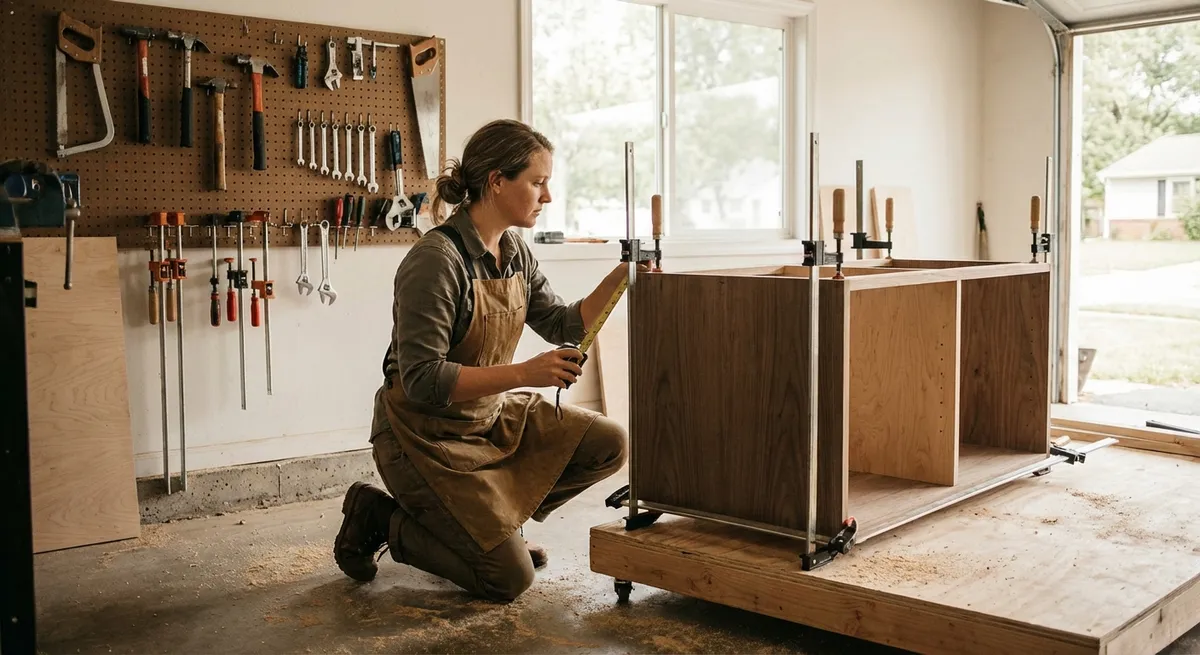
Start With the Work, Not the Walls
Before you move a single bench or buy a single cabinet, define what your workspace actually needs to do.
List your primary tasks: mixing small batches of mortar or concrete, cutting and assembling wood forms, storing masonry tools, staging materials, or finishing small repairs. Then map these tasks to physical zones in your garage, basement, or shed.
A common pro approach is to think in “stations” rather than one big general space. For example, a cutting and layout station near the door (for long material runs), a mixing and wet-work area near a hose or drain, and a clean bench for layout, marking, and small assemblies. Work from the largest, messiest tasks down to the smallest, cleanest ones.
Use painter’s tape on the floor to outline proposed bench locations, material stacks, and tool racks. Walk through an imaginary project step by step: unload material, cut, dry fit, mix, set, clean up. Any time you double back or cross paths awkwardly, adjust the layout. Professionals call this “mocking up the workflow”—doing it on the front end saves countless hours once you start building.
Build a Bench That Can Take a Beating
A solid, stable workbench is the cornerstone of a serious DIY workspace. It doesn’t need to be pretty, but it must be rigid, flat, and at the right height.
A practical height for most people is around 34–38 inches (86–97 cm); taller users or those doing more layout and marking may prefer the higher end. If you’ll be mixing small batches of mortar or setting block samples on the bench, err toward slightly lower so you’re not lifting heavy buckets too high. If possible, mock up height with blocks or sawhorses and a sheet of plywood, and run through some typical tasks.
For framing, 2×4 or 2×6 lumber with a simple rectangular base and cross-bracing works well. Anchor the bench to the wall or floor with screws or concrete anchors to eliminate wobble—pros rarely trust a freestanding bench for accurate work. Top it with 3/4-inch plywood or a doubled 1/2-inch layer, screwed from below so you have a smooth surface for marking and assembly.
Consider splitting your bench into a “dirty half” and a “clean half.” The dirty side can take the brunt of mixing tubs, fasteners, and demo work, possibly protected with a removable hardboard or cement board skin. The clean side stays reserved for measuring, layout, and tasks where dust and grit can cause mistakes or damage.
Treat Tool Storage Like a Jobsite Trailer
Professionals organize tools so they can walk into a jobsite trailer and instantly find what they need. Your home workspace can work the same way if you design storage around frequency of use, not just available wall space.
Group tools by task, not by type. Instead of keeping all hammers together and all saws together, create kits: masonry repair, concrete forming, general carpentry, tile work, etc. Each kit gets its own bin, box, or shelf section. When it’s time to re-point a joint or pour a small pad, you grab a kit and know everything you need is there.
Mount commonly used hand tools on a backboard near your main bench, but be selective. Too many tools on a wall board turn into visual clutter and slow you down. Reserve that prime real estate for “every project” tools: tape measures, layout squares, levels, utility knives, pencils, chisels, frequently used screwdrivers, and a few go-to wrenches.
Heavier or less frequently used tools—rotary hammer, angle grinder, mixing paddle, specialty trowels—can live in labeled totes or drawers. Label on two sides, not just the front, so you can identify them even if orientation changes. For power tools, wrap cords loosely and store batteries separately in a cool, dry spot with a dedicated charging station and a power strip. Keep chargers off the floor to avoid dust and accidental splashes if you’re mixing or washing out nearby.
Design for Dust, Water, and Waste From Day One
Dirty work is part of construction and masonry, but pros design their work areas so messes are contained and cleanup is fast. Build that thinking into your home workspace upfront.
If you’re in a garage, try to keep your dust-generating tasks—cutting, grinding, sanding—near the overhead door. Use a simple “blast zone” rule: the first 3–6 feet inside the door is where the dustiest work happens, with plastic sheeting or a curtain separating it from the rest of the shop when needed. A fan blowing outward during cutting can help direct dust outside, but always check local noise and dust ordinances and be considerate of neighbors.
Set up a dedicated wet area if you’ll be mixing mortar, concrete, or grout. This should be near a hose bib, utility sink, or drain, and it’s worth putting down a sacrificial surface: a piece of cement board, leftover tile, or cheap rubber matting. Never wash cementitious materials directly down a household drain. Instead, use a washout bucket: rinse tools into the bucket, let the solids settle and cure, then dispose of hardened material in the trash and pour clear water off the top onto soil or gravel, not into storm drains.
For dust control on dry tasks, pair your saws and sanders with a shop vacuum designed for fine dust, ideally one rated for HEPA filtration. Use bags appropriate for concrete or drywall fines where applicable. Keep a stiff broom, wide dustpan, and a designated “dirty” brush for cleaning off tools and surfaces before they go back into clean storage. Professionals clean as they go because a clean workspace is safer and more accurate—and you’ll complete more projects if your shop is inviting to walk into.
Use Pro-Style Staging to Keep Projects Moving
On active job sites, crews don’t work out of a pile of mixed materials; they stage everything in a way that keeps the job flowing and avoids handling things twice. The same principle dramatically improves DIY productivity in a home workspace.
Create a staging zone where materials for the current project live—lumber, bags of mix, fasteners, fittings, and hardware—separate from long-term storage. That zone might be a single shelf, a rolling cart, or a marked-off section of floor with pallets to keep bags off concrete. Anything in this zone is “live” and should relate to work in progress.
Before starting a project day, pull and stage all the materials and tools you expect to use. Lay them out roughly in the order you’ll need them: demo tools up front, then layout, then cutting/forming, then mixing, then finishing. This mirrors how site foremen think about sequencing tasks. As you work, put tools back into a small “active” tool tote instead of scattering them across surfaces.
At the end of each session, do a 10–15 minute reset: return surplus materials to storage, restock fasteners and consumables that ran low, and sweep your main walkways and bench surfaces. Pros know that the first 30 minutes of the next day are either spent hunting and cleaning or actually building—this short reset ensures you’re building.
Conclusion
A well-planned home workshop multiplies the value of every tool you own and every hour you can spare for projects. By designing your space around real tasks, building a serious bench, treating tool storage like a jobsite trailer, planning for dust and water, and adopting professional staging habits, you create a workspace that works as hard as you do. The result isn’t just a tidier garage; it’s straighter forms, cleaner joints, fewer mistakes, and projects that you’re more likely to finish—and be proud of—because the environment supports the work.
Sources
- OSHA – Construction Industry Safety and Health - Guidance on safe work practices, dust control, and equipment use relevant to home workshops
- U.S. Environmental Protection Agency – Concrete Washout Best Practices - Details on proper handling and disposal of concrete and mortar washout water
- Fine Woodworking – Bench Fundamentals - Practical principles for designing a stable, functional workbench that translate well to DIY shops
- Family Handyman – Garage Workshop Ideas - Examples of layout, storage, and workflow strategies for small and medium home workspaces
- Harvard T.H. Chan School of Public Health – Dust and Health - Information on the health impacts of dust and why good dust management in DIY spaces matters