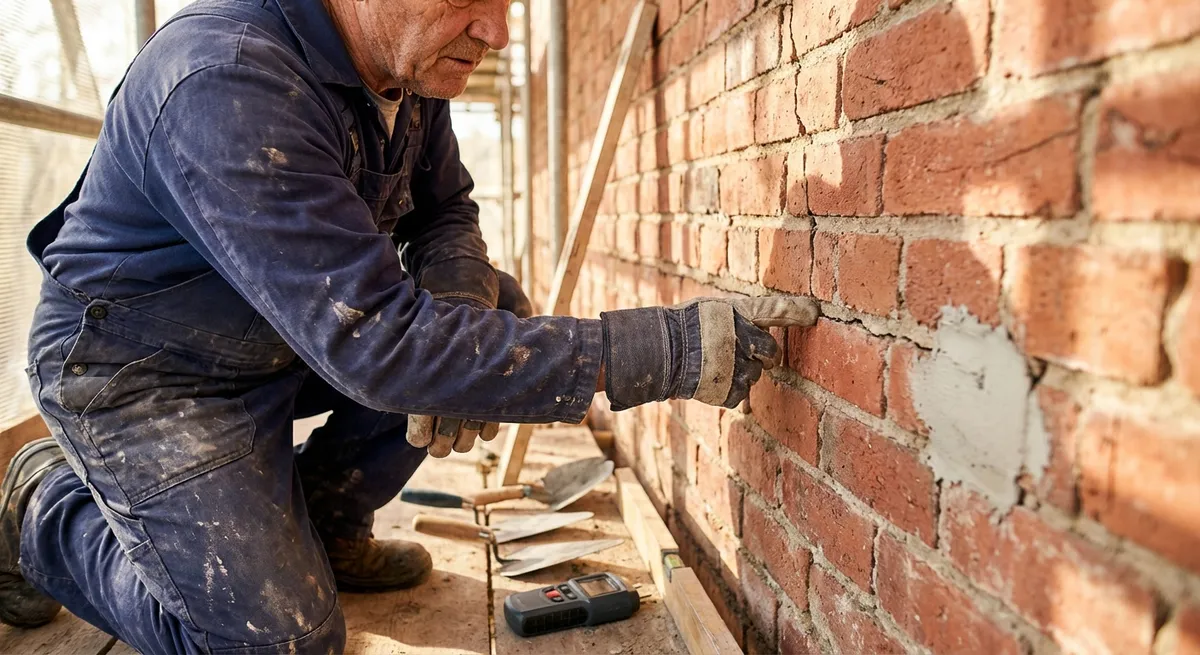
This guide walks through five expert-level practices for assessing existing masonry and making smarter choices before you mix a single batch of mortar.
Start with the Load Path, Not the Crack
Most people walk up to a damaged wall and stare directly at the worst crack. Professionals start by asking: Where is the load going, and what’s changed?
Begin your assessment by tracing the load path—from roof or floor framing down through bearing walls, lintels, columns, and foundations. Look for changes in stiffness: window and door openings, beam pockets, and transitions from masonry to wood or steel. Misaligned or overloaded elements at these points often cause the cracks you see elsewhere.
Stand back 15–20 feet and sight along the wall horizontally and vertically. Note any bowing, leaning, or step patterns in cracks near corners, openings, or floor lines. Use a level or laser to confirm what your eye sees. A long, vertical crack near mid-span of a wall that supports a beam is very different from a small step crack above a window; one might point to foundation movement, the other to a failed lintel.
Document where the wall is restrained (floor diaphragms, returns, pilasters) and where it’s free to move. Movement joints, if present, should be at logical locations; if they’re missing or poorly placed, that can explain random cracking. Before prescribing any repair, write down your load-path observations. This simple habit improves repair accuracy and gives you a clear story to communicate to owners or inspectors.
Read Mortar and Units Before You Choose Materials
Selecting repair materials by “what’s on the truck” is a fast way to create compatibility problems. Instead, learn to read the original mortar and units so your repair works with the wall—not against it.
Start with hardness. Press a steel nail into the mortar joint. If it scratches easily and creates powder, the mortar is likely lime-rich and relatively soft (common in older brickwork). If it resists scratching and chips, it’s likely stronger, cement-rich mortar. Your repair mortar should generally be equal to or slightly weaker than the masonry units. Too-strong mortar can force cracks into bricks or stones instead of the joint.
Observe color, sand gradation, and joint profile. Color tells you about cement content and possible pigments; sand size and shape influence workability and final appearance. For visible work, take clear, close-up photos of existing joints and mix test batches to match color and texture as the mortar cures—not just while it’s wet.
Check the units themselves. Historic brick may be under-fired and quite soft; modern brick and concrete block are usually much harder and more uniform. Tap units with a hammer handle—dull thuds often indicate internal damage or saturation; clear ringing sounds are usually a good sign. For stone, note whether it’s sedimentary (like limestone or sandstone) or igneous (like granite); these differ in absorption and reaction to acids and salts.
When in doubt, consult manufacturer data or historic masonry guidance for recommended mortar types and ratios. Investing time in material compatibility avoids bond failures, efflorescence, and patchwork repairs that age poorly.
Control Water Before You Chase Cosmetic Flaws
Many masonry “defects” are symptoms of uncontrolled moisture, not just bad workmanship. Addressing appearance without fixing water paths simply resets the clock.
Begin at the top. Check coping, parapets, and roof intersections. Missing or failed flashing, open coping joints, or poorly detailed counterflashing allow water into the wall. Look at how water is shed from roofs and balconies—it should be directed away from masonry, not onto it. Blocked gutters and short downspouts can feed chronic saturation at the base of walls.
Move down the wall and look for staining patterns. Vertical streaks from above often trace water entry points. Horizontal bands at floor levels may point to internal leaks from slabs or decks. Efflorescence (white, powdery salt deposits) signals migrating moisture; concentrated areas can reveal specific entry or evaporation points.
At the base, inspect grading and hardscape. Soil should slope away from the wall, with no standing water. Mulch or planters pushed against masonry trap moisture and promote freeze–thaw damage. For below-grade walls, note whether there’s any indication of drainage systems, weep holes, or waterproofing.
Only after you understand how water enters, travels through, and exits the wall should you plan crack repairs, repointing, or sealants. In some cases, a modest investment in drainage, flashing repair, or simple diverters will do more for the wall’s long-term health than any amount of patching.
Match Repair Techniques to Movement Type
Not all cracks are equal. Treating a thermal movement joint like a structural failure—or vice versa—leads to ineffective or even dangerous repairs. Before choosing a method, classify the movement you’re dealing with.
Look at crack geometry. Straight, continuous cracks that align with structural elements (columns, beams, foundations) often indicate structural movement or settlement. Stair-step cracks along mortar joints, especially near corners or openings, typically reflect differential settlement or minor flexing. Thin, recurring cracks that open and close seasonally may be thermal or moisture-related.
Use simple monitoring for borderline cases. Install crack gauges or even glass slides or pencil marks to see whether movement is ongoing and in what direction. Photograph and date cracks during different seasons if you suspect temperature or moisture cycles are involved.
Once you understand the movement, align your technique:
- For inactive, minor cracks: conservative repointing or stitching may be appropriate.
- For ongoing, non-structural movement (thermal, shrinkage): consider creating or restoring movement joints and using flexible sealants where joints should accommodate movement.
- For structural issues: crack repairs alone are insufficient. You may need to consult an engineer for reinforcement, underpinning, or load redistribution before cosmetic work.
Avoid the instinct to “lock everything up” with rigid fillers and heavy-duty mortars. Masonry needs controlled locations where it can move safely. Good repairs respect that reality instead of fighting it.
Plan Access and Sequencing Like Part of the Repair
Access and sequencing aren’t just logistical details; they directly affect the quality and durability of masonry work. Professionals plan how they’ll reach, prepare, and protect the work as carefully as they plan the mix design.
Assess how close you can safely get to the work surface. For low or small jobs, ladders might be enough, but for anything with sustained work at height, stable scaffolding or platforms provide safer, more consistent conditions. Working from an unstable position almost guarantees inconsistent joints, poor consolidation, and weak bonding.
Think through the sequence: demolition, cleaning, preparation, installation, and curing or protection. For example, when repointing, you’ll need to remove deteriorated mortar without damaging surrounding units, wash or blow out joints, allow proper surface dampening, then place and tool new mortar at the right stiffness. If you’re working in direct sun or wind, plan shading and misting to prevent rapid drying that leads to weak joints and shrinkage cracks.
Coordinate around weather. Masonry work in freezing or very hot conditions requires specific adjustments—heated or cooled materials, windbreaks, temporary enclosures, and controlled curing. Rushing work into a poor weather window often leads to callbacks and repairs that age inconsistently.
Finally, protect adjacent finishes and surroundings. Overspray from cleaning, mortar droppings, and acid cleaners can stain or damage nearby materials. Simple measures like drop cloths, temporary barriers, and controlled washing areas elevate the professionalism of the work and reduce conflicts with clients or neighbors.
Conclusion
Strong masonry work starts long before the first trowel hits the wall. By reading the load path, understanding existing materials, controlling water, matching repairs to movement types, and planning access and sequencing with intention, you reduce guesswork and increase the odds that your work will last.
For contractors, these practices translate into fewer callbacks and clearer communication with clients and engineers. For DIYers, they provide a framework to decide when a project is within your capabilities—and when it’s time to call in a specialist. In both cases, the goal is the same: masonry that performs well, ages gracefully, and respects the structure you’re working on.
Sources
- The Masonry Society – Evaluation and Repair of Masonry Structures - Professional guidance on assessing and repairing masonry, including compatibility and movement considerations
- National Park Service Preservation Brief 2: Repointing Mortar Joints in Historic Masonry Buildings - Authoritative recommendations on mortar selection, joint preparation, and compatibility for existing masonry
- Brick Industry Association – Technical Notes on Brick Construction - Detailed technical documents on brick behavior, movement joints, water management, and structural considerations
- Portland Cement Association – Masonry Construction - Practical information on masonry materials, design, and construction best practices
- U.S. General Services Administration – Historic Masonry Preservation Guidelines - Federal-level guidance on diagnosing masonry problems, moisture issues, and appropriate repair strategies