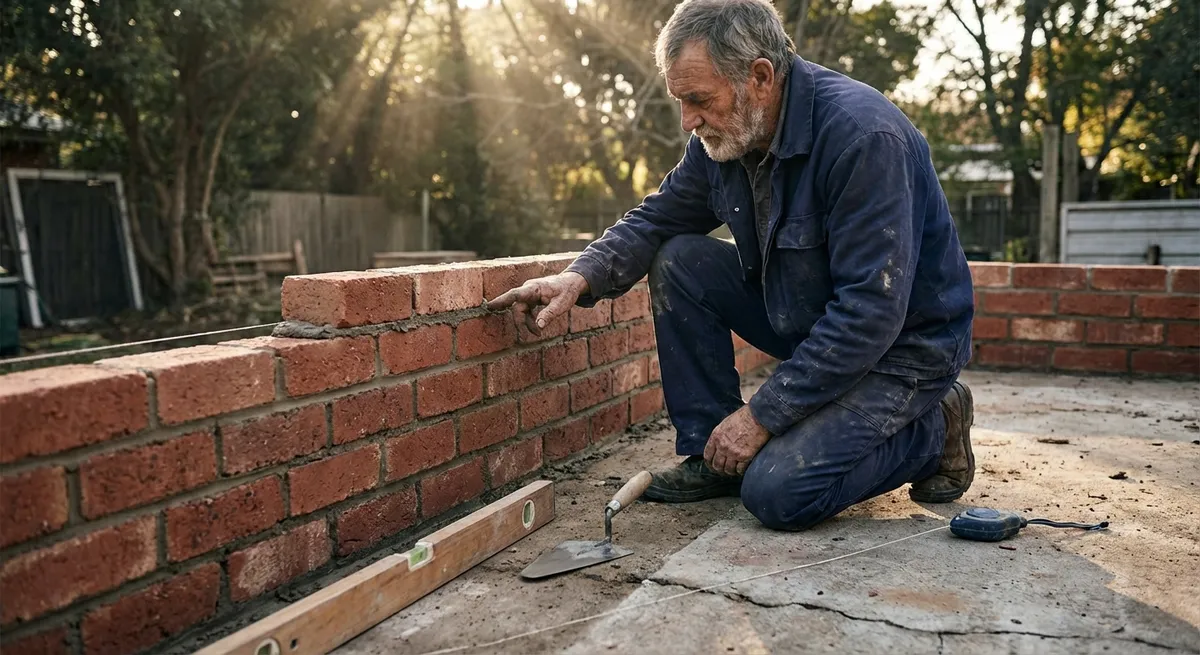
This guide focuses on practical, field-ready habits—not theory—that help you plan, build, and troubleshoot masonry work more like a seasoned professional.
Tip 1: Start with the Substrate, Not the Stone
Before touching a single brick or block, assess what you’re building on and against. Most masonry problems start in the first inch: the base, the footing, and the adjacent structure.
Spend focused time on:
- Footing condition and level
- Use a long level or laser level to check the entire run, not just the corners.
- Mark high spots with spray paint or chalk and grind or chip them down rather than “fitting” them with thicker mortar.
- If you must correct low spots, use a bonded leveling bed (per manufacturer specs), not a random extra-thick mortar joint.
- Load path and movement joints
- Confirm where the masonry is bearing: directly on a footing, on a slab, or on a structural ledge.
- Identify where expansion joints or control joints should be (corners, long unbroken runs, and transitions between materials).
- Integrate joint locations into your layout from day one instead of cutting them in later.
- Existing walls, frames, or structure
- Check plumb on adjacent framing or older masonry you’re tying into.
- If the existing wall is out of plumb, decide whether you’ll step, taper, or visually “split the difference” so the new work doesn’t highlight the old flaws.
- Verify that anchors or ties are compatible with both materials (e.g., masonry-to-concrete vs. masonry-to-wood).
Doing a disciplined substrate check lets you build with consistent joints and true lines, instead of using every course to correct hidden problems.
Tip 2: Match Mortar to the Material and the Environment
Many failures in brick and block work come down to mismatched or poorly mixed mortar. Treat mortar selection as a design decision, not an afterthought.
Key considerations:
- Know your mortar types and strengths
- Type M: Very high compressive strength; suited for hard stone, foundations, and below-grade work, not ideal for softer historic brick.
- Type S: Strong, good for exterior, below-grade, and structural masonry.
- Type N: Medium strength, more flexible; commonly used for exterior, above-grade walls and veneers.
- Type O: Low strength; often for historic restoration where the brick is weaker than modern mortars.
- Match hardness to unit and exposure
- Softer brick + harder mortar = brick damage over time, as the masonry unit takes the stress instead of the joint.
- For retaining walls, foundations, or high-load areas, lean toward stronger mixes, but always consider the specific block or brick manufacturer’s guidance.
- Control water, not just ratios
- Measure water consistently; don’t guess by feel until you’ve dialed in a repeatable process.
- Aim for a workable, plastic mix that holds a ridge when you spread it but does not slump or run.
- In hot or windy conditions, slightly reduce water and use smaller batches so you’re not laying with over-stiff or partially cured mortar.
- Respect working and re-tempering times
- Discard mortar that has started to set; lightly re-tempering with water is acceptable only within the manufacturer’s recommended window and only once.
- Don’t add chemical accelerators or antifreeze agents not approved for masonry; follow cold-weather admixture specs from reputable manufacturers.
Choosing and mixing mortar methodically allows walls to move, drain, and age as designed instead of cracking or spalling prematurely.
Tip 3: Use Layout Tools to Make the Wall Work for You
The most efficient masons let string lines, story poles, and layout marks carry most of the precision. Your tools should “enforce” alignment so your eyes don’t have to fight every course.
Practical layout habits:
- Establish a repeatable story pole
- Cut or mark a straight 2x or similar board with the height of each course, including bed joints.
- Use that same pole to transfer elevations around corners, openings, and returns so everything lines up without constant recalculating.
- For multi-day jobs, that story pole becomes your reference memory—critical if weather or site conditions change.
- Set string lines correctly
- Pull tight, low-sag lines using line blocks or pins at corners and leads.
- Keep the string just off the finished face of the units, not buried in mortar, and adjust as corners rise.
- Move the line up one course at a time and check it against your story pole frequently.
- Dry lay critical sections
- Around doors, windows, and corners, lay a “dry run” on the ground to visualize your bond pattern and cut locations.
- Adjust joint widths slightly across a full run—within acceptable tolerances—to avoid tiny sliver cuts at the end.
- Use control lines for plumb and plane
- Snap chalk lines on slabs or ledges to mark wall thickness and face location.
- Periodically drop a plumb bob or use a laser to ensure the wall is not drifting out of plane across multiple courses.
Letting the layout system do the heavy lifting makes your production more consistent and reduces rework—especially helpful when supervising crews or working across multiple days.
Tip 4: Handle Units and Joints with a Water-First Mindset
Moisture control is central to durable masonry. That doesn’t just mean rain—it means the way you manage water in units, joints, and details.
Apply a water-first mindset in these ways:
- Condition units appropriately
- Extremely dry brick or block will suck water out of mortar, leading to weak bonds and rapid cracking.
- Lightly dampen highly absorptive units in hot or windy weather so the mortar doesn’t flash-dry at the interface. Avoid saturating them—no standing water in cores or on faces.
- Keep joint tooling consistent
- Tool joints when the mortar has “thumbprint hard” firmness: firm but still slightly impressionable.
- Use the same jointer profile throughout a wall (concave, V-joint, etc.) to maintain uniform weather resistance.
- Properly compressed joints shed water better and resist freeze-thaw damage.
- Respect weeps, flashing, and drainage paths
- Don’t clog weep holes with mortar droppings. Use mortar collection devices or batt insulation strips behind veneer walls where specified.
- Ensure flashing actually slopes outward and protrudes enough to direct water away from the wall surface.
- Where codes or plans call for through-wall flashing (lintels, shelf angles, base of wall), install it as detailed, not “approximately.”
- Protect fresh work from rapid drying or saturation
- In hot, dry conditions, shade the work and lightly mist walls after initial set to prevent plastic shrinkage cracking.
- In wet or freezing conditions, cover walls to shed water and maintain minimum curing temperatures as required by code and manufacturer.
Managing water before, during, and after laying units is one of the fastest ways to improve long-term performance and reduce callbacks.
Tip 5: Finish With Inspection Habits, Not Just Clean-Up
Experienced masons don’t wait for an inspector or a failure to tell them something is wrong. They build quality control into their daily routine, and it starts before the mortar is fully cured.
Turn end-of-day clean-up into structured inspection:
- Check alignment and dimensions while corrections are still possible
- Sight down the wall from multiple angles to catch waves, bulges, or dips.
- Spot-check dimensions against the plans—especially at openings, bearing points, and interfaces with other trades (framing, steel, glazing).
- Look for early cracking and stress indicators
- Hairline cracks radiating from corners or concentrated at one control joint may signal movement, load issues, or curing problems.
- Address small issues immediately—add or adjust control joints, relieve unintended restraints, or correct drainage conditions.
- Verify anchors, ties, and reinforcement
- Before grout or concrete fully locks things in, confirm rebar spacing, laps, and clear cover match the plans and code requirements.
- Check veneer ties for correct embedment in mortar joints and secure fastening to the backup wall.
- Document with photos and notes
- Capture reinforcement placement, flashing details, and joint layouts before they’re covered.
- Maintain a simple log of weather conditions, mortar types used, and any deviations from plans with reasons—very helpful for future repairs, inspections, or warranty questions.
- Refine your process from what you see
- Treat each wall as feedback on your technique: if joints vary, revisit your layout or mixing routine; if stains appear, adjust your cleaning methods.
- Update your standard practices and checklists as you identify recurring strengths or weaknesses.
Consistent, honest self-inspection converts every job into training for the next. That’s how craftsmanship scales from solo DIY projects to professional crews and larger sites.
Conclusion
Strong masonry isn’t only about strong materials; it’s about disciplined habits applied from the footing to the final joint. When you prioritize substrate assessment, deliberate mortar selection, precise layout tools, moisture-aware handling, and structured inspection, you stack the odds in favor of durable, clean, and code-compliant work.
Whether you’re managing a crew or refining your own skills, start treating these five habits as non-negotiable parts of your process. Over time, they become the quiet advantage behind walls that stay straight, structures that stay dry, and projects that age the way they should.
Sources
- [The Masonry Society – Mortar for Masonry](https://masonrysociety.org/Masonry/Mortar_for_Masonry.aspx) – Overview of mortar types, selection, and performance considerations from a leading masonry organization
- [Portland Cement Association – Mortar Types and Uses](https://www.cement.org/cement-concrete/concrete-materials/mortar) – Technical guidance on mortar properties, mixing, and appropriate applications
- [International Code Council – International Building Code (IBC)](https://codes.iccsafe.org/content/IBC2021P1) – Code requirements for masonry construction, including mortar, reinforcement, and weather provisions (registration may be required)
- [NCMA (National Concrete Masonry Association) – TEK Resources](https://ncma.org/resources/) – Technical notes on concrete masonry design, construction details, movement joints, and moisture control
- [U.S. General Services Administration – Historic Masonry Preservation Briefs (via NPS)](https://www.nps.gov/tps/how-to-preserve/briefs.htm) – Detailed guidance on mortar compatibility, moisture, and repair practices, especially for brick and stone work