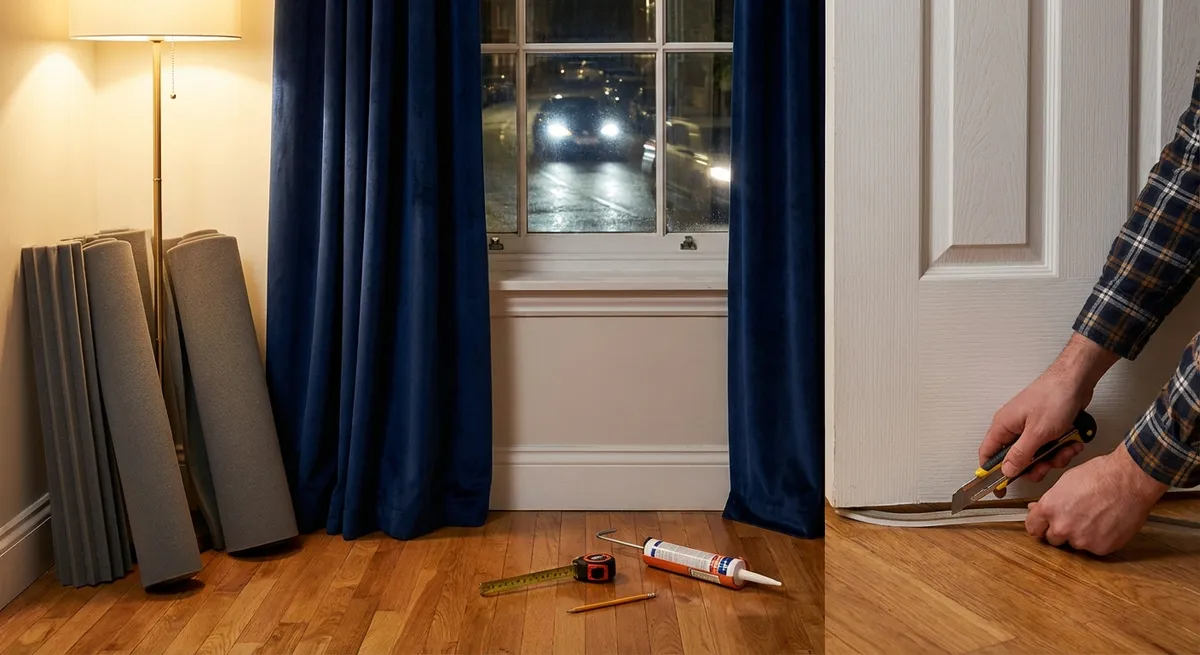
This guide walks through five expert-level, but still DIY-friendly, noise-reduction projects. Each tip focuses on doing the work in a way that actually performs: proper materials, correct sequencing, and common pitfalls to avoid.
Understanding How Sound Moves Through a Home
Before you start adding panels or foam, it helps to know what you’re fighting. Sound moves through buildings in two main ways: airborne and structure‑borne (impact) transmission.
Airborne sounds are voices, TV, music, or traffic. They move through the air, then pass through gaps, flexible wall surfaces, and thin partitions. Structure‑borne sounds are footsteps, cabinet slams, or a washing machine in spin cycle. These vibrations travel through framing, subfloors, and joists.
Most homes leak sound through three predictable weak points:
- Gaps and penetrations (under doors, around electrical boxes, can lights)
- Lightweight or rigidly connected assemblies (single-layer drywall, shared studs)
- Hard, reflective finishes (bare drywall, concrete, glass, hardwood)
Effective noise-control work addresses at least two of these: sealing air paths and changing how surfaces reflect or transmit vibration. That’s where the projects below come in.
Expert Tip 1: Treat Doors Like the Acoustic Holes They Are
Interior doors are often the single weakest point in an otherwise decent wall. Hollow-core slabs, big gaps at the threshold, and unsealed casing can undo the benefit of double drywall or insulation.
Upgrade strategy:
- Assess the door construction. Knock on it—if it sounds drum‑like, it’s likely hollow-core and poor at blocking noise.
- Swap to solid-core where it matters most. Bedrooms, home offices, and shared walls between living areas benefit most. Solid-core doors add mass, which is critical for blocking airborne sound.
- Address perimeter gaps.
- Install an adjustable door sweep at the bottom. Choose one that seals against a threshold, not just brushes the floor.
- Use high-quality adhesive-backed weatherstripping along the jamb stops on the latch and hinge sides. Aim for light compression when the door closes—not so tight that the latch strains.
- Seal the casing and frame.
- From both sides, run a small bead of acoustical sealant or high-quality acrylic latex caulk along the edges of the casing where it meets the wall.
- If you have access during a renovation, backfill any large gaps between the door jamb and framing with low-expanding foam, then trim and seal.
Professional details that matter:
- Don’t rely on foam alone. Foam is too light to block sound; it just fills voids. You still need solid-core material and tight seals.
- Avoid cutting down the bottom of the door too aggressively when fitting to flooring. A ½-inch gap is already pushing it for noise control; combine any unavoidable gap with a well-fitted sweep.
This one upgrade can make a previously “leaky” room feel significantly more private and is easy to explain to clients as a high-impact, modest-cost improvement.
Expert Tip 2: Build a Quieter Shared Wall Without Gutting Everything
You don’t always get to start from bare studs. In many homes, the challenge is improving an existing shared wall (say, between a bedroom and living room) with limited demolition. That’s where “add-on” wall treatments come in.
Basic approach: add mass plus damping on one side.
- Verify structural and electrical conditions.
- Confirm that adding another layer of drywall (usually ½–⅝ inch) won’t cause clearance issues with trim or doors.
- Locate and mark electrical boxes; you’ll need cutouts and airtight covers later.
- Use damping compound between layers.
- Apply a viscoelastic damping compound (often sold as a “green glue” type product) between the existing drywall and a new layer. This converts vibration energy into tiny amounts of heat, reducing sound transmission.
- Follow manufacturer’s application pattern and thickness—random zig-zag patterns typically work better than sparse beads.
- Stagger seams and joints.
- Install the new drywall layer so seams don’t line up with existing seams underneath. This reduces continuous weak lines in the assembly.
- Finish with acoustic caulking.
- Use acoustical sealant at wall perimeters (ceiling, floor, corners) and around electrical box openings before installing cover plates.
- Don’t substitute standard silicone where long-term flexibility matters; acoustic sealant is designed to stay elastic.
Electrical box treatment:
- Use acoustical putty pads or pre-formed acoustic box covers around electrical boxes, especially in shared walls where boxes are back-to-back.
- If possible, avoid lining boxes directly opposite each other; offset them by at least one stud space in new work.
This method adds minimal depth and avoids full demo, yet can produce a noticeable drop in conversational noise through a wall when executed carefully.
Expert Tip 3: Tame Echo and Reflections in Hard-Finished Rooms
Not all noise problems are about blocking sound between rooms. Sometimes the issue is what happens inside a space: harsh echoes, “live” rooms where every sound seems amplified, or a home office where calls sound hollow.
These are acoustic issues, not isolation issues. The goal is to absorb and diffuse reflections rather than simply add mass.
Room treatment strategy:
- Identify reflection paths.
- In a rectangular room, the worst offenders are parallel hard surfaces: bare walls, glass, tile, and concrete.
- Clap in the room and listen: a sharp, “ringy” echo means excessive reverberation.
- Use soft, thick materials strategically.
- Prioritize absorption on two opposing walls first. This could be:
- Fabric-wrapped acoustic panels (DIY or off-the-shelf)
- Deep bookshelves filled with irregular items (books, decor)
- Thick, wall-hung textiles with an air gap behind them
- Elevate panels off the wall slightly.
- A 1–2 inch air gap behind a panel improves low- to mid-frequency absorption compared to mounting flush.
- Use simple furring strips or French cleats to create the gap.
- Treat floors and ceilings if needed.
- On hard floors (tile, hardwood, concrete), use dense area rugs with thick underlayment in the main listening or seating area.
- For ceilings, consider acoustic ceiling tiles or cloud panels in home theaters and studios. For a more subtle approach, use textured surfaces or beams to break up reflections.
Construction-level details:
- Avoid over-treating small rooms with thin foam panels; they often kill high frequencies while leaving low and midrange frequencies uncontrolled, creating an unnatural sound.
- In mixed-use spaces, aim for a blend: some absorptive surfaces, some diffusive (bookshelves, irregular decor), and some reflective (limited bare wall) rather than wall-to-wall absorption.
For clients or personal projects, framing this work as “comfort and clarity” rather than just “soundproofing” can help justify the investment.
Expert Tip 4: Quiet the Ceiling Below Noisy Floors
Impact noise—from footsteps, dropped objects, or moving chairs—travels efficiently through framing. If you’re working on a basement finish or have ceiling access under a noisy upper floor, you can significantly improve things without touching the flooring above.
Best-practice assembly from below:
- Decouple where possible.
- Install resilient channels or sound isolation clips with hat channel to suspend the new ceiling from the joists.
- Follow manufacturer spacing and fastener requirements strictly; a single screw accidentally tying drywall directly into a joist can short-circuit the system.
- Add insulation in joist bays.
- Use standard fiberglass or mineral wool batts friction-fit between joists. The goal is to absorb cavity noise, not pack it completely solid.
- Don’t compress batts tightly; compressed insulation is less effective acoustically.
- Use heavier ceiling board.
- ⅝-inch Type X drywall offers better sound control than ½-inch, thanks to increased mass and stiffness.
- For higher-performance builds, consider double-layer drywall with damping compound between layers, similar to walls.
- Seal all edges and penetrations.
- Treat can lights, ceiling fans, and HVAC penetrations as noise leaks. Use IC-rated, airtight housings for recessed lighting where possible.
- Seal the perimeter of the ceiling with acoustic sealant before taping and mudding.
Common errors to avoid:
- Attaching fixtures directly to framing that bypasses isolation channels; instead, use appropriate decoupled mounting solutions specified by the channel or clip manufacturer.
- Leaving gaps at soffits or bulkheads; these often act as sound “chimneys” if not properly closed and sealed.
This type of upgrade is particularly valuable when finishing basements under active family rooms or installing home theaters below living spaces.
Expert Tip 5: Plan Noise Control into Mechanical and Utility Work
Mechanical rooms, laundry areas, and home offices often share walls or floors with quiet zones. Tackling noise at the equipment and layout stage is far more effective than trying to mask it later.
Practical mechanical noise strategies:
- Start with placement.
- Where possible, keep noisy equipment (furnaces, air handlers, compressors, washers/dryers) away from bedrooms and dedicated quiet spaces.
- For new work, group noisy functions along a “service spine” of the house and design adjacency carefully.
- Isolate vibration at the source.
- Use anti-vibration pads under washers, dryers, and air handler units.
- Install flexible connectors where ductwork and piping meet mechanical equipment to avoid rigid, noise-transmitting paths.
- Line critical ductwork thoughtfully.
- Use internally lined ducts or external acoustic wraps near air handlers and in short runs serving bedrooms.
- Avoid sharp transitions and undersized ducts; higher air velocity usually means more noise.
- Enclose mechanical rooms with better assemblies.
- Use solid-core or gasketed doors for mechanical rooms near occupied spaces.
- Upgrade walls around equipment rooms similarly to the shared-wall approach: insulation in the cavity, higher-mass drywall, and perimeter sealing.
- Address penetrations and chases.
- Seal all cable penetrations, pipe chases, and duct openings into adjacent rooms with fire-rated sealant where required.
- Where codes allow, avoid over-sized framing openings around ducts; tighter fits (still respecting clearance and fire requirements) reduce flanking paths.
Professionals who incorporate these elements into their standard mechanical and layout planning often see fewer noise complaints—and have an easier time meeting client expectations for “quiet” modern homes.
Conclusion
Thoughtful noise control is less about expensive, exotic products and more about disciplined building fundamentals: add mass, decouple where vibration travels, absorb reflections, and seal every path sound can sneak through. By treating doors as critical components, upgrading key walls and ceilings, tuning room acoustics, and planning around mechanical noise, you can deliver spaces that feel more solid, private, and calm.
For construction pros, these techniques become value-add options you can clearly explain and price. For DIY enthusiasts, they’re practical, project-sized upgrades that noticeably improve day-to-day life. Start with the noisiest spot in your home—or the most sound-sensitive one—and apply one or two of these strategies with professional-level attention to detail. The difference is something you’ll hear—and stop hearing—every day.
Sources
- U.S. Department of Energy – Energy Saver: Soundproofing - Overview of how sound travels in buildings and strategies to control it, including insulation and sealing.
- U.S. General Services Administration – Sound Control in Buildings - Technical guidance on airborne and structure-borne sound, wall assemblies, and practical control measures.
- Sound Transmission Class (STC) – Whole Building Design Guide - Explains STC ratings, how wall and floor assemblies perform, and what ratings mean in practice.
- Berkeley Lab – Home Energy Saver: Ducts and Air Flow Noise - Discusses how duct design and equipment placement affect noise and comfort.
- MIT School of Architecture + Planning – Fundamentals of Room Acoustics (Lecture Notes) - Academic material on reverberation, absorption, and how surfaces affect sound in enclosed spaces.