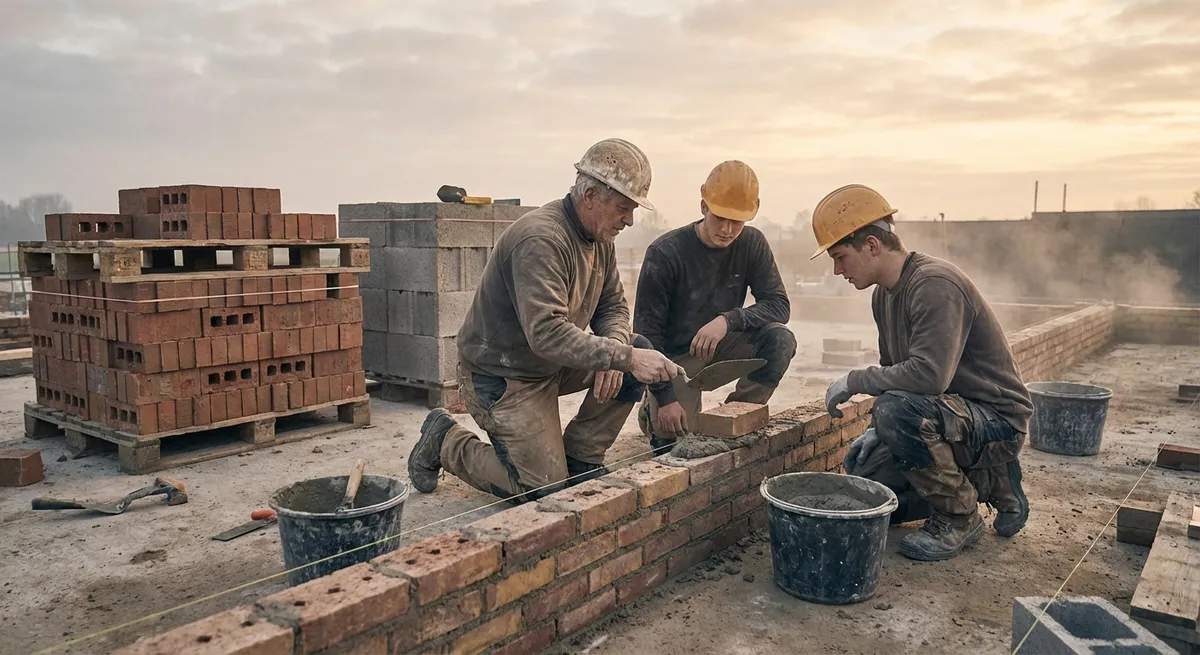
Whether you’re a construction professional refining your process or a serious DIYer tackling your first structural project, mastering a few core practices will dramatically improve your results. The following field-tested tips focus on what actually changes the quality, speed, and durability of your masonry work.
1. Start With the Base: Prepare and Prove Your Foundation
Every masonry success or failure starts long before the first unit is laid. Your base must be stable, level, and properly drained, or you’ll fight problems for the life of the structure. For patios and small garden walls, remove all organic material and loose soil, then compact in lifts (typically 3–4 inches at a time) using crushed stone or gravel. If you can leave a footprint in the base, it’s not compacted enough. For structural walls, verify footing size, depth below frost line, and rebar placement against your local code or engineering specs; don’t just trust what “looks about right.”
Once the base is in, strike a level line with a laser or builder’s level across the entire work area, not just at the corners. Check diagonals to confirm the layout is square—if the footprint is out of square, your coursing will show it. Snap control lines for face and height so you’re not relying on “eyeballing” from brick to brick. Before you mix any mortar, do a dry layout of the first course to see where you’ll need cuts and where joints may need minor adjustments to avoid slivers. Fixing layout issues dry takes minutes; fixing them after you’ve set half a wall can burn an entire day.
2. Mix Mortar With Intent, Not Guesswork
Mortar isn’t just “mud”; it’s a structural and weather-resisting component that has to be matched to both the units and the environment. Start by selecting the right mortar type (typically N or S for exterior above-grade structural work, O or N for interior or softer historic masonry), based on compressive strength and flexibility. Using mortar stronger than the units can push cracking into the brick or block instead of the joint, which is the opposite of what you want. Always follow manufacturer ratios—shovelfuls and coffee cans are fine as long as they’re consistent and measured.
Add water gradually and aim for a workable, peanut-butter-like consistency: it should hold shape on a trowel when inverted but still spread smoothly under moderate pressure. Let the mortar “slake” (rest) for 5–10 minutes after initial mixing, then remix without adding more water unless absolutely necessary. This allows the water to fully hydrate the cement and improves workability. Avoid retempering mortar with water if it has started to set; that weakens the final joint and can lead to dusting and premature failure. On hot, dry, or windy days, mix smaller batches and keep materials shaded to maintain consistent performance.
3. Control Alignment With Strings, Story Poles, and Consistent Joints
Straight, plumb, and level masonry doesn’t happen by accident. Use string lines and story poles instead of relying on a level alone. Set mason’s line between corner leads and check the tension; a sagging line will give you a wavy wall, while an overtightened line can bow. Corner leads—built up several courses ahead, carefully plumbed and squared—act as your reference for the whole run. Take the time to get these perfect; every course you build between them will benefit.
Create or mark a story pole with your planned course heights and joint thicknesses, then use it throughout the job to keep everything consistent. Standard mortar joints are typically 3/8 inch, but the key is uniformity; random joint thickness is one of the fastest ways to make otherwise decent work look amateur. Check plumb and level often: every second or third course, not just “when it seems off.” In addition to checking wall faces, put a level on the units lengthwise to avoid a “smiling” or “frowning” run that looks level at the ends but dips or crowns in the middle. Small corrections made early are almost invisible; large corrections made late always show.
4. Manage Moisture: From Mixing to Long-Term Durability
Water is both friend and enemy in masonry. During construction, it’s essential for hydration; long-term, uncontrolled water is the main driver of damage. Start by conditioning your materials correctly: in hot or very dry conditions, lightly dampen clay brick or highly absorbent block so they don’t pull water too quickly from the mortar. The units should be surface-dry to the touch, not dripping or visibly wet. Excessively wet units can cause mortar to slump and weaken the bond.
As you build, pay attention to drainage paths and detailing instead of assuming the wall is “solid enough” to shrug off water. Incorporate weep holes above flashing at the base of cavity walls, over openings, and at other critical points. Use appropriate flashing materials and bring them out to daylight, not buried behind finishes where they can trap moisture. Tool your joints properly—concave joints are generally best for exterior work because they compress the mortar and shed water. After completion, protect fresh masonry from rapid drying, rain, and freezing with breathable coverings for at least a few days. A well-built wall can still fail if it’s allowed to saturate and freeze before the mortar has gained strength.
5. Finish and Clean With the Future in Mind
The final appearance of masonry is often decided in the last 10% of the job: joint tooling, cleaning, and protection. Tool joints when the mortar is “thumbprint hard”—firm enough that pressing leaves a mark without smearing. Tooling too early can drag the mortar and weaken the bond; too late and the joint will be crumbly and uneven. Use the same jointer profile across the entire job; mixing profiles makes even high-quality work look inconsistent. Brush the wall lightly after tooling to remove crumbs and even out the texture.
When cleaning, resist the temptation to blast away mistakes with aggressive acids or high-pressure washers. Start with the least aggressive method: soft brushing and clean water. If a cleaner is needed, select one designed for your specific masonry type and test it in an inconspicuous area. Always pre-wet the wall before applying chemical cleaners, and rinse thoroughly afterward to avoid streaks and residual staining. For stains like efflorescence or mortar smears, address the source as well as the symptom—if salts keep reappearing, you may have a drainage or vapor issue behind the wall. Finally, consider whether a breathable sealer is appropriate for the application and climate; in some cases it can extend service life, but the wrong product can trap moisture and accelerate damage.
Conclusion
High-quality masonry work is built on disciplined habits more than specialized tools. A stable base, correctly mixed mortar, precise alignment, controlled moisture, and careful finishing each play a direct role in how long your work will last and how good it will look doing it. Construction professionals can use these practices to tighten up site performance and reduce callbacks, while committed DIYers can close the gap between “home project” and trade-level results.
Approach each project as a system—structure, water management, materials, and detailing working together—rather than just a stack of units. When those elements align, you don’t just build a wall or a patio; you create masonry that performs reliably and ages well, project after project.