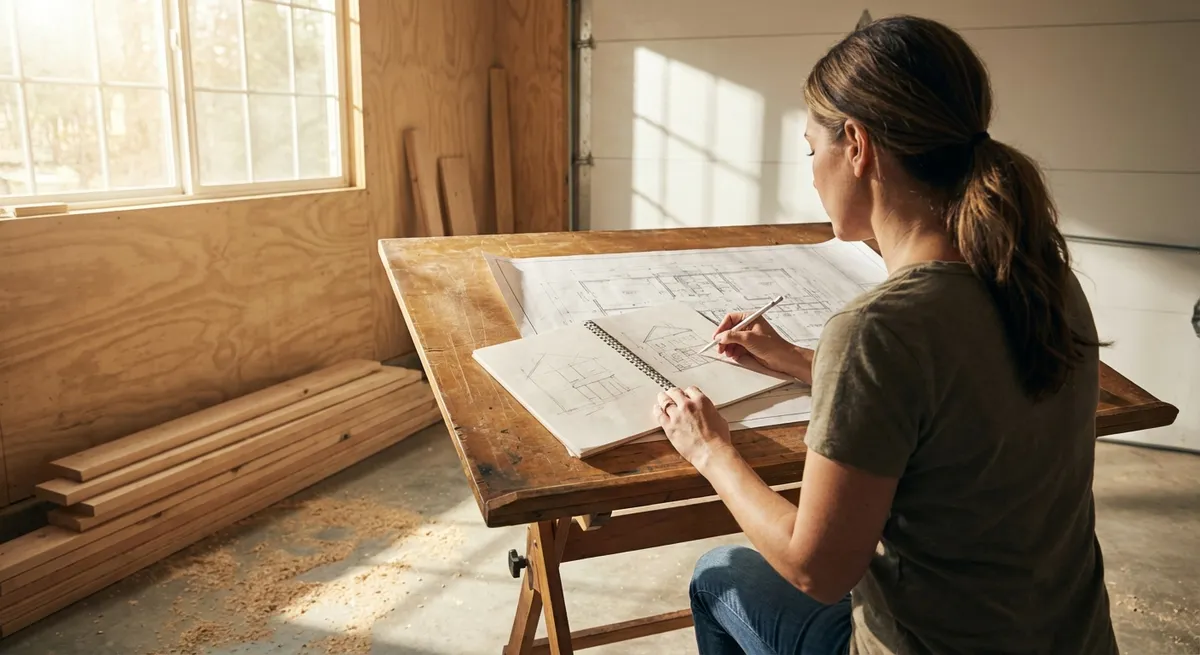
Start with a Purpose-Driven Sketch, Not Just Inspiration Photos
Scrolling through inspiration photos is a good way to get ideas, but it’s a bad way to start a build. Pros begin with purpose, then translate that into a rough but deliberate sketch.
Define what the project must do before thinking about how it should look. For example, instead of “build a patio bench,” define conditions like “must support 3 adults, shed water, and fit a 6 ft long cushion.” This functional list becomes your design filter.
Next, do a dimensioned hand sketch. It doesn’t need to be artistic. Use plain printer paper, a pencil, and a ruler. Draw the project from at least two viewpoints (front and side). Add key measurements you already know: total length, height, depth, and any constraints (doorway widths, property lines, existing slabs, etc.).
Mark where the project interfaces with existing structure or ground: wall connections, footing locations, or slab edges. This simple step exposes problems early—like a gate that won’t open fully if you place a post too close, or a bench that blocks a required walkway.
Finally, capture critical clearances on your sketch: walking space, access for maintenance, distance from utilities, and required code clearances (for things like steps, railings, or egress). Pros treat these constraints as part of the design, not an afterthought to be squeezed in later.
Turn Rough Dimensions into a Simple Material Takeoff
Once your sketch has measurements, you can turn it into a basic material list the way a contractor would. This prevents mid-project runs to the store and cuts down on wasted material.
Start by breaking your project into simple components: posts, beams, panels, footings, slabs, or wall segments. For each component, list how many you need and their dimensions. For example, a small outdoor bench might consist of:
- 4 legs (4x4 x 18")
- 2 long rails (2x4 x 48")
- 2 short rails (2x4 x 16")
- 5 seat boards (2x4 x 48")
Then convert that component list into stock sizes. If lumber comes in 8', 10', and 12' lengths, “nest” your pieces onto the fewest boards with the least offcut waste. Pros sketch cut diagrams on the side of the material list to avoid guesswork at the saw.
For masonry or concrete projects, treat it similarly. For a concrete pad, multiply length × width × thickness (in feet) to find volume in cubic feet and divide by 27 to get cubic yards. Then add 10–15% for waste, edge irregularities, and over-excavation. For block or brick, count units per row, rows in height, and add 5–10% for cuts and breakage.
Finally, add hardware, connectors, and consumables: screws, anchors, post bases, rebar chairs, form ties, construction adhesive, sealant, and protective gear. Pros don’t treat these as optional—they make the difference between “it stands up today” and “it’s still sound in a few years.”
Think in Load Paths: Where Weight and Forces Actually Go
A big difference between pro-grade work and weekend improvisation is how they think about loads. You don’t need engineering software, but you do need to think through where weight and forces travel.
Start with gravity loads: what’s resting on what? For a small deck or bench, the load moves from the top surface, into framing, into posts or supports, and finally into the ground. Check each link in that chain:
- Is the connection solid (screws/bolts instead of random nails in critical spots)?
- Is the bearing area adequate (no tiny blocks carrying heavy concentrated loads)?
- Is the foundation below able to carry the load (not sitting on uncompacted fill or soft topsoil)?
Next, consider lateral forces—wind, people leaning, soil pushing on walls, or items being bumped. Any tall, narrow, or long project needs resistance to tipping or racking. This usually means:
- Triangulation (bracing) for framed projects
- Enough embedment depth and proper footings for posts
- Adequate reinforcement and drainage for retaining or garden walls
Even for small DIY builds, asking “what happens if someone leans hard on this corner?” or “what if water builds up behind this?” can reveal weak points. Pros run this mental check before committing to a design.
If your project is anything someone will stand on, climb, or attach to a house, review basic code minimums for spans, railing heights, and stair geometry. Even if you’re not pulling a permit, treating code as the floor—not the ceiling—keeps your project safe and respectable.
Sequence the Build on Paper Before You Start Cutting
Professionals think in terms of build sequence: what has to happen first so everything else can follow efficiently and correctly. Doing this on paper takes minutes and can save hours onsite.
Write a simple step-by-step outline before you touch a tool, for example:
Layout and mark footprint
Excavate and set forms or post holes
Place footing concrete and set anchors/post bases
Frame primary structure (posts, beams, ledger if applicable)
Add secondary elements (joists, bracing, panels)
Finish surfaces and protection (sealant, paint, caps)
As you outline, ask “Do I need access here later?” This helps you avoid closing things up before installing anchors, conduits, drainage pipe, or backing for future fasteners. Pros are always thinking one or two steps ahead.
Look for steps that can run in parallel (like cutting parts while concrete cures) and steps that are sequence-critical (like running conduit before pouring a slab). This lets you schedule your workdays and drying/curing times realistically instead of guessing.
Finally, flag inspection points for yourself, even if there’s no building inspector involved: check diagonals for square before locking framing, check level and plumb before tightening anchors, confirm clearances before final fasteners. Treat these checkpoints as non-negotiable stopping points.
Build in Adjustability and Maintenance from Day One
Long-lasting projects aren’t just strong on day one—they’re accessible and adjustable when reality shifts. Pros expect movement, wear, and change of use, and design for it.
Where parts meet the ground, use replaceable or sacrificial components where practical. For example, a wood project with a concrete base should keep wood off direct soil contact and use adjustable post bases or shims that can be replaced if they corrode or rot.
In assemblies that might need tightening or adjusting, prefer mechanical fasteners (bolts, screws) in accessible spots rather than hidden nails or adhesive only. For fences, gates, and doors, slotted holes or adjustable hardware can compensate for minor movement in posts or framing.
Consider service access: can you reach fasteners, clean out drainage, or refinish surfaces without tearing the project apart? Leave removable panels or access hatches where you expect clogging, wear, or future upgrades (like adding low-voltage lighting).
Finally, document what you built. Pros leave behind:
- A simple sketch or photo with key dimensions
- Notes on materials used (fastener types, concrete mix, sealers)
- Locations of hidden items (conduit, rebar, anchor points)
A few quick notes in a project notebook or a labeled photo album on your phone will make any future repair, expansion, or troubleshooting dramatically easier.
Conclusion
Well-built DIY projects don’t happen by accident. They come from a clear purpose, a simple but deliberate plan, an understanding of how loads move, a thoughtful build sequence, and provisions for future adjustment and maintenance. When you approach your next project the way a professional does—on paper first, in the field second—you get better results, fewer surprises, and structures you’ll be proud to stand behind for years.
Sources
- U.S. Department of Housing and Urban Development – Residential Structural Design Guide - Covers fundamental concepts of load paths, structural safety, and residential detailing that are useful for planning small DIY structures.
- International Code Council – International Residential Code (Overview) - Provides the model code basis for many local building codes, including span, footing, stair, and guard requirements relevant to DIY projects.
- Oregon State University Extension – Estimating and Costing for Home Projects - Practical guidance on planning and estimating materials and costs for residential projects.
- Portland Cement Association – Concrete Basics - Explains key concepts in proportioning, placing, and curing concrete, useful for footings, pads, and small slabs.
- Simpson Strong-Tie – Residential Construction Details - Technical details and guides on connections, load paths, and hardware that can inform safer DIY framing and attachment methods.