This guide focuses on five expert-level practices that apply across almost any DIY build. They’re not about fancy tools or tricks—they’re about the way you plan, sequence, and execute work so your project finishes straight, square, and durable.
Build Backwards From a Fixed Reference
Professionals rarely “eyeball and adjust as they go.” They choose a fixed reference and build everything off it. This keeps projects square, aligned, and easy to troubleshoot.
Start by deciding what absolutely cannot move or change: a house wall, an existing slab edge, a door threshold, or a property line that’s already surveyed. That becomes your control point or control line. Use it to define your layout and check your work at each step.
Snap chalk lines, set string lines, or laser lines from that reference and measure everything to those, not to random edges or surfaces that might be out of square. For example, if you’re building a deck that meets an existing patio, let the house wall and the patio edge define two main lines and square off those—not off the yard fence that might be several degrees out.
Re-check your reference often: if you bump a string line, remeasure from the original fixed point instead of “fixing it by eye.” This is how pros keep errors from compounding across the project. When something doesn’t fit, always measure back to your original control, not to whatever you just installed. That one discipline alone eliminates a lot of crooked walls, racked frames, and out-of-square platforms.
Pre-Build a Dry Run for Critical Assemblies
On professional jobs, anything that will be hard to fix later usually gets a rehearsal. Doors are dry-fit before hardware is finalized, stair layouts are double-checked in scrap, and panel layouts are mocked up before committing to cuts.
Adopt the same discipline at home by doing “dry runs” for the parts of the project that would be expensive or painful to redo. For example:
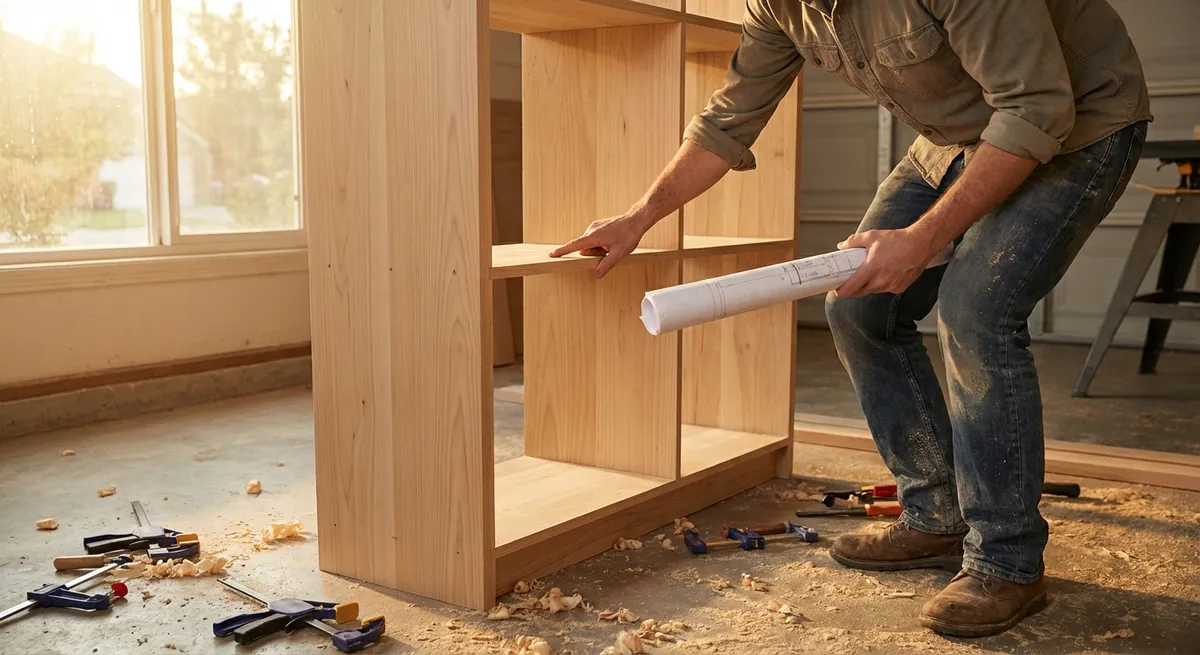
- Cabinets or built-ins: Set them in place before fastening, shim to level and plumb, and test door swing clearances and drawer pull-outs. Adjust layout before you drill permanent holes or cut scribe pieces.
- Stairs or steps: Lay out treads and risers with scrap pieces or cardboard, especially where you’re meeting an existing landing. Confirm consistent riser height—the single riser that’s ½" off is the one people will trip on.
- Tile layouts: Dry-lay a row or two (without thinset) to see where cuts land at edges and corners. Adjust your starting point to avoid narrow slivers of tile at a visible edge.
- Framed openings: Use temporary 2x scraps to simulate trim thickness so you don’t end up with odd, asymmetrical casing widths or reveals.
Treat dry runs as part of the build, not as optional “extra work.” They save both material and time by exposing bad assumptions early: tight clearances that will bind, misaligned hardware, or components that will clash with baseboards, windows, or mechanicals. Once you’ve rehearsed the critical assembly and know it works, the final install goes faster and cleaner.
Standardize Your Measurements and Marks
A surprising amount of DIY frustration comes from measurement inconsistency: different tapes, inconsistent reference faces, or unclear marks. Professionals eliminate that noise by standardizing how they measure and mark across the whole job.
Pick one primary tape measure for layout and a backup that matches it (check them side by side at a couple of standard lengths). Use the same tape for most critical dimensions so you aren’t dealing with small calibration differences. Mark from the same face or edge whenever possible—for example, always measure stud layout from the same corner of a wall, not from whatever edge is closer.
Use deliberate, readable marks:
- Use a “V” or tick mark pointing to the actual cut line, not just a random line across the board.
- Label key dimensions directly on the material when there’s any chance of confusion.
- For repetitive spacing (studs, joists, balusters), mark all positions before you start installing to avoid creeping errors.
When possible, build physical gauges for repeated measurements: a spacer block for consistent gaps, a story pole for repeated heights, or a template for hole locations. Pros do this on stair risers, siding courses, and drill patterns because a physical reference is faster and more reliable than re-reading a tape 40 times.
Finally, double-check critical measurements with a second method—tape and diagonal measurement, laser and hand measurement, or layout and actual material fit. If they disagree, stop and find out why before committing to cuts or fastening.
Control Fastening and Movement, Not Just Strength
A joint that “feels strong” today can still fail if it isn’t allowed to move the way the material wants to move. Professional builders plan for movement—expansion, contraction, creep, and load shifts—along with pure strength.
Start by understanding what each material does:
- Wood expands and contracts more across the grain than along it, especially with moisture changes.
- Concrete shrinks slightly as it cures and moves with temperature swings.
- Metal fasteners and framing can expand and contract with heat.
- Allow wood decking and trim boards slight gaps for expansion; use manufacturer-recommended fastener patterns and edge distances instead of improvising.
- Pre-drill near board ends or in hardwoods to avoid splitting that weakens the joint.
- For sheet goods (plywood, OSB, drywall), follow recommended fastener spacings and avoid overdriving screws, which reduces holding power and can telegraph through finishes.
- Flexible sealants rather than rigid fillers
- Slip joints or slots instead of tight, fixed connections
- Expansion gaps covered by trim rather than tight butt joints
Use fasteners and patterns that recognize that behavior:
Where two materials meet—like wood siding against masonry, or a door frame in a concrete wall—assume they will move differently. That’s where you use:
Think in terms of “where is this piece allowed to move, and where is it restrained?” A controlled movement joint that looks invisible on day one will keep things straight and crack-free on year ten. Fastening is not just about holding things together; it’s about directing and limiting movement in ways that preserve the structure and the finish.
Plan Tool Use Around Workflow, Not Just Tasks
Many DIYers think about tools in terms of individual tasks: “I need a saw for this cut” or “I need a drill for these holes.” Professionals think in terms of workflow: the sequence of operations, setup time, and how tools can stay staged and ready through the entire job.
Before you start, walk through your project in order and list the operations, not just the tools: layout, rough cuts, assembly, fastening, surface prep, finish details, cleanup. Then group tools and supplies by phase and location. For example:
- Stage layout tools (tape, pencil, level, chalk line, laser) where you’ll actually snap lines and mark cuts.
- Set up cutting stations where offcuts and dust are manageable and where you’re not carrying long boards through tight turns.
- Keep assembly and fastening tools (drills, impact drivers, clamps, nailers) near where pieces will come together, typically closer to the final structure.
Standardize consumables so you can work without constant changes: one main screw type per assembly, one main bit size, one nail length for a given layer, and clearly labeled boxes. Professionals often color-code or label boxes and bins so they can see at a glance which fastener goes where.
Finally, schedule maintenance tasks into your workflow: when will you change blades, charge batteries, or swap dust collection bags? A fresh blade before finish cuts, or fully charged batteries before a long fastening run, can be the difference between a clean, efficient finish and a frustration-filled final push where mistakes multiply because tools are dull or weak.
When you organize your work around a smooth flow, you waste less time hunting tools, you handle materials fewer times, and your focus stays where it belongs—on accuracy and quality.
Conclusion
Consistently professional results don’t come from a single “pro trick”; they come from disciplined habits layered into every step of a build. Start from a solid reference, rehearse critical assemblies, standardize how you measure, control how things move as well as how they hold, and stage your tools around a planned workflow.
Apply these five practices on your next DIY project and you’ll notice the difference where it matters most: straighter lines, cleaner fits, fewer surprises at the end—and a finished job that looks and feels like it belongs on a professional site, not just in a weekend project album.
Sources
- [U.S. Department of Energy – Building Envelope Fundamentals](https://www.energy.gov/eere/buildings/building-envelope) - Explains how materials behave, expand, and contract in real-world conditions
- [Fine Homebuilding – Layout Basics for Framing](https://www.finehomebuilding.com/project-guides/framing) - Professional guidance on reference lines, squaring, and consistent layout practices
- [The Family Handyman – Measuring and Marking Tips](https://www.familyhandyman.com/list/measuring-and-marking-tips/) - Practical methods for accurate measurements and repeatable marks on DIY projects
- [American Wood Council – Wood Handbook (USDA Forest Service)](https://www.fpl.fs.usda.gov/products/publications/several_pubs.php?grouping_id=100&heading_id=7) - Technical reference on wood movement, fastening, and structural behavior
- [Occupational Safety and Health Administration (OSHA) – Hand and Power Tools](https://www.osha.gov/hand-power-tools) - Official guidance on safe, effective tool use and maintenance practices