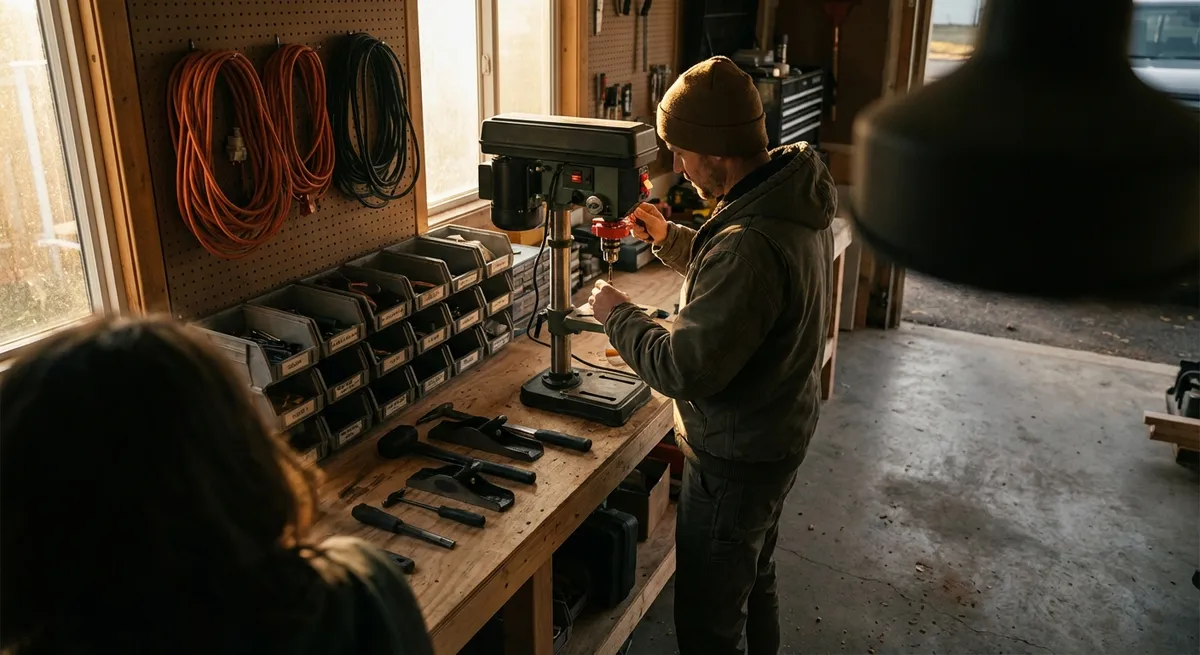
Designing a Workspace That Works Like a Jobsite, Not a Storage Unit
Most home “workshops” quietly turn into storage rooms with a workbench in the corner. Professionals prevent that by designing spaces around workflow, not just where there’s an empty wall. Start by mapping the basic sequence of your most common projects: bring materials in, measure and mark, cut or drill, assemble, finish, and store. Arrange your space so you can move through those steps without constantly backtracking or climbing over clutter.
Whenever possible, dedicate a clear “cutting and dust” zone and a separate “clean assembly” area. Even in a single‑car garage, you can achieve this with a folding work table for assembly and a fixed cutting station near the door for ventilation. Keep your measuring and marking tools stored at shoulder height right above the bench—this reduces reaching and searching, and it mirrors how many pros set up jobsite carts. Finally, plan safe pathways: no cords across walking routes, no stack of lumber leaning where vehicles or kids move through, and at least one clear exit path at all times.
Expert Tip 1: Build a Core Tool Set Around Tasks, Not Brands
Professionals rarely buy tools because they’re new; they buy them to solve repeat problems. Apply that same logic at home. List the project types you actually do (for example: light framing, trim, cabinet installs, basic masonry, deck repairs) and identify the critical tools for each. You’ll spot overlaps—measuring, drilling, cutting, fastening—that form your true “core set” instead of a random collection.
Prioritize a reliable measuring chain (tape measure, combination square, and a torpedo level), a good drill/driver, and one accurate cutting tool you know inside out (a circular saw with a guide rail, a miter saw, or even a high‑quality handsaw if space and budget are tight). Supplement with project‑specific tools as needed instead of trying to cover every scenario in advance. This approach mirrors how small contractors outfit their trucks: a stable core, with specialized tools added when the work justifies it. Invest in safety‑critical items—GFCI‑protected power strips, hearing and eye protection, dust mask or respirator—before buying “nice‑to‑have” gadgets.
Expert Tip 2: Standardize Your Materials and Fasteners
On professional sites, consistency keeps mistakes and rework down. You can borrow that strategy by deliberately limiting the variations of materials and fasteners you use. For example, choose a primary screw type for most wood projects (such as #8 or #9 construction screws in a few standard lengths) and a go‑to masonry anchor you trust. Label the bins clearly and always store them in the same place.
Standardizing also helps with layout and planning. If you consistently use 2x lumber and ¾" sheet goods, you can design projects around standard increments (multiples of 16" or 24" on center, full and half sheet dimensions). This reduces wasted offcuts and awkward pieces. Keep a small reference board or notebook with your “shop standards”: typical screw lengths for different material pairings, drill bit sizes to match anchors, and preferred spacing for common tasks like wall cleats or deck boards. Over time, you’ll stop re‑calculating the basics and start building faster with fewer errors.
Expert Tip 3: Treat Measurement and Layout as Its Own Skill
Professionals know that most “bad cuts” started as bad measurements. Upgrading your layout habits is one of the quickest ways to get better results without buying more tools. First, commit to using the same tape measure throughout a project; different tapes can be off by a small but meaningful amount. When accuracy matters, measure from the same reference point each time instead of “hopping” measurements down a line.
Use story sticks—scrap strips of wood marked with key dimensions—for repetitive layouts like shelf spacing, railing pickets, or repeated cuts. This eliminates accumulating errors from measuring each part individually. For longer layouts, snap chalk lines for straight, visible references and confirm critical points with a level or laser. Finally, mark cut lines clearly with a sharp pencil or fine‑tip marker and indicate the waste side with a small “X.” These seemingly small habits mirror how layout pros work, and they dramatically reduce the “cut it again, still too short” cycle.
Expert Tip 4: Build Repeatable Jigs Instead of One‑Off Solutions
Jobsite carpenters and cabinetmakers frequently rely on simple jigs to do repeat tasks faster and safer. In a home workshop, building a few well‑thought‑out jigs can elevate your work more than adding another power tool. Start with a cutting guide: a straight edge jig for your circular saw or a crosscut sled for a table saw, depending on what you own. This gives you clean, repeatable cuts without fighting the tool every time.
You can also create drill guides for consistent hole spacing, sanding blocks sized to your most common edges, or clamping cauls that help keep glue‑ups flat. When you catch yourself improvising the same “temporary fix” (such as clamping a board to the bench to act as a stop), consider turning that solution into a permanent jig. Label and hang your most‑used jigs where you can grab them in seconds. This is exactly how pros speed up standard tasks and save their energy and focus for the parts of the project that actually require judgment and creativity.
Expert Tip 5: Document Your Projects Like a Small Contractor
Professionals know that notes, photos, and simple records save time on the next job—and protect them if something goes wrong. Adopting a scaled‑down version of that practice at home will make your future projects easier and your repairs more straightforward. Keep a dedicated project notebook or digital folder where you store sketches, measurements, material lists, and actual settings you used (saw blade type, drill bit size, spacing, and so on).
Take progression photos of in‑wall work (electrical runs, plumbing routes, blocking) before you close anything up. Store these in clearly titled folders: “Basement wall framing – North wall,” for example. Later, when you’re hanging cabinets or drilling for anchors, those photos can prevent you from hitting a hidden line—or help you quickly locate solid blocking. At the end of each project, write a short “post‑project note” with what worked well, what failed, and what you’d change next time. Over a year or two, this habit builds a personal reference manual tailored to your tools, materials, and home.
Building Momentum Without Burning Out Your Space
A reliable DIY setup isn’t built in a single weekend; it evolves as you refine how you work. Start by organizing your space around workflow instead of storage, then upgrade your core tools and layout habits before chasing specialty gear. Standardize your fasteners and materials, lean on simple jigs for repeat tasks, and document your work so each new project starts a step ahead of the last.
With these professional‑grade practices in place, your garage or basement stops being “just somewhere to stash tools” and becomes a workshop that consistently produces safe, accurate, and repeatable results—whether you’re repairing, upgrading, or building from scratch.
Sources
- OSHA – Hand and Power Tools Safety - Official guidance on safe use of common tools and jobsite practices
- Fine Homebuilding – Workshop Design and Layout - Articles and videos on organizing and optimizing small workshops
- Family Handyman – Must‑Have Tools and Hardware for Homeowners - Practical overview of core tools and fasteners for DIY projects
- This Old House – How to Build Shop Storage and Jigs - Tutorials and ideas for jigs, storage, and workflow improvements
- University of Missouri Extension – Measuring and Layout in Carpentry - Educational resource on layout techniques, accuracy, and carpentry basics