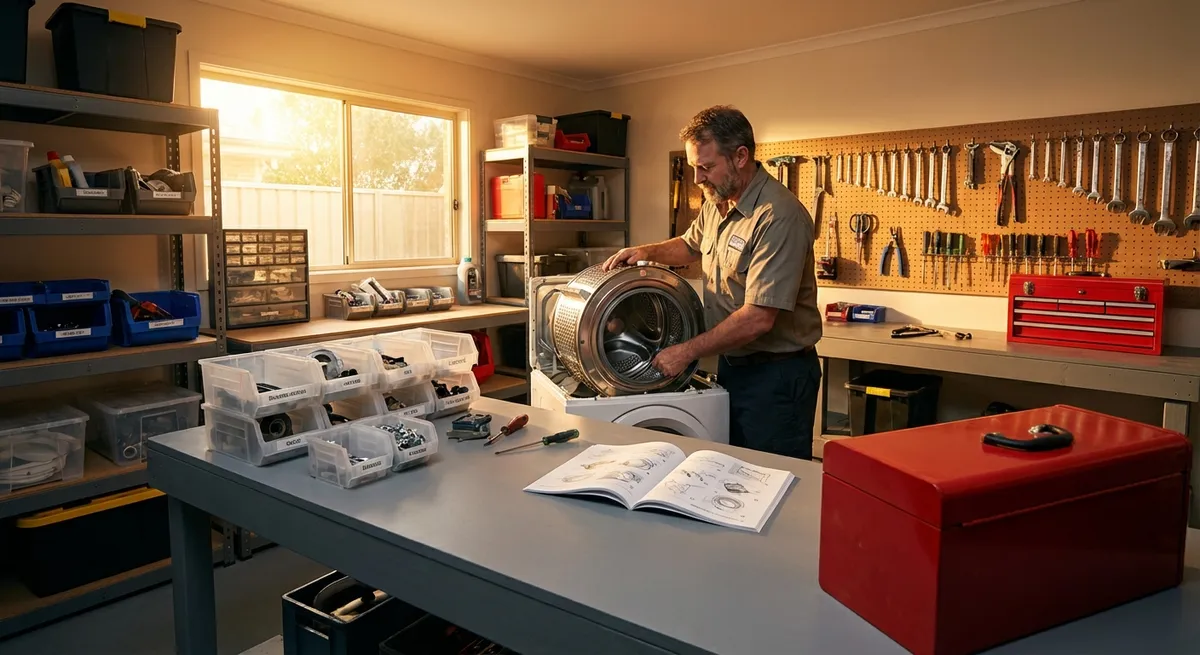
Start With the Failure Point, Not the Symptom
Paint that keeps peeling, a crack that reappears, or a door that won’t stay latched are symptoms, not root causes. Professional-caliber repairs begin with understanding what actually failed.
Before reaching for tools, slow down and inspect:
- Trace moisture paths. Stains, peeling finishes, and efflorescence (white powder on masonry) often indicate water intrusion. Use a bright flashlight and check above, behind, and adjacent to the damage. Look for missing caulk, failed flashing, hairline cracks, or poor drainage.
- Check movement and load. Cracks at corners, door misalignment, and grout failure can be caused by structural movement or improper fastening. Open and close doors/windows, step on nearby floors, and lightly press on walls or railings to feel for flex or shift.
- Look for previous repair attempts. Different materials (for example, soft patch next to hard original material, or mismatched mortar) tell you what’s already failed once. Plan a new approach rather than stacking more material on the same weak layer.
- Use simple test tools. A moisture meter, torpedo level, and straightedge can reveal hidden issues. High moisture content, out-of-plumb framing, or a bowed substrate often explain why finishes won’t stay intact.
- Ask: what changed? Recent renovations, new fixtures, grading changes, or heavy use often trigger new problems. Linking the timing of the issue to a change on-site will guide a more accurate fix.
Building this diagnostic habit takes minutes but saves hours of rework. Aim to be able to state the suspected cause in one clear sentence before you start any repair.
Match Materials to the Original Build, Not Just the Shelf
Many repairs fail because the new material and the existing construction don’t work well together. Professionals think in terms of compatibility—strength, flexibility, vapor behavior, and even color—rather than grabbing whatever is on sale.
Key compatibility checks:
- Rigid vs. flexible. Use flexible sealants (like high-quality exterior caulk) where movement is expected—joints between different materials, window perimeters, or expansion joints. Use rigid fillers (patching compounds, mortars) only where the substrate is stable and well-supported.
- Strength balance. For masonry, matching or being slightly softer than the original material is often best. Overly hard repairs (e.g., high-strength mortar on old soft brick) can cause surrounding material to crack or spall instead of absorbing stress in the repair itself.
- Indoor/outdoor rating. Many interior-grade products break down quickly under UV, temperature swings, or moisture. Check the label for exterior or wet-area approval before using in bathrooms, basements, or outside.
- Breathability and vapor movement. In older masonry walls or basements, using non-breathable coatings or dense patching materials can trap moisture behind the repair, leading to blistering or freeze-thaw damage. In these cases, choose vapor-permeable products designed for masonry.
- Adhesion across surfaces. When bonding to mixed substrates—painted surfaces, old concrete, metal fasteners—select products with broad adhesion specifications and follow any primer recommendations precisely.
Before buying, read the technical data on the product label or manufacturer’s website. Confirm:
- Approved substrates (what it can bond to)
- Service conditions (temperature, moisture, UV exposure)
- Cure time and recoat windows
Matching the repair product to the original construction avoids the common “good product, wrong place” failure.
Control Surface Prep Like It’s Half the Job (Because It Is)
No repair technique can overcome poor surface preparation. Professionals treat prep as a defined phase of work—not a quick wipe-down before the “real” task.
Build a consistent surface prep checklist:
- Remove everything loose. Scrape, chip, or grind away loose paint, crumbly mortar, delaminated concrete, rotten wood, and failing caulk. Anything that moves under light pressure is a weak layer that will break the bond.
- Clean for adhesion, not just appearance. Dust, oils, efflorescence, and mold interfere with bonding. Depending on the substrate:
- Use a stiff brush and vacuum for dust and debris.
- Wash oily or greasy surfaces with a degreaser, then rinse and dry.
- Treat mold or mildew with appropriate cleaners and allow thorough drying.
- Create the right profile. Smooth, glossy, or polished surfaces often need a light sanding or grinding to create a mechanical “tooth” for new materials to grip. Follow product guidance on acceptable surface roughness.
- Dry time discipline. Many failures result from trapping moisture below a repair. If a product requires a dry substrate, confirm drying with time, air movement, or a moisture meter. Conversely, some cement-based products specify a damp (but not wet) surface—follow that direction carefully.
- Mask for precision. On visible finishes, use painter’s tape and clean edges around the repair area. This not only keeps lines sharp but also prevents over-application that can trap moisture or interfere with adjacent components.
Treat prep as non-negotiable. If you don’t have enough time to complete proper prep and installation in one session, stop after prep and return when you can finish without rushing the critical bonding step.
Build in Movement: Repair for How the Area Is Used
Areas under regular stress—stairs, thresholds, corners, handrail anchor points, and exterior joints—demand repairs that account for movement and impact. Many “mysterious” repeat failures happen in these high-use zones.
Plan your repair with movement in mind:
- Evaluate how the surface is loaded. Is it walked on, leaned against, slammed, or thermally cycled by sun exposure? The type of stress determines whether you need additional support, flexible materials, or protection.
- Reinforce, don’t just patch. For cracked corners, stair nosings, and anchor points:
- Add mechanical reinforcement where possible (corner beads, brackets, longer fasteners into solid backing).
- Use mesh tape or reinforcing fabric over larger fill areas before applying finishing material.
- Use backer rods and proper joint design. In gaps around windows, doors, and expansion joints, install backer rod behind sealant to:
- Control sealant depth
- Encourage a proper “hourglass” shape that flexes instead of tearing
- Reduce waste and ensure consistent performance
- Respect expansion and control joints. Never fill designed joints with rigid patch materials. Restore them with appropriate flexible sealants so the structure can keep moving without cracking finishes.
- Protect edges and transitions. Thresholds, outside corners, and stair edges benefit from metal or PVC edge trims and nosings. These components take the hit so the repair material doesn’t.
Think of your repair as a small part of a moving system. If it’s too rigid where things need to flex—or too soft where things take impact—it will eventually fail even if the workmanship is clean.
Finish and Cure With Patience: The Last 10% That Decides Durability
Even well-planned repairs can be compromised in the final stages. Rushing cure times, covering too early, or skipping protection during the first days of use are common ways to shorten the life of otherwise good work.
Adopt a controlled finishing and curing process:
- Respect manufacturer cure times. Distinguish between “tack-free,” “recoat,” and “full cure.” Walking on, loading, or sealing a repair before full cure can cause microcracks, adhesion loss, or tackiness that never fully resolves.
- Control temperature and moisture. Avoid installing temperature-sensitive products in extreme heat, direct sun, or near freezing unless they are specifically rated for those conditions. If necessary, shade exterior work or use temporary heat or ventilation indoors.
- Stage reassembly. When repairs are hidden behind trim, fixtures, or furniture, wait until the repair has reached the recommended cure stage before reinstalling components. Trapping uncured material can lead to blistering or slow failure.
- Monitor the first use period. The first few days or weeks are revealing. Listen for creaks, watch for micro-cracking, and check for early discoloration or moisture reappearance. Early small adjustments (adding fasteners, improving drainage) can prevent another full repair later.
- Document what you used and when. For contractors, note products, batch numbers, and installation dates. For homeowners, keep labels or take phone photos. If an issue arises, clear records make troubleshooting and warranty claims more straightforward.
Finishing and curing are where patience pays off. A repair that looks done is not necessarily ready for load, weather, or sealing. Give materials the conditions they’re designed for, and they’ll return that care with longer service life.
Conclusion
Reliable repairs are less about secret techniques and more about disciplined habits: diagnose the real problem, choose materials that work with the existing build, prep meticulously, account for movement and use, and protect the repair through its cure. Whether you’re running a crew or handling your own property maintenance, treating each repair as a small system—rather than a quick patch—reduces callbacks, repeat work, and surprise failures. Build these practices into your standard workflow, and “fix it right the first time” becomes your norm instead of your exception.
Sources
- [U.S. Department of Housing and Urban Development – Residential Rehabilitation Inspection Guide](https://www.huduser.gov/portal/publications/rehabinspection.html) - Practical standards for diagnosing and planning durable residential repairs
- [Portland Cement Association – Concrete Repair Basics](https://www.cement.org/learn/concrete-technology/concrete-construction/concrete-repair) - Guidance on preparation, compatibility, and performance of concrete repairs
- [Building Science Corporation – Guide to Moisture Control in Buildings](https://buildingscience.com/documents/guides-and-manuals/gm-010-guide-to-moisture-control-in-buildings) - In-depth coverage of diagnosing and preventing moisture-related failures
- [U.S. Consumer Product Safety Commission – Home Maintenance and Safety](https://www.cpsc.gov/Safety-Education/Safety-Guides/home) - Recommendations on safe repair practices and avoiding common hazards
- [The University of Minnesota Extension – Caulking and Weatherstripping](https://extension.umn.edu/weatherizing-and-energy-conservation/caulking-and-weatherstripping) - Detailed guidance on selecting and using flexible sealants in building joints