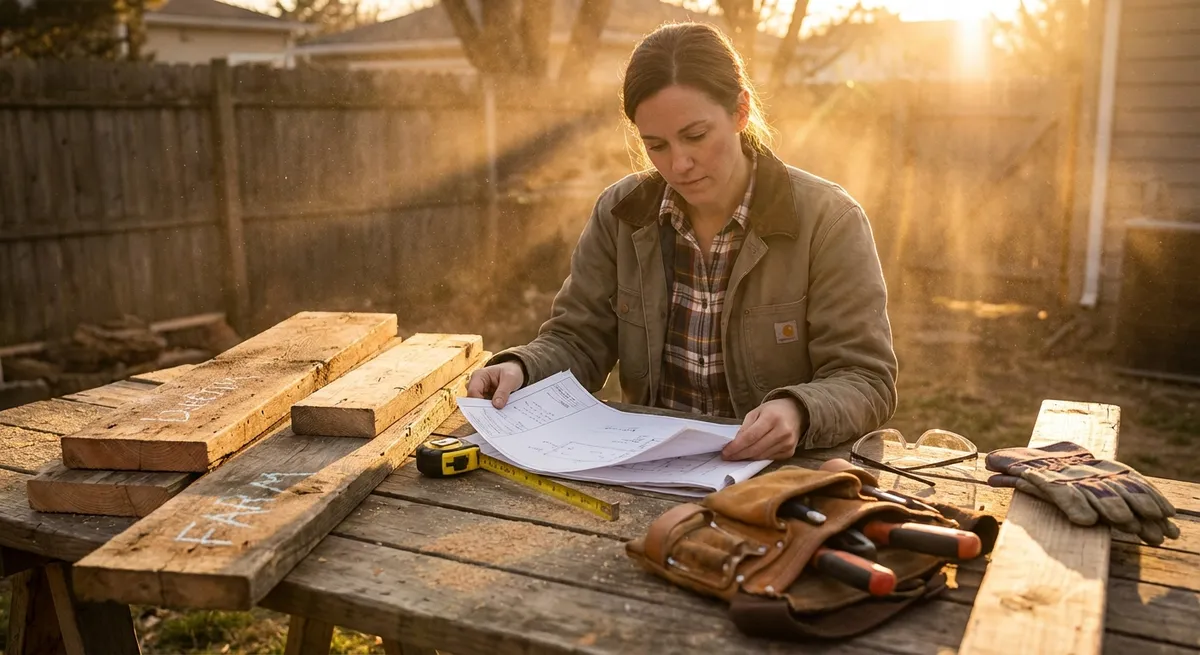
Below are five expert-level habits that construction pros rely on every day, translated into practical, step‑by‑step tactics you can use on your own projects.
Tip 1: Let the Measurement Dictate the Design, Not the Other Way Around
Pros don’t force materials to fit their idea; they adjust the idea to match what the measurements and site conditions allow.
Before you commit to a sketch or start buying materials, walk the work area with a tape measure, level, and notepad. Measure key reference points: total length, height changes, existing structures, and anything that could interfere (downspouts, vents, doors, slope, neighboring fences, etc.). Note where surfaces are out of plumb or out of level—assume nothing is perfectly straight. Photograph the space from multiple angles and mark rough dimensions on the photos; this gives you a quick reality check when you’re planning later.
Translate those field measurements into a scaled drawing, even if it’s just on graph paper. Make each square represent a realistic unit (for example, 1 square = 4 inches or 10 cm). Sketch in critical elements—door swing arcs, clearance around HVAC equipment, or vehicle turning radius in a driveway. Now you can see quickly if a proposed wall, patio, or storage build-out will actually work in the real space. Adjust dimensions to match standard material sizes (paver modules, plywood sheets, lumber lengths) so you cut less and waste less. This is how pros avoid awkward slivers of concrete, misaligned masonry joints, and cramped walkways that never felt “off” on paper until it was too late.
Tip 2: Choose Materials Based on Environment, Not Just Appearance
Many DIY projects fail early because the materials were chosen for how they look, not for how they’ll behave in that specific environment.
Start by listing the stresses your project will face: moisture, freeze–thaw cycles, direct sun, heavy loads, salt exposure (de-icing salts or coastal air), or contact with soil. For any structural or long‑term exterior work—steps, small pads, low garden walls—confirm whether sub-base materials, mortars, and fasteners are rated for outdoor use and for your climate zone. For example, fasteners labeled “interior only” or “electro‑galvanized” will corrode quickly outdoors, especially in wet or coastal regions; look instead for hot-dip galvanized or stainless-steel hardware when exposed to the elements.
In masonry and concrete-related projects, understand the difference between mixes intended for structural use, patching, or decorative surfacing. Using a generic bag of “cement mix” for every task is a shortcut to delamination and cracking. Read the manufacturer’s technical data sheet (usually available as a PDF on their website) for recommended uses, minimum thickness, compatibility with existing surfaces, and curing conditions. Match mortar types (for example, Type N vs. Type S) to the brick or block and exposure level. When in doubt, favor systems where all components (adhesives, mortars, sealers) are from the same manufacturer and explicitly compatible; pros do this to reduce unpredictable chemical interactions between products.
Tip 3: Build From Stable Reference Lines, Not From Whatever Is “Close Enough”
Professional crews don’t trust existing edges or walls to be straight, level, or square. They create their own reference system first, then build to that.
Before setting a single stone, block, or form, establish control lines. For horizontal projects (patios, small slabs, walkways), strike a level reference line on nearby walls or stakes using a line level or laser. Mark this line clearly; it becomes your “truth” for slope and elevation decisions. For vertical or layout-intensive work (walls, stairs, fence lines), snap chalk lines to mark straight paths and square corners. Use the 3-4-5 rule (a basic application of the Pythagorean theorem) to verify right angles: measure 3 units on one side, 4 on the other, and adjust until the diagonal measures 5 units.
Drive stakes securely at key corners and pull masonry string lines taut between them. These strings represent where faces of walls, edges of forms, or fence lines should end up. Build to the strings—not the ground, not the house siding, not the neighboring fence posts. As you work, continually re-confirm that string lines haven’t sagged or shifted. This extra 20–30 minutes at the beginning eliminates cumulative error, which is what causes wavy walls, crooked pavers, and stair treads that never quite line up.
Tip 4: Sequence Tasks for Strength First, Looks Second
Homeowners often jump to the visible, satisfying parts—setting stone, finishing concrete, or installing caps—before the structural parts have been thought through. Pros reverse the sequence: strength and support always come before appearance.
Break your project into layers or stages: subgrade preparation, base or footing, structural elements, then finishes and sealers. For a small concrete or paver job, for example, the uncompacted soil and base will determine how well everything above it performs. Remove organic material (roots, topsoil, sod) until you reach firm, undisturbed soil, then add and compact a granular base in controlled lifts (thin layers, compacted before adding the next). Use the right compaction tool (plate compactor or hand tamper), and don’t move on until the base feels solid underfoot with no soft spots.
Apply the same thinking to vertical work: ensure posts, piers, or footings are properly sized and anchored before worrying about alignment of finish materials. Check that each structural component meets minimum embedment or bearing requirements suggested by code or manufacturer data. When in doubt, slightly oversize footings and reinforcement within reason; retrofitting strength after finishes are in place is far harder than stepping up support at the beginning. Once you’re confident in the structural backbone, take your time on finishing details such as joint tooling, surface texture, or trim alignment—those final touches will only matter if the project holds up.
Tip 5: Use Inspection Checkpoints Like a Building Professional
Professional projects pass through inspections: footing, framing, mechanical, final. Even without a permit, you can adopt the same mindset by creating your own checkpoints.
Before starting, define 3–5 “pause points” where you will stop, step back, and verify critical aspects before moving on. Examples include: after layout but before excavation, after base compaction but before placing forms, after reinforcement is set but before pouring concrete, and after the first course of a wall but before stacking higher. At each checkpoint, run a simple checklist: Are dimensions within tolerance? Are slopes correct and consistent? Are components securely fastened or braced? Are clearances (door swing, egress paths, drainage routes) still maintained?
If something is off, fix it at that stage—even if it means removing material you just placed. Pros treat early errors as non-negotiable; the cost to correct them multiplies at every stage. Document your checkpoints with photos and notes, especially when work will be covered later (buried drains, rebar in footings, post anchors inside concrete). These records make troubleshooting far easier if you ever have to diagnose movement, moisture issues, or cracking in the future. Over time, you’ll develop your own repeatable inspection habits that significantly improve project reliability.
Conclusion
Thinking like a professional doesn’t require a contractor’s license—it requires discipline in how you plan, choose materials, set reference lines, sequence work, and check your own progress. When you let measurements guide design, match materials to environment, build from stable control lines, prioritize structure over finish, and enforce your own inspection checkpoints, you dramatically reduce the chances of early failure.
Adopt these five habits on your next DIY project and you’ll find that your results not only look more “pro,” they behave that way season after season.
Sources
- U.S. Department of Housing and Urban Development – Residential Rehabilitation Inspection Guide - Offers professional-style checklists and inspection principles you can adapt to DIY projects
- Portland Cement Association – Homeowner Resources - Guidance on concrete mix selection, base preparation, and durability considerations for residential work
- Simpson Strong-Tie – Fastening and Anchoring Solutions - Technical information on choosing appropriate fasteners and connectors for different environments and structural demands
- Concrete Construction – Layout and Formwork Basics - Professional strategies for establishing control lines, squaring corners, and planning accurate forms
- University of Minnesota Extension – Site Grading and Drainage - Explains how to read and design slopes and drainage, crucial when planning exterior concrete and masonry projects