Start With the Site: Grade, Water, and Load
Before you buy a single block, you need to understand what the wall is really holding back.
Walk the site after a rain, if possible. Note where water naturally flows, where it ponds, and any soft spots underfoot. You’re looking for three key things: slope direction, drainage paths, and existing hard surfaces that might redirect water toward your wall. If you’re building near a driveway, patio, or foundation, assume stormwater will concentrate there and treat it as a load, not an afterthought.
Map the wall line with marking paint or string and consider what’s above it: parked vehicles, a shed, a fence, or just lawn. A wall that only retains topsoil for a planting bed can be built more simply than one supporting a driveway edge, but both still need drainage and a proper base. When in doubt, step the wall back into the slope instead of pushing it forward; that reduces pressure and makes drainage detailing easier.
If your planned wall height, soil type, or loading conditions are uncertain—or you’re approaching 4 feet in height—consult your local building department and, when required, a structural engineer. Many jurisdictions require engineering or permits above a certain height or when supporting structures, even for “DIY” work.
Build the Base Like It Matters (Because It Does)
A retaining wall is only as good as its bottom course. Cutting corners here guarantees extra “maintenance” later in the form of rework.
Excavate a trench along your layout that’s wide enough for the block plus at least 6 inches of working room behind it. Depth will depend on local frost depth and manufacturer guidance, but a common rule for small segmental walls is to bury roughly 10% of wall height plus one additional course. In cold climates, you may need to go deeper to get below frost heave.
Remove all organic material—roots, topsoil, and loose fill. You want to build on undisturbed native soil or well-compacted structural fill. If the trench bottom is soft or pumping (water and fines surfacing under foot pressure), over-excavate and replace with compacted granular base.
Install 4–6 inches of compactible aggregate base (often 3/4" minus with fines) and compact it in thin lifts with a plate compactor. Compact until the base feels solid and the compactor changes pitch—a field cue many pros rely on. Use a long level, straightedge, and string lines to get this base flat, level side-to-side, and consistent along the wall line. Small corrections here prevent visible “waves” later.
Complete the base course carefully: each unit should seat firmly on the base with no rocking. Shim with small amounts of bedding sand only when necessary; widespread shimming is a sign your base isn’t truly flat.
Expert Tip 1: Treat the first course like finished work. Spend extra time on alignment and level. Wall systems are designed to self-align as they stack, but only if that bottom course is straight, uniformly supported, and dead level.
Design Drainage as Part of the Structure, Not an Add-On
Most small retaining walls fail because they trap water. Water adds weight, increases lateral pressure, and cycles through freeze–thaw, all of which can push even well-built walls out of alignment over time.
As soon as you place the first course, think “drainage sandwich”: wall block at the front, free-draining stone and pipe in the middle, compacted soil at the back.
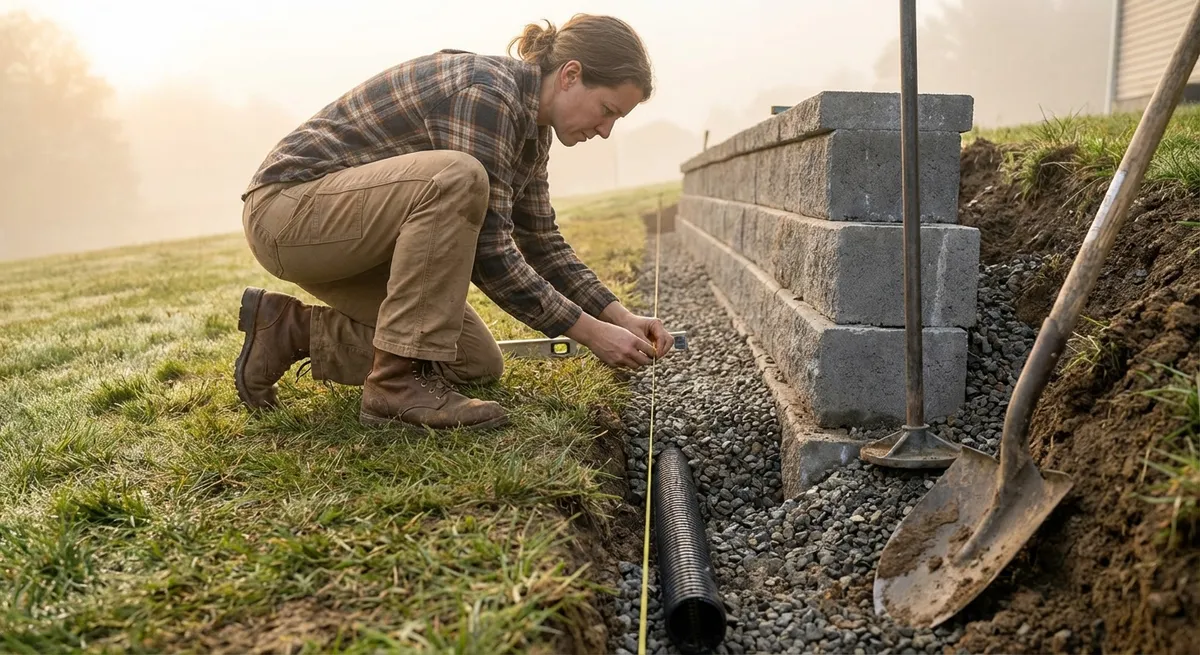
Place a perforated drainpipe (with a filter sock, if available) directly behind the base of the wall, sloped slightly—1% or more—toward a daylight outlet. If daylighting isn’t possible, connect to an existing drainage system per local code or direct to a drywell designed to handle the anticipated flow. Don’t dead-end the pipe; water needs a defined exit.
Backfill directly behind the wall with 3/4" clean crushed stone at least 12 inches thick from the back of the block into the slope. This vertical “chimney” of stone allows water to move quickly down to the drainpipe instead of pressurizing the soil. Place a non-woven geotextile fabric between the stone and the native soil to prevent fines from clogging the stone over time.
As you step up the wall, keep the drainage layer and fabric rising with you. Avoid compacting native soil directly against the back of the block; that defeats the purpose of the drainage zone and can introduce point loads.
Expert Tip 2: Always provide a path for water to leave the wall zone. A perforated pipe with real slope to daylight or a properly sized drainage system isn’t optional—it’s the cheapest insurance you can buy against bulging and frost damage.
Reinforcement and Backfill: Think in Layers, Not Just Height
Even for small walls, treating backfill as structural—not just something to “put back”—pays off in performance. Poorly backfilled walls see more movement, faster.
Backfill in thin lifts, typically 6–8 inches at a time, alternating between placing clean stone immediately behind the wall and compacted soil further back. Compact each lift with a plate compactor, staying at least 12 inches away from the back of the block to avoid pushing it out of alignment. In the zone close to the wall, a hand tamper or smaller compactor is safer.
If your wall system or designer calls for geogrid reinforcement, install it exactly as specified—pay attention to grid orientation, embedment length into the slope, and spacing between layers. Lay the grid flat on a prepared, level surface of compacted backfill and stone, tension it by pulling tight, and then secure it with pins or soil before placing the next lift.
Meter your backfill progress against your wall height; don’t let the wall “get ahead” of backfill by more than a single course or two. This ensures the front of the wall and the soil behind it move together as a system.
Expert Tip 3: Compact in thin, consistent lifts and keep the wall and backfill rising together. This minimizes differential settlement and keeps the wall face from gradually leaning outward under unbalanced loads.
Finish the Top to Keep Water Out, Not Just for Looks
The top of the wall is where most DIY projects shift focus to cosmetics—caps, plants, lighting. Pros know it’s also where you either keep water out of the structure or invite it in.
Once you reach final height, install a final course of drainage stone directly behind the wall up to cap level and wrap it with geotextile fabric to prevent soil migration. Install cap units with an exterior-grade, manufacturer-approved concrete adhesive, paying particular attention at corners and steps where movement can start.
Grade the soil behind the wall to shed water away from the face. Aim for at least 2% slope (about 1/4" per foot) for a few feet back from the wall. Where the wall meets hard surfaces like patios or walks, bridge that joint with a slight slope and, if possible, a narrow drainage strip filled with stone to intercept surface water.
If you’re adding planting beds, avoid overfilling soil right up against the back of the caps. Maintain a thin mulch layer over soil and leave the drainage stone protected behind fabric; you want water from irrigation and rainfall to move through the topsoil and then away, not saturate the wall zone.
Expert Tip 4: Grade the top to direct surface water away from the wall face. Many walls that look structurally sound at the base fail prematurely because surface water is allowed to spill directly down behind the block.
Field-Proven Habits That Keep Your Wall Straight and Standing
Beyond the technical details, a few practical habits from experienced crews make a noticeable difference in real-world performance and appearance.
Work with string lines and check frequently. Snap a line along the front edge of the base course and use it as a benchmark for every course. A wall that wanders even 1/4" in and out over a short run will catch the eye, especially with manufactured block.
Dry-fit complex areas first—corners, curves, and steps—before committing with cuts or adhesive. This helps you plan unit layout, minimize awkward slivers, and manage pattern breaks that can distract from the finished look.
Respect manufacturer details. Segmental retaining wall systems are tested assemblies, not just “blocks that stack.” Follow the block producer’s guidance on minimum embedment, setback per course, cap adhesives, and compatible geogrid types. Small deviations multiply over time when exposed to changing soil moisture and freeze–thaw cycles.
Finally, document what you installed—block type, base depth and material, drainage configuration, geogrid brand and spacing. This record is valuable if you or someone else needs to troubleshoot or extend the wall in the future.
Expert Tip 5: Treat a small wall like a scaled-down engineered system. Consistent layout, tested components, and documented details are what separate a temporary fix from work that stays straight through real‑world weather and loading.
Conclusion
A small retaining wall may look like a simple landscape feature, but the physics behind it are the same as on larger civil projects: soil pressure, water movement, freeze–thaw, and settlement. By investing effort in the base, designing drainage from the first course, compacting in true structural layers, and finishing the top to shed water, DIY builders can achieve results that hold up under everyday use. For professionals, these same habits reduce call-backs, protect your reputation, and make small hardscape jobs feel as solid as your larger structural work.
Sources
- U.S. Department of Agriculture – Engineering Field Handbook, Chapter 7: Grassed Waterways - Provides foundational guidance on water flow, slopes, and drainage paths that apply directly to grading around retaining structures.
- NC State University Extension – Design of Retaining Walls - Explains soil pressure, wall stability concepts, and basic design considerations for small and large retaining walls.
- Allan Block – Retaining Walls Installation Guide - Manufacturer best practices for base preparation, drainage, geogrid, and finishing details for segmental retaining wall systems.
- Keystone Retaining Wall Systems – Installation Guidelines - Step-by-step instructions and technical notes on base, backfill, drainage, and reinforcement for modular retaining walls.
- University of Minnesota Extension – Retaining Walls for Homeowners - Homeowner-focused overview of planning, materials, permits, and construction practices for residential retaining walls.