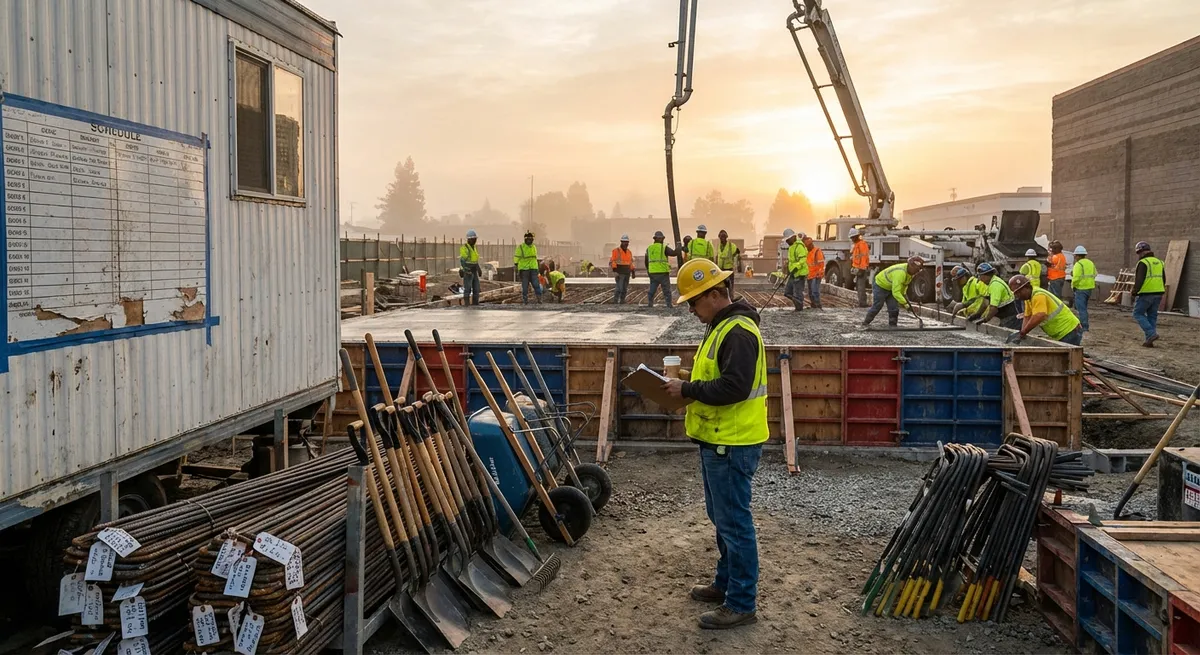
Plan the Pour Around Time, Not Just Volume
Most people calculate how many yards of concrete they need and stop there. Professionals plan how long that concrete will be workable and who is doing what during that window.
Start by checking the mix’s expected set time from your ready-mix supplier and adjust for weather. Hot, windy days shorten your working time dramatically; cool, damp days stretch it. Use that information to build a simple timeline for the day: form inspection, reinforcement check, pre-pour briefing, first truck in, last truck offsite, finishing stages, and protection/curing setup.
Before the first truck arrives, walk the job and treat it like a mini pre-construction meeting. Confirm access for trucks and wheelbarrows, verify that rebar, mesh, vapor barriers, and embeds are fully secured, and check that formwork is braced and staked. Assign roles clearly: who is on chute, who is on rakes/screed, who floats, who edges and joints, and who monitors surface bleed and finish timing.
For DIY projects, shrink this process—but don’t skip it. Even for a 10'x10' slab, lay out the sequence on paper. Have tools staged in zones (placing, leveling, finishing, curing) so you aren’t hunting for a trowel while the surface is setting. A few minutes of planning around time, not just volume, often saves hours of panic and patching later.
Treat Subgrade Prep as the First Quality Inspection
Concrete doesn’t fail in the middle of a slab; it usually fails where support underneath is inconsistent. Crews that meet deadlines over the long haul invest extra time in subgrade prep so they don’t lose days later fixing settlement cracks, ponding, or callbacks.
Begin with uniform excavation to the design depth, removing organic material, soft spots, and debris. Subgrade should be firm and consistent—not muddy, loose, or layered with topsoil. For driveways, patios, and slabs-on-grade, add a well-graded granular base (like compacted crushed stone) to improve drainage and support.
Compaction is where many DIY and even some small professional jobs cut corners. Use a plate compactor or jumping jack in manageable passes, overlapping each run. Make at least two passes in perpendicular directions over the entire area. Spot-check firmness using a simple boot test: you shouldn’t be sinking in or kicking up loose material. If you see visible deflection when walking, you’re not done compacting.
Where moisture is an issue, install a vapor barrier per code or specification, sealing overlaps and penetrations. Take a final “QC walk” before placing reinforcement or forms, looking for low pockets where water could pond or where the base is noticeably softer. Correcting those spots now costs minutes; fixing cracked or uneven concrete later costs days.
Use Reinforcement and Joints to Control, Not Eliminate, Cracks
Concrete will crack. The difference between a clean, professional job and a problem job is whether those cracks appear where you planned. Reinforcement and joints are tools to control crack location and width—when they’re used deliberately.
For slabs, position rebar or welded wire reinforcement at the right depth—typically in the upper third of the slab thickness, not lying on the subgrade. Support steel on chairs or dobies and tie intersections securely enough that workers and wheelbarrows don’t push it to the bottom. In DIY work, this often means slowing down and double-checking steel position as you pour.
Plan control joints in advance. For typical slabs, a good starting rule is that joint spacing (in feet) should not exceed 2–3 times the slab thickness (in inches). For a 4" slab, joints every 8–12 feet are common, forming roughly square panels. Too wide a spacing leads to uncontrolled cracking.
Cut joints to proper depth—about one-quarter of the slab thickness—using a groover while the concrete is plastic or a saw as soon as it can be cut without raveling the edges. Mark joint locations on forms or layout lines before the pour to avoid guessing under pressure. Don’t neglect isolation joints around columns, walls, and other fixed elements, especially where differential movement is expected.
Reinforcement and joint layout should be treated as a design task, not an afterthought. When they’re done purposefully, most cracking becomes tight, controlled, and visually acceptable, rather than a reason to rip out and replace sections of a project.
Finish for Performance First, Appearance Second
A flawless-looking surface that dusts, delaminates, or scales in the first winter is not a win. Professionals finish concrete based on the slab’s intended use, environment, and mix design, then chase aesthetics within those limits.
Begin by striking off (screeding) the concrete to the correct elevation, using a straight screed board or vibrating screed. Follow promptly with bull floating to embed aggregate just below the surface and bring up a consistent cement paste. At this stage, resist the urge to overwork the surface, especially if bleed water is present.
Bleed water must evaporate before steel troweling or hard finishing. Working that water back into the surface weakens the top layer, leading to scaling and dusting. Use a simple test: place your hand on the slab. If it still feels slick and glossy with water, wait. If it’s dull and supports slight pressure without leaving a wet film, you can proceed.
Match the finish to the use. For exterior flatwork exposed to rain, snow, and freeze-thaw cycles, a light broom finish is usually preferred for slip resistance and durability. Reserve hard steel trowel finishes for interior slabs where smoothness is critical (e.g., warehouses, garages) and moisture conditions are controlled. On hot or windy days, have an evaporation reducer or light misting setup ready to avoid surface crusting that leads to crazing and plastic shrinkage cracks.
Throughout the finishing process, designate one person as the “surface boss” whose job is to monitor timing and condition, not just swing tools. This person decides when to move from bull float to mag float, from edging to brooming or troweling. A single, experienced decision-maker helps prevent overworking early or rushing final passes just to “make it look good” before it’s ready.
Treat Curing as Part of the Schedule, Not an Afterthought
Curing is where many schedules quietly go off the rails. People assume concrete is “done” once it looks hard, strip forms early, load slabs prematurely, or expose surfaces without protection. The result is microcracking, surface defects, or structural underperformance that forces repairs, replacements, or delayed occupancy.
Plan your curing method before the pour: wet curing (soaker hoses, wet burlap, or blankets), curing compounds (membrane-forming sprays), or a combination. For most structural and exterior work, the goal is to keep the concrete continuously moist and at the right temperature for at least the first 7 days, longer for high-performance mixes or critical elements.
Immediately after finishing, protect the slab from rapid moisture loss, wind, direct sun, and freezing conditions. For slabs, spraying a curing compound is often the fastest way to lock moisture in, especially on large jobs. For DIY work, simple methods like plastic sheeting properly sealed at the edges or damp burlap kept continuously wet can be highly effective.
Respect early-age strength limits. Check with the supplier or engineer for when forms can be safely stripped and when light vs. full loading is allowed. Many crews follow a 3-, 7-, and 28-day strength mindset: be conservative about moving heavy equipment or storing materials on a new slab in the first week. A job that “saves a day” by loading early often loses several days a few months later dealing with cracks, curling, or settlement.
Include curing in your job schedule with clear responsibilities—who applies curing compound, who monitors moisture and temperature, and who verifies that cure conditions are maintained over nights and weekends. When curing is treated as a standard line item, not a nice-to-have, long-term performance improves and callbacks shrink, which is the most reliable way to keep future jobs on schedule.
Conclusion
Concrete work that finishes on time—and stays out of the repair budget—depends less on tricks and more on discipline. Planning pours around workable time, taking subgrade prep seriously, using reinforcement and joints to steer cracks, finishing for function, and scheduling curing as part of the job all add structure to what can feel like a chaotic process.
For construction professionals, these habits reduce rework, shrink punch lists, and protect margins. For DIY builders, they turn a one-shot task into a predictable workflow instead of a guess. The slab might look similar either way on day one, but months and years later, these field-proven practices are why some projects quietly keep performing while others keep showing back up on the repair list.
Sources
- [Portland Cement Association – Concrete Slab Construction](https://www.cement.org/learn/concrete-technology/concrete-construction/concrete-home-building/concrete-slab-construction) - Guidance on slab preparation, placement, reinforcement, and finishing
- [American Concrete Institute (ACI) – Guide to Concrete Practice](https://www.concrete.org/tools/freetopics.aspx) - Technical documents and free topics on curing, joints, and durability best practices
- [U.S. Department of Transportation – Concrete Pavement Field Reference](https://www.fhwa.dot.gov/pavement/concrete/pubs/07029/) - Practical field recommendations on subgrade prep, joints, and curing for concrete pavements
- [NRMCA – Hot Weather Concreting Tips](https://www.nrmca.org/concrete-technology/hot-weather-concreting/) - Best practices for planning, placing, and finishing concrete in hot conditions
- [Cement.org – Concrete Jointing and Crack Control](https://www.cement.org/learn/concrete-technology/durability/cracking) - Detailed explanation of crack types and how joints and reinforcement control them