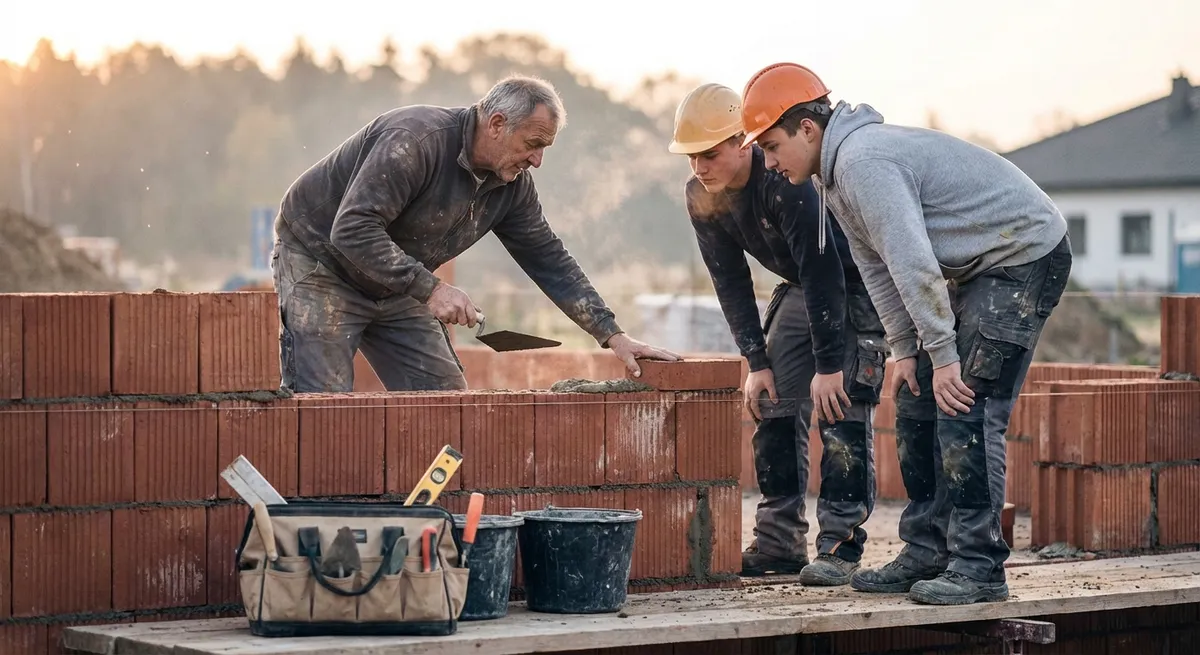
This guide walks through five expert-level practices that working masons and serious DIYers can fold into their workflow immediately. The focus is practical: what to do, when to do it, and how to spot problems before they’re baked into the wall.
Tip 1: Control Your Layout Before You Touch a Trowel
Most masonry defects start before the first unit is laid. A rushed or improvised layout leads to awkward cuts, creeping joints, and walls that fight you all day.
How to dial in a pro layout:
- Start with the control points, not the wall. Mark finished corners, openings (doors, windows), control joints, and any intersections with existing work. Snap chalk lines on the footing or slab to show the actual face of the wall, not just the centerline.
- Dry-stack a test course. Lay out a full course of brick or block on the ground along your line, with actual joint spacing. Adjust joint width slightly to “grow” or “shrink” the run so your units land cleanly at corners and openings. Aim to limit sliver cuts under 1/4 unit whenever possible.
- Use bond patterns to your advantage. For brick, confirm whether running bond, stack bond, or a decorative pattern is required. For block, verify that half-bond or third-bond aligns with openings and lintels. Adjust your starting point rather than forcing the pattern mid-wall.
- Plan your course heights. Identify sill heights, lintel elevations, and any alignment with siding, trim, or other cladding. Measure actual unit dimensions (they vary slightly) and calculate how many courses you need to hit those elevations with consistent bed joints.
- Lock in reference lines. Pull mason’s lines for both faces of the wall, using line blocks or line pins on the corners. Make sure they represent your finished faces, not just theoretical centers. Check with a tape at multiple points before you start laying units.
By investing an extra 20–30 minutes in layout, you avoid chasing dimensional problems with awkward cuts and forced joints later in the build.
Tip 2: Mix and Manage Mortar for Consistent Workability
Even good technique falls apart if your mortar is fighting you. Too stiff, and you’re starving the bond; too wet, and units float and joints wash out. On small jobs, DIYers often rely on “looks about right” instead of measurable consistency.
Key practices for dependable mortar:
- Follow the manufacturer’s proportions. For bagged mortar, measure water using a marked bucket instead of guessing. For site-mixed mortar, use a consistent volume method (e.g., 1 part cement, 1/4–1/2 part lime, 2.25–3 parts sand by volume, depending on specified type).
- Match mortar type to the job.
- Type N (medium strength) for most above-grade walls and veneers.
- Type S (higher strength) for below-grade, retaining walls, and higher-load applications.
- Avoid using a stronger mortar than the masonry units require; overly hard mortar can accelerate brick or block cracking rather than sacrificially cracking itself.
- Check water on-site, not just at the start. Adjust for humidity, direct sun, and wind. In hot, dry conditions, your mix will “tighten up” faster; you may need to remix more often in smaller batches.
- Use a brief slake time. After initial mixing, let the mortar rest for 5–10 minutes, then remix without adding more powder. This improves workability and consistency.
- Respect the retemper window. Most manufacturers allow a limited period (often 1.5–2.5 hours) in which mortar can be retempered (lightly re-mixed with small amounts of water). After that, discard it. Using mortar beyond its workable life undermines bond strength and durability.
Consistent mortar mixes give you reliable “feel” through the trowel, so you can focus on alignment and speed instead of constantly compensating for bad mud.
Tip 3: Use Lines, Levels, and Story Poles as a System
Masonry is judged by the eye long before it’s judged by engineering. Wavy courses, stairs in the bed joints, and out-of-plumb corners immediately reveal where controls broke down.
Build a simple control system and stick to it:
- Set stout corner leads. Build corners (leads) up 4–8 courses ahead of the field, checking each course with level (plumb and level) and square. The corner is your visual and structural anchor; if it’s off, the whole wall reflects that error.
- Stretch mason’s lines correctly.
- Keep lines tight to avoid sag; lightly “pluck” to check for slack.
- Use line pins, line blocks, or corner poles rather than improvising with nails or random ties.
- Keep the line a hair off the units (about a line’s thickness) rather than pressing it against them.
- Check plumb early and often. Use a 4-foot level on both faces of the wall and at corners. Don’t wait until the end of a long run to discover drift; correct minor deviations within 1–2 courses.
- Employ a story pole. Mark all course heights, window sills, and lintels on a straight 2x or aluminum pole. Stand it at corners to confirm course alignment before you reach those critical elevations. This prevents mismatched sill heights and ugly step-ups in the bond.
- Watch joints at transitions. At corners, inside returns, and around openings, visually confirm that bed and head joints align and remain consistent in width. Use a pointing trowel or jointer to adjust joint thickness while the mortar is still plastic.
Treat your lines, levels, and story pole as non-negotiable references, not suggestions. Correcting 1/8 inch now is far easier than explaining a crooked window surround to a client later.
Tip 4: Protect Work From Weather, Not Just While You’re On-Site
Masonry continues to change long after you’ve packed up tools for the day. Rain, frost, wind, and sun can undermine bond strength, change appearance, and create hairline cracks that don’t show up until weeks later.
Weather-smart practices that pay off:
- In hot, windy, or sunny conditions:
- Lightly dampen high-suction units (like some bricks or dry CMU) before laying. They should be surface damp, not dripping.
- Shade the work area with tarps or shade cloth where practical.
- Mix smaller batches of mortar more frequently to maintain workability.
- In cold conditions:
- Follow the cold-weather masonry guidelines: protect materials from freezing, heat mixing water if specified, and never lay units on frozen surfaces or with frozen mortar.
- Use insulating blankets to protect fresh work overnight when temperatures drop.
- Protect fresh masonry from rain. At the end of the day—or when storms threaten—cover the top of unfinished walls with plastic or tarps, loosely draped and weighted so air can circulate. Avoid wrapping the entire wall tightly, which can trap moisture.
- Control uneven drying. Strong wind on one face of the wall can cause differential shrinkage and hairline cracking. Windbreaks (temporary plywood or fabric barriers) help keep both faces drying more evenly.
- Respect curing time before loading. Don’t backfill, install heavy anchors, or load lintels prematurely. Follow structural and manufacturer guidelines for minimum cure times before applying significant loads or lateral pressure.
Effective weather management is invisible when done right—your masonry simply looks uniform and performs as designed, without efflorescence streaks, popouts, or early cracks.
Tip 5: Finish Joints and Clean as You Go for Long-Term Performance
Joint finishing and cleaning are often treated as cosmetic steps, but they have real performance impacts: water resistance, ease of maintenance, and how well future sealants or coatings bond.
Make joint finishing a structural habit, not just an aesthetic one:
- Time the tooling window. Joints should be thumbprint hard: firm enough not to smear, soft enough to compress. If you tool too early, you drag mortar; too late, you polish the surface without tightening the bond.
- Choose the right joint profile.
- Concave and V-joints are popular because they compress mortar and shed water efficiently.
- Raked or struck joints can be visually appealing but are more vulnerable to water intrusion if not detailed correctly.
- Maintain consistent depth. Uneven tooling depth shows up immediately in raking light and can create weak points for moisture entry. Work systematically from one end to the other to avoid missing sections.
- Clean mortar strikes immediately. Scrape off heavy droppings with a margin trowel or small pointing trowel while they’re still green. Use a soft brush—not water—to tidy joints and faces as you move up the wall.
- Use chemical cleaners sparingly and correctly.
- Always test in an inconspicuous area first.
- Follow manufacturer’s dilution ratios and pre-wet the wall to reduce absorption.
- Rinse thoroughly to avoid streaking, etching, or accelerated efflorescence.
- Document your finish. Take close-up photos of sample panels or early sections to show the agreed joint profile, color, and texture. On larger or multi-day projects, this helps maintain consistency from start to finish.
Well-tooled joints and disciplined cleaning don’t just make today’s wall look good—they make it far easier to repair, seal, or refinish years down the line.
Conclusion
Good masonry isn’t mysterious; it’s the sum of predictable, repeatable habits. When you tighten up layout, control your mortar, lean on a reliable line-and-level system, protect work from the weather, and treat joint finishing as a performance step—not just a cosmetic one—you get walls that stay straight, shed water, and age well.
Whether you’re a contractor training a new crew member or a DIY builder tackling your first serious wall, treating these five practices as non-negotiables will raise the baseline quality of every project you touch. Over time, that consistency is what separates masonry that merely stands from masonry that lasts.
Sources
- Brick Industry Association – Technical Notes on Brick Construction – Detailed guidance on brick design, materials, weather considerations, and workmanship standards.
- Portland Cement Association – Masonry Mortar – Explains mortar types, mix proportions, and performance considerations for different applications.
- International Code Council – International Building Code (IBC) – Reference for structural and code requirements affecting masonry design and construction.
- NCMA (National Concrete Masonry Association) – TEK Notes – Technical resources on concrete masonry units, wall systems, detailing, and best practices.
- U.S. General Services Administration – Preservation Brief: Repointing Mortar Joints in Historic Masonry – In-depth discussion of mortar selection, joint finishing, and cleaning for durable, compatible masonry work.