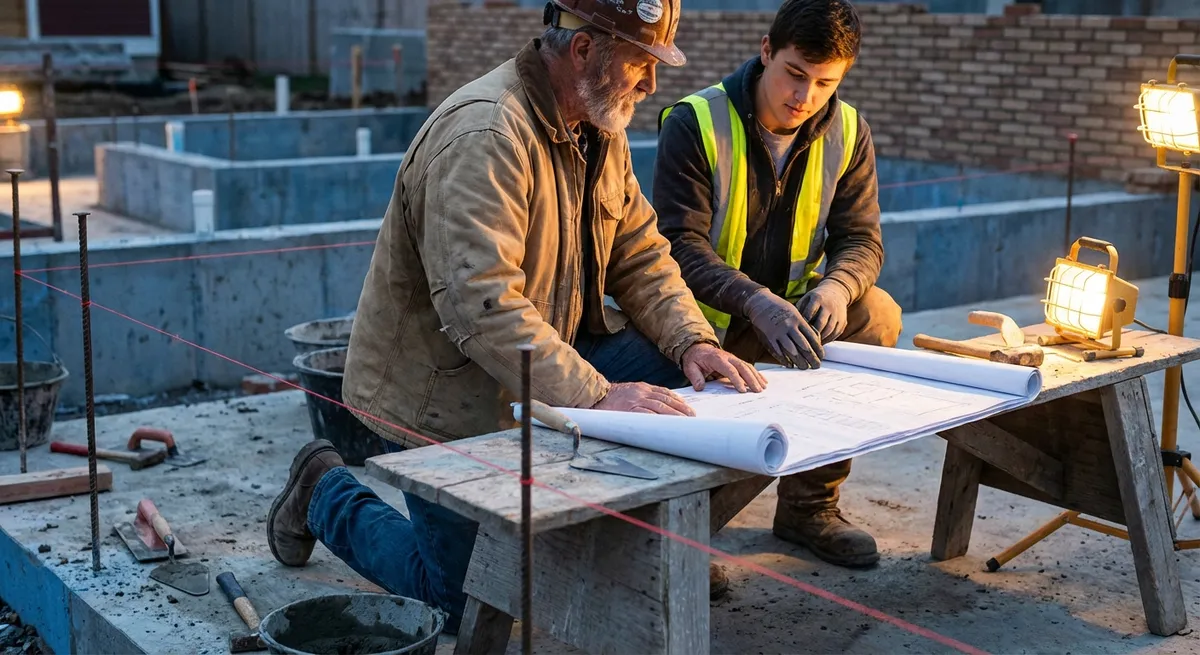
Building From the Ground Up: Reading the Site Before You Build
Every masonry project begins with the site, and it’s where many long-term problems are silently baked in.
Start by evaluating drainage and soil conditions, not just the footprint. Identify high and low points, existing hardscapes, and how water currently moves. A simple way to start: after a heavy rain, walk the site and note any standing water or soft spots—those areas need extra attention or a design rethink.
Check existing structures (house foundations, slabs, retaining walls) for cracks, settlement, or movement. New masonry tied into a failing or shifting structure will inherit those problems. Use a long level, laser, or string lines to check for plumb and level, and note any areas where you’ll need joints, flexible connections, or isolation.
For exterior walls and retaining work, confirm you have space for proper base depth, backfill, and drainage assemblies—many failures come from squeezing systems into too-tight spaces. Avoid designing to the absolute minimum; give yourself room for gravel base, geotextile fabric, perforated drain pipe, and inspection/cleanouts where needed.
Access is part of site planning. Decide how materials, mixers, and waste will move in and out. A well-planned material path prevents damaged surfaces, shortens carry distances, and saves hours of labor. On tight lots, plan where pallets will sit, how you’ll protect turf or paving, and where you’ll stage cutting operations to control dust and debris.
Finally, document the site with measurements, photos, and sketches before you dig. This makes it easier to coordinate with inspectors, utilities, and future changes—even if you’re the owner and builder.
Expert Tip #1: Treat water as the main client. Every detail—base slope, weep locations, flashing decisions—should answer the question “Where does the water go next?” If that answer is ever “onto/behind the masonry and nowhere out,” redesign that area before you start.
Choosing Materials That Match the Job, Not Just the Look
A clean sample board can hide a lot of mismatch between product and purpose. Material selection should be performance‑driven first, aesthetic second.
Start with exposure: freeze–thaw cycles, de‑icing salts, coastal air, and intense sun all affect what will last. Check manufacturer data sheets for intended use (above grade, below grade, saturated conditions, poolside, paving, etc.) and verify that both the units (brick, block, stone, pavers) and the mortar or adhesive are rated for your environment.
Coordinate mortar type with the masonry units and structural demands. For example, clay brick and soft stone often pair better with more flexible, lower-strength mortars (like Type N or O), while structural block walls usually need higher-strength mixes (like Type S). Overly strong, rigid mortar on softer units can cause cracking or spalling over time.
If you’re mixing concrete or mortar on site, commit to a single, documented mix design for each use: foundation, wall core fill, setting bed, grout. Write it down: ratio by volume, aggregate type and size, and any admixtures. This keeps helpers and subs from “eyeballing” different ratios that cure at different strengths and colors.
Think through compatibility. Not all sealers, cleaning agents, and waterproofing products work with all masonry types. Some can trap moisture, cause efflorescence, or etch surfaces. Before you buy in volume, test a small area or sample with your planned cleaner or sealer, following manufacturer instructions.
Where possible, order a bit more material than your calculated quantity—especially with brick, stone, or pavers—so you can cull damaged pieces and blend colors across batches. Returns and reorders from a different dye lot can be visually obvious for years.
Expert Tip #2: Design with replacements in mind. Keep labels, product data sheets, and a few spare units stored dry and protected. Future repairs are far more successful (and less visible) when you can match the original materials precisely.
Laying Out Worklines That Protect Your Finish
Professional-looking masonry project outcomes often come down to the accuracy and clarity of the layout.
Start by locking in a true reference: a known level line (laser or water level) and at least one square corner. Use the 3-4-5 method (or larger multiples like 6-8-10, 9-12-15) to verify square, and double-check measurements from multiple directions. On remodels, assume nothing is straight—measure from several points and capture the average conditions.
Use layout lines generously: snap chalk lines, pull mason’s line, and mark key elevations on stakes, batter boards, or temporary screeds. The more complex the build (steps, corners, openings, multiple levels), the more you benefit from layout “checkpoints” that you can revisit after each stage.
Think through pattern and cuts before you place the first unit. On patios and veneer work, dry-lay a section or map out where cuts will land, especially near edges, doors, or focal points. Adjust your starting point so you avoid sliver cuts or awkward joints in prominent locations.
For walls with openings, don’t just center windows and doors visually; align them with modular dimensions of your masonry when possible. Slightly adjusting opening sizes or locations on paper can save hours of field cutting and improve structural behavior around lintels and jambs.
During layout, integrate control joints, movement joints, and expansion joints into the design. Mark their planned locations clearly. Ignoring movement joints at the planning stage often leads to cracks appearing where you didn’t intend them.
Expert Tip #3: Use temporary “story poles.” Mark course heights, sill elevations, and header heights on a straight board (or on a nearby stud/column). This quick visual reference helps keep everything aligned and avoids remeasuring the same dimensions all day.
Sequencing Work So Each Step Supports the Next
Good sequencing protects your work from accidental damage and prevents you from working against yourself.
Plan your build in stable layers: base prep, structural elements, then finishes. For outdoor work, finish all excavation, base compaction, and drainage installation before bringing masonry units on site. Once units arrive, they should be going onto a well-prepared base, not stored where future digging or grading will disturb them.
Think vertically and horizontally. Don’t race to full height on one wall while other connected elements lag; uneven loading can create stress and misalignment. Instead, lift walls in balanced stages, especially on structural work. For DIYers, that might mean setting a daily maximum height for new wall courses to reduce settlement and out-of-plumb tendencies.
Schedule wet processes with cure times in mind. Concrete foundations and slabs need sufficient cure before bearing major loads; masonry mortars need time before backfilling or applying concentrated loads from lintels, beams, or roof framing. Check and follow curing recommendations in product data sheets rather than relying on rules of thumb.
Mix noisy, dusty, and high-impact tasks (saw cutting, demolition, heavy compaction) earlier in the sequence so you’re not risking damage to near-finished masonry. When retrofitting, complete structural modifications and rough-in for utilities before committing to veneer or finish surfaces.
Don’t forget environmental sequencing: plan to pour, lay, and grout when weather is most favorable. Extremely hot, cold, wet, or windy conditions can dramatically affect workability and curing. On longer projects, build slack into the schedule for weather protection—temporary tents, tarps, or heat can’t be improvised effectively at the last minute.
Expert Tip #4: Write a simple 1–2 page “build script.” Outline what must be completed (and inspected, if applicable) before each next step. Treat it like a checklist, not a novel. This small effort sharply reduces backtracking, rework, and missed details.
Quality Controls You Can Build Into the Plan
Most visible defects—cracks, stains, uneven joints—are easier to prevent than to fix. Integrating quality checks into your plan keeps small problems from becoming permanent features.
Define acceptance standards before you start: joint width range, allowable lippage on flatwork, maximum crack width that triggers investigation, tolerances for plumb and level. For professional jobs, align these with applicable standards or specifications. For DIY work, write down realistic targets so you can judge consistently.
Specify inspection points. For example: “Check base compaction and slope after grading, before any unit is laid,” or “Verify block cells are fully filled after each grout lift.” Photos with a smartphone at these stages help document that work was done as planned—useful for warranty discussions or your own future reference.
Plan for moisture and staining control. Identify where efflorescence is most likely (grade lines, capped walls, parapets) and specify drainage, flashing, and breathability details to reduce trapped moisture. For features exposed to salts, de‑icers, or pool chemicals, consider sacrificial surfaces or protective treatments specified ahead of time.
Safety and ergonomics affect quality more than many people realize. Include in your plan how you’ll reduce awkward lifts, reach, and repetitive strain (scaffold heights, material staging, mechanical hoists if available). Fatigue leads to inconsistent joint work, sloppy cuts, and missed steps.
Finally, plan your cleanup strategy. Decide how mortar droppings, slurry, and wash water will be handled from day one, not after you’ve stained a new patio. Some cleaning chemicals must not reach planting beds or storm drains; know the restrictions and disposal methods in advance.
Expert Tip #5: Use “first work” as a standard. On day one, set a small section of masonry as cleanly and carefully as possible. Take measurements, photos, and notes on joint profile, spacing, and finish. Keep referring back to this benchmark as the job progresses to maintain consistency.
Conclusion
Well-executed masonry is the sum of dozens of small, disciplined decisions made before anyone opens a bag of mortar. Reading the site carefully, choosing materials for performance as well as appearance, laying out precise worklines, sequencing tasks intelligently, and embedding quality checks into the plan all pay dividends in durability and appearance.
For construction professionals, this planning framework helps standardize good outcomes across crews and projects. For serious DIY enthusiasts, it turns complex masonry work into a manageable, stepwise process rather than a guessing game. In both cases, the most reliable way to build masonry that lasts is to treat the planning phase as real work—not just a formality between the sketch and the first course.
Sources
- Portland Cement Association – Concrete Masonry Construction - Overview of best practices for concrete masonry, including materials, layout, and construction considerations
- The Masonry Society – Movement Control in Masonry Walls - Technical guidance on movement joints and crack control planning
- NCMA (National Concrete Masonry Association) – TEK Resources - Peer-reviewed technical notes on design, construction, and materials for masonry systems
- U.S. General Services Administration – Building Envelope Design Guide: Masonry - Federal-level guidance on masonry envelope performance, detailing, and durability
- Building Science Corporation – Understanding Drainage, Drying, and Groundwater - Practical building science explanations of moisture, drainage, and their impact on masonry and concrete assemblies