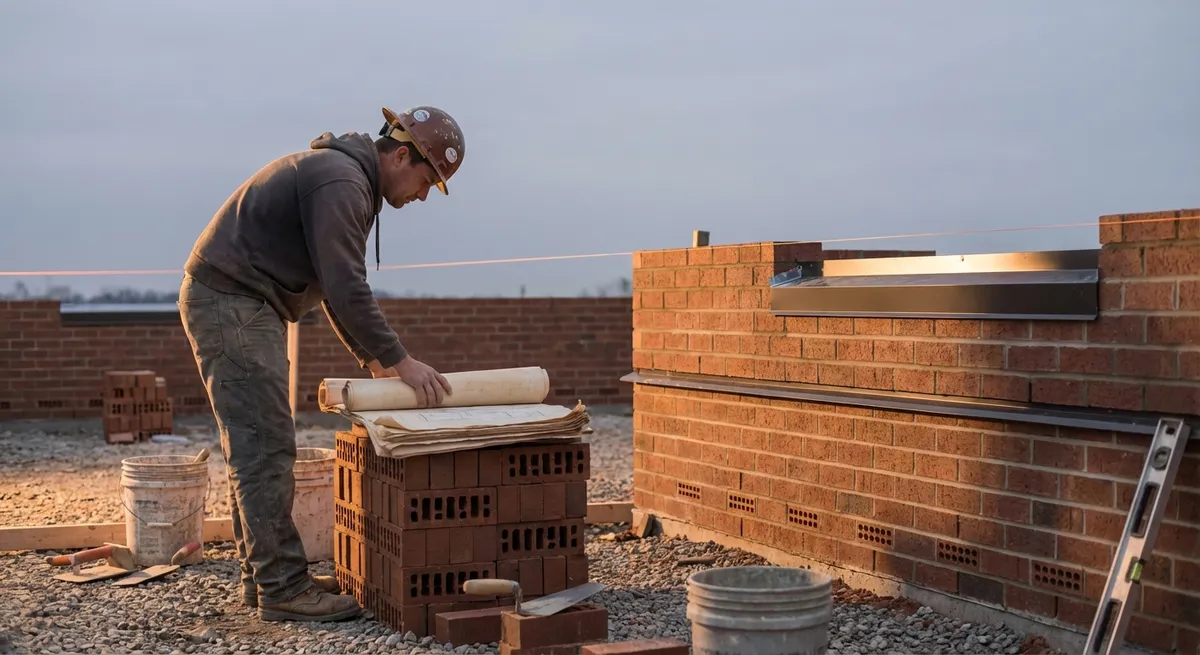
Start with the Structure, Not the Surface
Masonry often gets treated like a finish, but structurally it behaves very differently from wood framing or light-gauge steel. Bricks, blocks, and stone are strong in compression, weak in tension, and extremely sensitive to movement—both in the structure they’re attached to and in the soil beneath them.
Before choosing a pattern or color, confirm how the masonry will be supported and restrained. A free-standing garden wall, a brick veneer on wood framing, and a retaining wall all have different structural demands. For load-bearing work, follow engineered plans or prescriptive codes that specify wall thickness, reinforcement spacing, footing size, and control joints. For veneer, check that the backup structure is straight, adequately braced, and ready to accept anchors at the required spacing.
The goal is to create a support system that carries the masonry’s weight evenly, avoids point loads, and allows controlled movement where needed. When the structure is right, the mortar joints will stay tight, the courses will stay level, and the wall will move as a system instead of cracking in random spots.
Moisture Management: Design for Water You Can’t See
Masonry can look solid, but it’s naturally porous. Wind-driven rain, ground moisture, and condensation all find ways into assemblies that weren’t detailed to manage water. Successful walls are designed to accept that moisture will get in—and then give it a controlled way back out.
On exterior veneer, a drainage cavity (airspace) behind the masonry is not a luxury; it’s a survival feature. A few key practices:
- Maintain a consistent cavity width (commonly 1"–2"), free of mortar droppings that can bridge the gap.
- Install weep systems at the base of walls and above openings so trapped water can exit.
- Use through-wall flashing at transitions, slab edges, and shelf angles, lapped correctly and carried out to the face of the wall.
- Make sure the backup wall (sheathing plus WRB) is installed like it’s the primary weather barrier—because it is.
Even for garden walls or hardscape features, controlling water matters. Backfill with free-draining material behind retaining walls, include perforated drainpipe where needed, and avoid trapping water at the base with non-permeable surfaces. Water that can’t drain will freeze, expand, and push on your masonry from the inside out.
Movement Joints and Reinforcement: Let the Wall Move Where You Choose
Masonry doesn’t like being forced to stay still. Temperature swings, moisture cycles, and structural deflection all move buildings. If the wall isn’t detailed to accommodate that movement, cracks will form where you don’t want them.
Expansion joints (for brick) and control joints (for concrete masonry units) are your way of telling the wall where it’s allowed to crack or separate in a controlled, sealant-filled line instead of a jagged break through random bricks or blocks. Proper joint spacing depends on wall length, height, exposure, and materials, but following code recommendations and manufacturer guidance is mandatory for predictable performance.
Reinforcement is the other half of this equation. Horizontal joint reinforcement (wire ladder or truss-type) in bed joints helps tie the wall together and control crack width. Vertical rebar in grouted cells on CMU walls provides strength and stiffness, especially in seismic or high-wind regions. Treat rebar layout and grout placement as a structural system—clean cells, correct bar cover, and continuous grout lifts where specified are what turn hollow block into a real structural component.
Detailing Openings: Windows, Doors, and Penetrations
Most masonry failures do not start in the middle of a clean, uninterrupted wall; they start where the wall is interrupted. Windows, doors, vents, hose bibs, and mechanical penetrations introduce three challenges at once: structural discontinuity, water paths, and concentrated stresses.
Above openings, lintels or arches must be sized and installed correctly to carry the masonry load around the opening without excessive deflection. Steel angles should have proper bearing on both sides and be protected from corrosion with coatings or flashing. Precast concrete or masonry arches must follow engineered shapes and bearing requirements.
Around the perimeter of openings, continuous flashing and properly detailed terminations of the cavity are crucial. Head flashing above windows should be integrated with the WRB, turned up at the back and ends, and brought forward to daylight or a weep. Sills should have slope to shed water, with drip edges that move water away from the face. Sealant joints around frames should be sized correctly, applied over proper backer rod, and placed where movement is expected—not smeared thinly over a rough gap.
Penetrations like pipes and vents should be sleeved or gasketed, not just mortared tight. Hard connections between dissimilar materials (rigid metal directly bonded into brick, for example) tend to crack as each material moves differently over time. Give those components room to move and a flexible seal to maintain weather resistance.
Expert Tip 1: Use Mock-Ups for More Than Just Appearance
Full-scale mock-ups are often required on commercial jobs, but they’re underrated even for smaller projects. A mock-up is not just a color sample; it’s a test bed for your entire masonry system.
Build a small, representative section that includes:
- A window or door opening
- A base detail with weeps and flashing
- The planned bond pattern and joint profile
- The exact mortar mix and tooling timing
Use the mock-up to dial in joint size, tooling pressure, cleaning methods, and flashing installation sequence. Take notes on how long it takes for mortar to reach proper tooling stiffness in real site conditions. Later, the mock-up can serve as a reference for workmanship standards and can help settle questions about what “acceptable” looks like. On multi-trade projects, use it to coordinate how masonry aligns with cladding, trim, or window systems.
Expert Tip 2: Control Mortar Workability, Not Just Strength
Many crews focus on compressive strength numbers and forget that mortar’s most important job is to bond units together and remain workable long enough for efficient laying. Overly stiff mortar produces poor bond and hollow joints; mortar that’s soupy or repeatedly retempered with water can shrink excessively and weaken.
Aim for consistency:
- Mix in measured batches with accurate water volumes, not “until it looks right” every time.
- Respect pot life and retempering limits as recommended by mortar and cement manufacturers.
- Adjust for weather: in hot, dry conditions, use shade, dampened (not saturated) units, and possibly set-control admixtures; in cold conditions, use appropriate cold-weather procedures and avoid frozen units or substrates.
Workability should allow full bedding and head joints without excessive squeezing or slumping. If you notice joints drying too fast to tool cleanly, adjust your staging and shading before you adjust the water content. A consistent, workable mortar will bond better, resist cracking, and help your finished wall look uniform from one day’s work to the next.
Expert Tip 3: Treat Layout as a Quality-Control Tool
Layout is more than snapping a couple of chalk lines. Thoughtful planning of course heights, bond patterns, and unit modularity can prevent awkward slivers at corners, misaligned joints at windows, and inconsistent head joints that telegraph “amateur” from a distance.
Before you start:
- Check actual unit dimensions (including nominal sizes and joint thickness) and mock up a few courses dry.
- “Story pole” critical heights—window heads, sills, parapets—so you know where full courses, cut units, or soldier courses will fall.
- Coordinate with other trades so that mechanical penetrations, anchor locations, and flashing terminations land in predictable places between joints.
On site, recheck critical dimensions as you go. If you encounter a deviation in the foundation or backup framing, correct it early rather than “making it up in the joints.” Consistent layout reduces cutting, speeds productivity, and dramatically improves the perceived quality of the finished work.
Expert Tip 4: Clean as You Build, Not After Everything is Done
Many stains, efflorescence streaks, and etched surfaces are the result of delayed or aggressive cleaning. Waiting until the end of a project to “fix” the wall with harsh acids or high-pressure washing can do more harm than good.
A more controlled approach:
- Strike and tool joints at the right time to minimize smear and droppings.
- Brush off fresh mortar from faces before it hardens fully.
- Protect completed work below active lifts with drop cloths or boards.
When chemical cleaning is required, always follow the brick or block manufacturer’s recommendations. Test any cleaner on an inconspicuous area first, use the mildest effective product, and wet the wall thoroughly before and after application to reduce the risk of etching or driving contaminants deeper into the masonry. Proper day-to-day housekeeping makes final cleaning a light polish, not a rescue mission.
Expert Tip 5: Design for Inspections and Long-Term Access
Good masonry design doesn’t end when the scaffold comes down. Walls that are impossible to inspect, maintain, or repair without major demolition are more likely to be neglected, leading to long-term failures that could have been avoided.
During design and construction, consider:
- Accessible points for checking weeps, flashings, and cavity conditions at logical intervals.
- Easy-to-remove panels or discreet inspection ports in key locations on complex walls.
- Clear documentation (photos, as-built notes) of what’s behind the face: reinforcement layout, flashing runs, and embedded anchors.
On retaining walls and hardscapes, think about how future drainage issues, root intrusion, or soil movement could be addressed without full rebuilds. Simple details like removable capstones in strategic spots or obvious access to drain outlets make maintenance realistic instead of theoretical. When owners and facility teams can inspect and repair masonry easily, the work you do has a far better chance of performing for decades.
Conclusion
Durable masonry is the result of disciplined planning, careful detailing, and consistent execution—not secret products or last-minute fixes. By treating structure as the foundation of appearance, managing moisture deliberately, controlling movement, and paying special attention to openings and interfaces, you create assemblies that are both beautiful and resilient. Layering in expert practices—mock-ups, controlled mortar workability, precise layout, ongoing housekeeping, and maintainable design—sets your work apart and reduces callbacks.
Whether you’re managing a commercial build or laying block on a weekend project, these principles scale. The more you apply them, the more your masonry stops being something you hope will last, and becomes something you can confidently stand behind.
Sources
- [Brick Industry Association – Technical Notes](https://brickandtile.org/technical/technical-notes/) – Detailed guidance on brick design, construction practices, flashing, movement joints, and durability.
- [The Masonry Society – Technical Resources](https://masonrysociety.org/resources/) – Research-based information on masonry design, reinforcement, and code requirements.
- [NCMA – Concrete Masonry Design and Construction Resources](https://ncma.org/resources/) – Best practices for CMU walls, retaining walls, reinforcement, and drainage.
- [Portland Cement Association – Masonry Construction](https://www.cement.org/learn/buildings-structures/masonry) – Practical information on masonry materials, mortar, and construction techniques.
- [U.S. General Services Administration – Masonry Preservation](https://www.gsa.gov/technical-procedures/masonry) – Federal guidance on inspection, cleaning, and long-term maintenance of masonry assemblies.