Understand and Control Moisture, Don’t Just Add Water
Water is the most common reason concrete doesn’t perform as expected. Too much water weakens the finished product; too little makes placement and finishing nearly impossible. The key is to treat water as a controlled ingredient, not a guess.
On site, always start with the manufacturer’s recommended water range for bagged mixes or the specified water–cement ratio for ready-mix. Measure water with a consistent container rather than “eyeballing” from a hose. When conditions are hot, dry, or windy, resist the temptation to add extra water to “loosen up” the mix in the wheelbarrow or truck—this can dramatically reduce compressive strength and increase shrinkage cracking.
Instead, adjust workability using:
- Plasticizers or water-reducing admixtures (for pros with mix access)
- Slightly longer mixing times
- Smaller batches mixed and placed more frequently
- Shade, windbreaks, and pre-dampened subgrade to slow evaporation
For DIY slabs or pads, a simple field check is to form a small mound of concrete and slice through it with a trowel. The sides should hold shape with a slight slump, not collapse into a puddle. If bleed water rapidly pools on top, your mix is likely too wet and will be more prone to dusting and surface scaling.
Treat the Base and Forms as Part of the Structure
Concrete derives much of its performance from what’s under and around it. A poorly prepared base or weak formwork can turn a solid mix into a failed project.
Start by removing organic material, soft spots, and topsoil from the placement area. For slabs, use a compacted granular base (like crushed stone) rather than placing directly on disturbed soil. Moisten the base lightly before the pour so it doesn’t pull water out of the fresh concrete too quickly, which can cause weak surface zones.
Formwork should be rigid, clean, and properly braced. Bowed or flexible forms lead to inconsistent thickness and unintended slopes. Use stakes or kickers on the outside of forms, not inside where they can interfere with finishing and reinforcement. Before you pour, check:
- Form height against a level or laser at several points
- Corners for square (measure diagonals to confirm)
- Alignment of control-joint locations relative to forms and rebar/mesh
Apply form release (oil or commercial form-release agents) to wood or metal forms that will be stripped, especially for vertical work. This reduces surface defects and makes stripping safer and quicker. For exposed edges, consider using chamfer strips on forms to create eased corners that are less prone to chipping.
Make Reinforcement Placement Deliberate, Not an Afterthought
Reinforcement—rebar, welded wire mesh, or fibers—works only when it’s properly located in the concrete. Tossing mesh on the ground and “pulling it up as you pour” is a common shortcut that often leaves the steel at the bottom, where it does minimal work.
For flatwork, use chairs, dobies (concrete blocks), or proprietary supports to keep reinforcement at the correct height, generally in the lower third to middle of the slab depending on design. Space chairs closely enough that the steel doesn’t sag under foot traffic and fresh concrete. Tie rebar intersections with wire ties to maintain layout and spacing.
Pay attention to:
- Proper lap lengths where bars overlap (often 30–40 bar diameters unless otherwise specified)
- Clear cover from forms and earth (commonly 2 inches for soil-exposed surfaces; verify with design codes)
- Avoiding tight bar clusters that create placement challenges and honeycombing
For small DIY projects like patios or shed slabs, welded wire reinforcement or a grid of #3 or #4 bars can significantly reduce cracking and curling when properly positioned. Synthetic fibers mixed into concrete can help with plastic shrinkage cracking but do not replace structural reinforcement; treat them as a supplement, not a substitute, unless the design explicitly allows it.
Place and Consolidate Concrete with a Clear Sequence
How you move and consolidate concrete is as important as what you mix. Poor placement introduces air pockets, weak planes, and inconsistent density that can lead to cracking and scaling.
Plan a placement path before the truck arrives or before you start mixing: know where the first concrete will go, how it will move across the forms, and where your team members will stand and work. Avoid dropping concrete from excessive height, which can cause segregation (coarse aggregate separating from the paste). Use chutes, tremies, or pump lines sized appropriately for the aggregate.
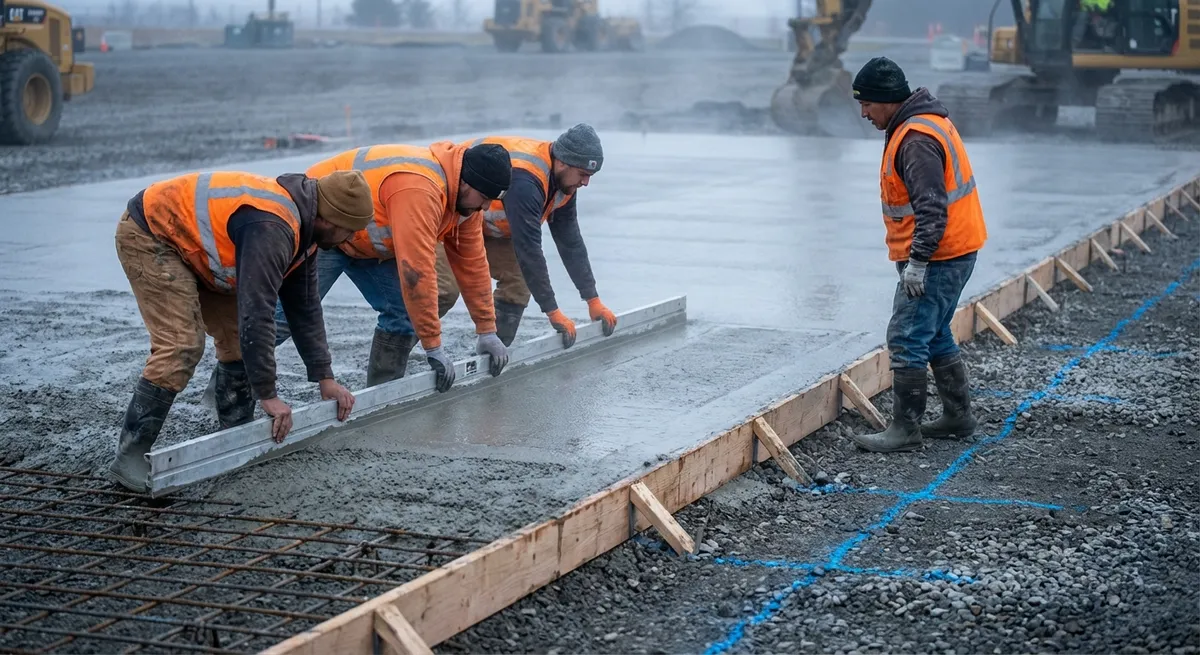
For slabs, deposit concrete in evenly distributed strips or bays rather than dumping one large pile and dragging it across. Use a come-along (concrete rake), not a regular garden rake, to pull concrete into place without trapping aggregate or tearing the forms. Strike off (screed) as you go, working from one reference edge toward an exit point.
Consolidation is crucial, especially for walls, footings, and heavily reinforced elements. On professional jobs, use an internal vibrator, inserting it vertically and withdrawing slowly to release air without over-vibrating, which can cause segregation and form blowout. For smaller DIY pours without a vibrator:
- Rod the concrete with a rebar or stake in tight areas
- Tap the outside of forms with a hammer
- Use a shovel to work around rebar and corners
These steps help eliminate voids and honeycombing, particularly around corners, embedded items, and form ties.
Finish and Cure with Patience, Not Speed
Most concrete problems show up at the surface: dusting, scaling, crazing, and random cracking. Often, these come from rushed finishing or neglected curing.
After screeding, use a bull float to embed aggregate beneath the surface and bring up a mortar paste. Then wait. Allow bleed water to rise and completely evaporate before proceeding. Working the surface while bleed water is present, or sprinkling extra water on top to “help finish,” weakens the surface and increases scaling risk, especially in freeze–thaw climates.
Once bleed water is gone, progress through finishing steps appropriate to the application:
- For broom finishes on slabs and sidewalks, lightly steel-trowel or mag-float first, then draw a broom perpendicular to traffic for traction.
- For interior slabs, more extensive troweling may be appropriate, but avoid over-troweling with air-entrained concrete, which can trap air and cause blisters.
Curing is where many otherwise good jobs fail. Concrete needs controlled moisture and temperature to develop strength and durability. As soon as finishing is complete and the surface can handle it, start curing by:
- Covering with wet burlap, curing blankets, or plastic sheeting
- Applying a curing compound (per manufacturer’s instructions)
- Maintaining moisture for at least 7 days for typical mixes, longer for high-performance or cold-weather pours
For DIY work, even simple measures—like keeping the slab damp with gentle misting and covering with plastic—can dramatically improve performance. In hot or windy weather, set up shade or windbreaks and start curing sooner to counter rapid evaporation. In cold weather, protect fresh concrete from freezing with insulated blankets and avoid deicing salts in the first winter on exterior flatwork.
Conclusion
Concrete doesn’t forgive rushed decisions or casual shortcuts, but it does reward a disciplined, practical approach. Control your water, respect the base and forms, place reinforcement where it can actually work, move and consolidate concrete with intent, and commit to proper finishing and curing. These five habits don’t require exotic tools or complex engineering—they require planning, consistency, and a willingness to slow down at the right moments. Applied together, they help both professionals and serious DIY builders achieve concrete work that performs predictably, looks better, and lasts longer with fewer callbacks and repairs.
Sources
- Portland Cement Association – Concrete Basics - Overview of concrete materials, placement, and finishing fundamentals
- American Concrete Institute (ACI) – Concrete in Practice Series - Practical guidance sheets on mix design, finishing, curing, and more
- U.S. Federal Highway Administration – Concrete Pavement Technology - Technical resources on concrete performance, durability, and best practices
- National Ready Mixed Concrete Association – Concrete Curing - Detailed explanation of curing methods and their impact on strength and durability
- Portland Cement Association – Slabs on Grade - Guidance on base preparation, reinforcement, and jointing for flatwork