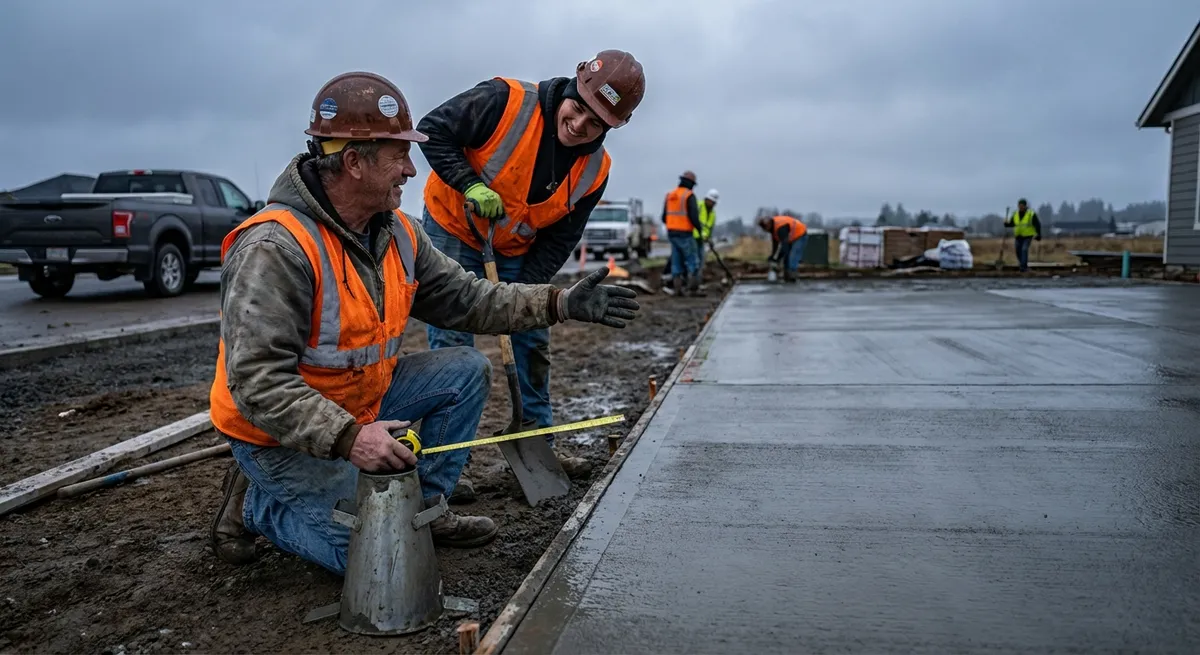
This guide focuses on five practical, expert-level tips you can apply on real jobsites and at home. Each tip is aimed at helping you get predictable, durable results without relying on guesswork.
1. Start With the Right Mix for the Job, Not the Bag on Sale
Concrete is not one-size-fits-all. Selecting the right mix design is the first real decision that affects strength, finish, and durability.
For structural work (footings, pads that carry posts, or garage slabs), target at least a 3,000–4,000 psi mix with a low water-to-cement (w/c) ratio. For exterior flatwork in freeze–thaw climates, look for air-entrained mixes designed for deicing salt exposure. Bagged mixes often publish compressive strength and recommended uses—read those labels instead of assuming all 80-lb sacks are equivalent.
When ordering ready-mix, discuss more than just psi with the batch plant. Clarify:
- Required slump (workability) based on how you’ll place and consolidate
- Any admixtures needed (air-entrainment, water reducer, accelerator/retarder)
- Maximum aggregate size if you’re pouring over tight reinforcement or into thin forms
Avoid the common “just add more water” approach. Every extra gallon of water per cubic yard lowers strength and increases shrinkage. If you need more workability, ask for a plasticizer or superplasticizer rather than extra water, especially for slabs or structural members. For DIY bagged mixes, measure water in a bucket—don’t rely on the hose. Consistent water content across batches is essential for uniform strength and appearance.
2. Treat Subgrade and Base Prep Like Part of the Structure
Even a perfectly mixed and placed slab will fail if the ground beneath it moves. Professional crews treat subgrade prep as structural work, not just dirt shaping.
Begin by removing all organic material—topsoil, roots, and soft spots must go. Concrete should never rest directly on uncompacted fill or loose soil. Shape the subgrade to uniform depth, then compact in lifts using a plate compactor or jumping jack. For driveways, patios, and walkways subject to load or freeze–thaw, place a compacted granular base (such as crushed stone) to improve drainage and spread loads.
Pay attention to moisture content during compaction. Extremely dry or saturated soils will not compact properly. Aim for soil that clumps lightly in your hand without oozing water—this indicates a workable moisture range. In expansive clay soils, consider using a thicker granular base and, where appropriate, a geotextile separator to reduce pumping and differential movement.
For interior slabs on grade, verify vapor conditions. Where moisture-sensitive finishes (wood, some resilient flooring) are planned, use vapor retarders in accordance with local codes and manufacturer guidelines. A stable, well-drained, uniformly compacted base is the cheapest insurance you can buy against settlement cracks and slab rocking.
3. Control Joints and Reinforcement Are Not Optional Details
Random cracking is concrete’s natural behavior; your job is to decide where those cracks go and how they behave. Properly placed joints and reinforcement don’t eliminate cracks, but they control their location and width.
For control (contraction) joints in slabs, a common rule of thumb is joint spacing equal to 24–36 times the slab thickness, in inches. For a 4-inch slab, that’s typically 8–12 feet maximum in each direction. Joint layout should produce as many square or near-square panels as possible; long, narrow rectangles are more prone to random cracking. Cut or tool joints to at least one-quarter of the slab depth for them to be effective.
Time your saw cuts correctly on fresh slabs. Cut too early and you risk raveling; too late and random cracks may form before you saw. On most mixes, this window falls within 4–12 hours after placement, but environmental conditions and mix design can shift that. Monitor the surface hardness and follow the saw manufacturer’s guidance.
Reinforcement (rebar or welded wire reinforcement) helps hold cracks tight. For slabs on grade, reinforcement should be located in the upper third to middle of the slab depth, not lying on the subgrade. Use chairs, dobies, or supports—not broken bricks or improvised scrap—to keep steel in position. For structural elements (beams, footings, walls), follow engineered bar sizes, spacing, and cover requirements strictly; small deviations can change performance under load or during a fire.
The key mindset: assume cracks will appear but plan for where they go and how wide they can open. Well-designed joints plus correctly placed reinforcement turn inevitable cracking into a controlled, mostly aesthetic issue rather than a structural or serviceability problem.
4. Place, Consolidate, and Finish With Timing—Not Just Tools
Most visible surface problems—dusting, scaling, blistering, and trowel burns—come from poor timing and technique during placement and finishing.
During placement, avoid excessive drophighs that can segregate the mix (coarse aggregate separating from paste). Place concrete as close as practical to its final location and use shovels or rakes to move it, not to drag stones to the surface. For slabs, strike off with a straight screed board or powered screed and then bull float immediately to embed aggregates and close large voids.
Consolidation is critical whenever forms or reinforcement create congestion. For formed walls, beams, or columns, use an internal vibrator properly: insert vertically, avoid touching rebar directly, and withdraw slowly. Over-vibration can cause segregation; under-vibration leaves honeycombing and voids. Work in systematic lifts so you overlap zones slightly without reworking the same area excessively.
Finishing should respond to the state of the concrete, not the clock. Avoid steel troweling while bleed water is present—trap that water and you risk a weak, flaky surface. Instead, allow bleed water to evaporate naturally, or, in hot and windy conditions, use evaporation retarders as recommended by the manufacturer. Start with a bull float or darby, then edge and groove as needed, followed by hand or power troweling only when the surface can support a finisher’s weight with minimal indentation.
For exterior slabs in freeze–thaw exposure, avoid very hard, polished finishes; a light broom or textured finish provides traction and reduces the risk of surface scaling. Also avoid adding dry cement to the surface to “tighten it up”—this creates a weak top layer with poor durability and inconsistent color.
5. Cure Like It Matters—Because It Does
Curing is where many otherwise good pours are quietly ruined. Proper curing allows the cement paste to hydrate fully, increasing strength, reducing permeability, and lowering the risk of shrinkage cracking and surface defects.
The goal of curing is simple: keep the concrete moist and at a moderate temperature for as long as practical during the early days after placement. For most conventional mixes, a minimum of 7 days of proper curing can make a dramatic difference in long-term performance; higher-performance or low w/c ratio mixes may benefit from longer curing durations.
Practical curing methods include:
- Continuous wet curing: Cover slabs with wet burlap, curing blankets, or soaker hoses, ensuring the surface never dries out.
- Curing compounds: Apply membrane-forming curing compounds as soon as finishing operations are completed and surface sheen has disappeared, following manufacturer coverage rates.
- Plastic sheeting: For small slabs or where water is limited, use polyethylene sheeting secured against wind, with edges sealed or weighted to reduce moisture loss.
In hot, dry, or windy conditions, evaporation can outpace bleed water quickly. Plan ahead with windbreaks, sunshades, or early-morning pours to reduce thermal and evaporation stress. In cold weather, protect fresh concrete from freezing with insulated blankets and, when appropriate, adjusted mix designs (accelerators, warm mixing water, or heated aggregates) tailored to ambient conditions.
Resist the temptation to load or traffic slabs too early. Even if the surface appears hard, internal strength may be insufficient. Consult mix design data and typical strength gain curves, and when timing is tight—such as for industrial or commercial projects—consider field-cured cylinders or on-site strength testing to confirm readiness for loads, saw cutting, or form removal.
Conclusion
Concrete rewards planning and punishes shortcuts. The consistent pattern behind durable, trouble-free work is not expensive products or secret tricks, but disciplined control over fundamentals: mix selection, base preparation, reinforcement and joints, placement and finishing timing, and curing.
By treating each of these steps as non-negotiable parts of the structure—not optional extras—you significantly reduce the risk of callbacks, premature repairs, and unpredictable performance. Whether you’re placing a small backyard pad or managing a multi-phase commercial pour, these five practices help ensure that the concrete you place today will still be working for you years from now.
Sources
- Portland Cement Association – Concrete Basics - Overview of concrete materials, placing, finishing, and curing fundamentals
- American Concrete Institute (ACI) – Concrete Slabs on Ground (ACI 360R-10) - Industry guidance on subgrade prep, joints, and reinforcement for slabs on grade
- National Ready Mixed Concrete Association – CIP Technical Guides - Practical bulletins on mix design, placing, finishing, curing, and common field problems
- U.S. Federal Highway Administration – Concrete Pavement Basics - Technical resources on base preparation, joints, and durability for exterior concrete pavements
- Cement Concrete & Aggregates Australia – Guide to Concrete Construction - Detailed construction-focused guidance on mix selection, reinforcement, and curing practices