This guide focuses on five practical, field-tested tactics that help concrete stay where you put it, perform as designed, and age predictably—without relying on perfect conditions or specialized equipment.
Understand the Site Before You Touch the Mix
Concrete problems often start long before the truck arrives. The subsurface and surroundings dictate how your slab will behave over time, so treating “site readiness” as a checkbox item is a fast way to invite movement, cracking, and drainage issues.
Begin by verifying the soil type and bearing conditions. Clay-rich soils expand and contract with moisture; sandy soils drain quickly but may lack cohesion. If you can easily roll damp soil into a tight ball that holds its shape, you’re likely dealing with a plastic, clay-heavy subgrade that will move with water. For problem soils, mechanical compaction and a well-graded granular base (often 4–6 inches of compacted gravel) help distribute loads and improve drainage.
Check for water paths: where does rain, roof runoff, and surface water go now, and what happens when a slab is in the way? Plan slopes away from buildings, typically at least 1/8–1/4 inch per foot for exterior slabs, so water sheds reliably. Confirm you won’t trap water against foundations, steps, or retaining walls.
Finally, stabilize the working platform. A slab placed on soft spots, organic material, or poorly compacted fill will settle unevenly. Walk the area—if your foot leaves more than a light imprint, compaction is suspect. Use a plate compactor in thin lifts (2–4 inches at a time) and recheck after any trenching, backfilling, or utility work. The goal is a uniform, firm base that doesn’t pump or deflect underfoot.
Calibrate Mix and Weather, Not Just Strength
Many field issues come from treating the concrete mix as a one-size-fits-all product. In reality, weather, slab thickness, and placement method all influence whether a particular mix will behave as expected.
Start with what the project requires: structural elements often specify compressive strength (e.g., 3,000–4,000 psi at 28 days), air entrainment for freeze-thaw exposure, and maximum water-cement ratios. For flatwork like driveways or patios in cold climates, an air-entrained mix (typically 4–7% entrained air) is crucial to resist scaling and surface spalling when exposed to freeze-thaw cycles and deicing salts.
On site, control water addition. Each extra gallon of water per cubic yard can significantly reduce strength and increase shrinkage. Rather than “loosening” a stiff load with water, work with your supplier on using the right slump, plasticizers, or superplasticizers when needed. For hand-placed slabs, a moderate slump (often in the 4–5 inch range, depending on the mix design and specs) gives a workable yet stable mix that won’t segregate.
Match set time to conditions. In hot, dry, or windy weather, concrete can lose surface moisture rapidly, leading to plastic shrinkage cracking and finishing headaches. Use set-retarding admixtures when conditions are hot, and consider windbreaks, sunshades, or misting to keep evaporation under control. In cold weather, avoid placing on frozen ground or when freezing is expected before the concrete gains strength; consider insulated blankets and cold-weather admixtures where allowed by code and spec.
Finally, communicate placement rate and access with the ready-mix supplier. If your pour sequence requires slower placement, ask for staged deliveries rather than one large load that will sit while you scramble to spread and strike it off.
Formwork That Holds Shape When Concrete Pushes Back
Concrete exerts surprising lateral pressure on forms, and once it blows out or bulges, you rarely get a second chance. Well-built formwork doesn’t need to be fancy; it needs to be straight, braced, and predictable.
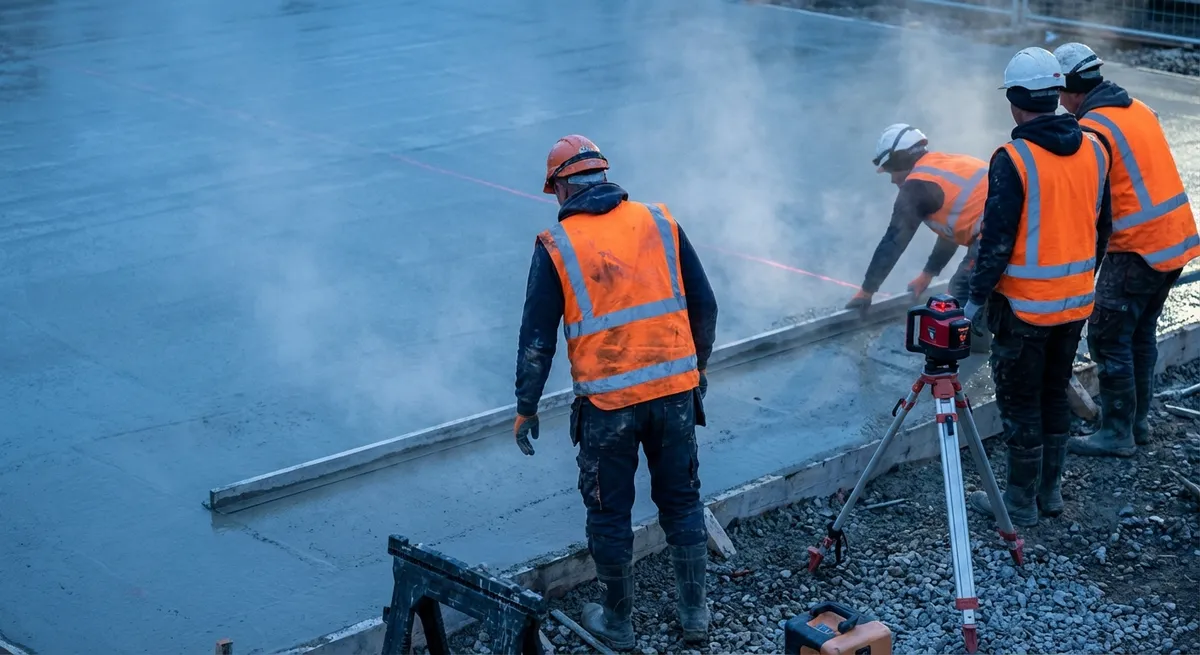
Begin with a clear line and elevation plan. Use string lines, laser levels, or builder’s levels to set accurate form heights that account for slab thickness, desired slopes, and existing fixed points (door thresholds, existing slabs, or drainage channels). Mark grade stakes at final slab elevation and double-check slope by measuring drop over a known distance.
Use straight, sound lumber or commercial forming systems. Bowed or twisted boards telegraph directly into the concrete edge. Stakes should be long enough to resist uplift and lateral movement; space them more closely where soil is soft or pour depth is greater. Fasten forms with screws rather than nails when possible—screws are less likely to work loose and simplify adjustments.
Brace corners and transitions. Corners are high-stress points where wet concrete pressure and vibration will try to push things out of square. Diagonal bracing from corners back into firm ground dramatically reduces movement. Around driveways and larger slabs, consider internal stakes on the “inside” of curves and corners where outward pressure is greatest.
Pay special attention to joints that intersect forms. Where planned control joints meet form edges, mark these clearly and ensure that joint layout aligns with changes in geometry, re-entrant corners, and openings. This alignment helps cracks follow planned paths rather than random lines.
Before placing concrete, walk the forms: push, kick, and lean on them with realistic force. If anything moves or flexes more than a fraction of an inch, reinforce it now; it will not get stiffer when full of wet concrete.
Place, Consolidate, and Finish in the Right Sequence
Many surface and structural defects come not from the mix itself but from how it’s placed and handled in the first hour. Treat placement and finishing as a controlled sequence instead of a scramble to “make it look smooth.”
Place concrete close to its final location to minimize dragging and raking, which can segregate aggregate and disturb reinforcement or vapor barriers. Work in strips or sections that match your crew size and finishing capacity. For slabs on grade, use shovels and come-along rakes rather than narrow garden rakes or improvised tools that can pull paste to the surface.
Consolidate the concrete enough to remove large air pockets without overworking it. For thinner slabs and hand-placed work, this often means rodding or tapping forms and lightly spading along edges. For thicker placements or heavily reinforced areas, an internal vibrator used correctly (short insertions, vertical, overlapping patterns) helps ensure full contact around reinforcement without segregating the mix. Avoid prolonged vibration in one spot, which can cause heavy aggregate to sink and create weak paste layers on top.
Strike off the surface with a straight screed board or aluminum screed, riding the form edges and working in a sawing motion. Aim for consistent pressure and multiple passes rather than trying to “get it perfect” on the first pull. Fill low spots immediately while the concrete is still plastic and repeat until the surface is roughly true.
Bull float immediately after screeding, before bleed water accumulates. Push the bull float across the slab with the leading edge slightly raised to avoid digging in, then pull back with the opposite edge raised. This step embeds larger aggregate, brings a workable paste layer to the top, and levels minor ridges.
Then wait. Allow bleed water to rise and evaporate naturally. Do not start steel troweling or heavy finishing operations while bleed water is present; sealing bleed water into the surface can weaken the top layer, trap excess moisture, and contribute to scaling, dusting, and delamination later.
Lock in Performance With Intentional Curing
The hours and days after finishing matter as much as what happened during the pour. Proper curing controls moisture loss and temperature, which in turn drives strength gain, shrinkage, and durability. Skipping or rushing curing is one of the most common reasons otherwise decent slabs underperform.
Plan your curing method before you pour. For many slabs, especially exterior flatwork, curing compounds (liquid membrane-forming products sprayed on the surface) are practical and effective. Choose a product compatible with any planned sealers, coatings, or adhesives; some curing compounds must be removed before overlay or flooring installation.
For high-performance or critical slabs, moist curing (covering with wet burlap, curing blankets, or saturated geotextile under plastic sheeting) often provides superior results. The goal is to keep the surface continuously damp without allowing water to pool or wash away surface paste. Overlaps in plastic should be sealed or taped to reduce evaporation.
Observe minimum curing durations. While detailed durations depend on mix design and environmental conditions, a common benchmark is at least 7 days of effective curing for typical structural concrete and exterior flatwork, and longer in cold weather or for high-strength mixes. Avoid heavy loads, equipment, or concentrated point loads on young concrete—while it may seem hard after a day or two, internal strength is still developing.
Manage joints as part of curing. Sawcut control joints should be installed as soon as the concrete can support the saw without raveling but before uncontrolled cracking begins—often within 6–24 hours depending on temperature, mix, and slab thickness. Aim for joint spacing approximately 2–3 times the slab thickness in feet (e.g., a 4-inch slab often wants joints 8–12 feet apart) unless design documents specify otherwise.
Finally, protect young concrete from sudden temperature swings, traffic, and deicing salts. In cold climates, keeping new slabs free of deicers for the first winter, where feasible, can significantly improve long-term surface durability.
Conclusion
Reliable concrete work is less about heroics on pour day and more about disciplined control over site conditions, mix behavior, form stability, placement sequence, and curing. When you:
- Build on a firm, well-drained base
- Match the mix and admixtures to the weather and use
- Brace forms to handle real-world pressure
- Place and finish in a deliberate, staged process
- Treat curing as part of construction, not an afterthought
you dramatically reduce surprises and callbacks. The result is concrete that not only looks right when the truck pulls away, but also stays put, performs reliably, and holds its value over time—whether you’re building for a client or for your own property.
Sources
- Portland Cement Association – Concrete Basics – Overview of concrete materials, placement, finishing, and curing fundamentals
- American Concrete Institute – Guide for Concrete Slabs (ACI 302.1R) – Industry guidance on slab-on-ground design, construction, and finishing practices
- U.S. Department of Transportation – Concrete Pavement Basics – Federal Highway Administration resources on concrete behavior, joints, and durability
- NRMCA – Cold Weather and Hot Weather Concreting – Practical technical tips on managing temperature-related placement and curing issues
- NRMCA – Curing Concrete – Detailed explanation of why curing matters and recommended curing methods