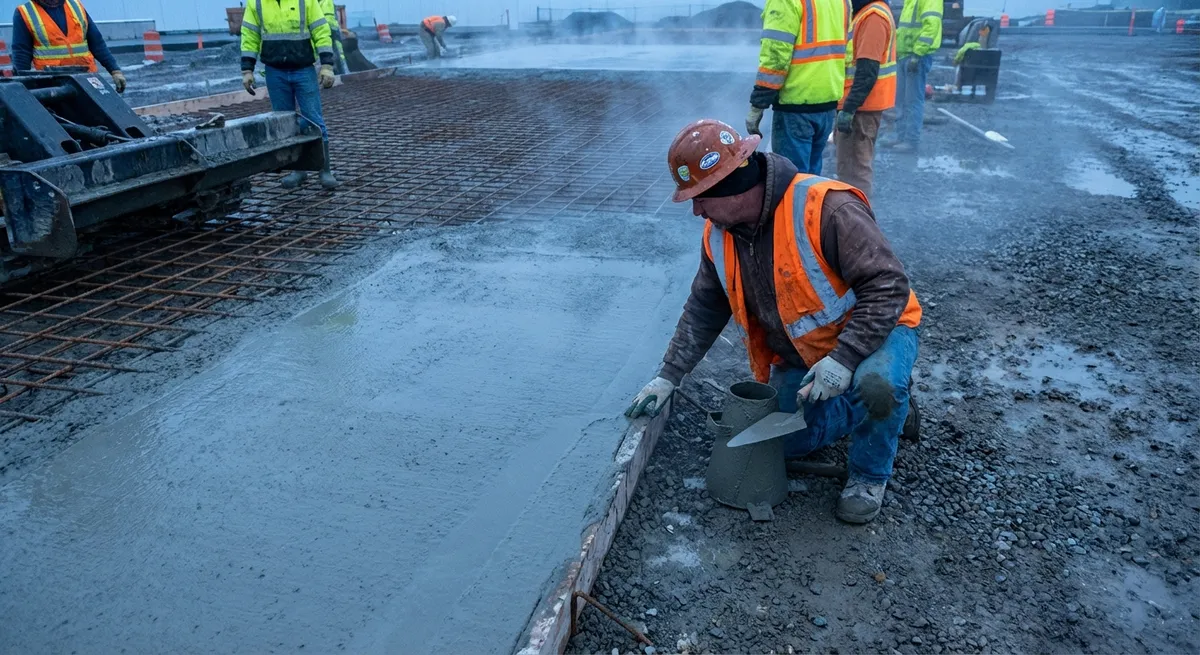
This guide focuses on practical, field-tested habits that help both professionals and serious DIYers get more predictable, durable results from their concrete projects.
Build on the Right Base: Subgrade and Formwork Done Properly
Concrete is only as good as what it sits on. Too often, slabs crack, settle, or heave not because of the mix, but because the base wasn’t prepared correctly.
Start by stripping all organic material—topsoil, roots, and loose fill must go. Concrete needs to bear on stable, compacted soil or engineered fill. If the native soil is soft, saturated, or expansive, consider bringing in a well-graded gravel or crushed stone base. Compact in thin lifts (2–4 inches at a time) using a plate compactor or jumping jack until you achieve a firm, non-pumping surface underfoot.
Formwork is just as critical. Use straight, undamaged lumber or steel forms, and anchor them with stakes driven on the outside so you can finish unobstructed. Check elevations with a builder’s level, laser, or a long straightedge and line level; a few extra minutes adjusting forms beats trying to “fix” elevation errors with a trowel later. Make sure forms are braced well enough to resist the lateral pressure of wet concrete—bulged forms mean thin, weak edges.
Finally, think drainage before you pour. Exterior slabs typically need at least 1/8–1/4 inch per foot of slope away from structures. Confirm that slope at the forms, not after the concrete is in place.
Expert Tip 1: Treat the subgrade like a structural element. A well-compacted, well-drained base with correctly set forms does more for slab performance than any “miracle” additive you can buy.
Control Water and Mix Consistency Instead of “Fixing It in the Pour”
Water is the most mismanaged ingredient in concrete work. Extra water makes placement easier, but it weakens the hardened concrete, increases shrinkage, and encourages cracking and surface dusting.
Order or batch concrete based on a specified slump appropriate to the work—typically lower for slabs and footings, slightly higher for congested reinforcement or complex forms. When using ready-mix, communicate clearly with the supplier about intended use, placement methods, and weather conditions. On site, resist the urge to “loosen it up” with added water. If you need better workability, use an appropriate water-reducing or plasticizing admixture rather than dumping in a bucket of water.
For bagged mixes, measure water instead of eyeballing it. Use the manufacturer’s recommended water range and mix long enough (usually at least 3–5 minutes in a mixer) to fully hydrate cement particles. The mix should be cohesive and workable without segregation—no ponds of water or piles of coarse aggregate separating out.
Consistency between batches is crucial. Whether on a small DIY slab or a larger professional job, changing water content mid-project invites cold joints, color variation, and differential shrinkage cracking.
Expert Tip 2: Decide your slump and stick to it. Control workability with admixtures and proper vibration or consolidation, not with last-minute water additions.
Place and Consolidate Like You’re Protecting the Aggregate Skeleton
Proper placement isn’t just about getting concrete from the truck to the forms; it’s about preserving the internal structure of the mix and eliminating hidden voids.
When placing, drop concrete as close to its final position as possible. Avoid long, steep chutes or dropping concrete from significant heights, which can cause segregation (coarse aggregate separating from paste). Place in layers of consistent thickness, working systematically across the form so you’re not dragging the mix around with rakes.
Consolidation—whether by hand rodding, tamping, or mechanical vibration—removes entrapped air and ensures full contact around reinforcement, embedded items, and corners. When using internal vibrators, insert vertically, allow the head to sink under its own weight, and withdraw slowly. Over-vibrating can bring excess paste to the surface and cause segregation; under-vibrating leaves honeycombing and weak spots. Each insertion should overlap the previous zone by several inches.
Around anchors, rebar, and tight corners, be deliberate. Work the concrete carefully into place with a shovel or trowel and give those areas extra attention during consolidation. Poor fill here often becomes visible as spalls or exposed reinforcement later.
Expert Tip 3: Think “short moves, thorough consolidation.” Move the concrete the shortest distance possible and consolidate methodically to avoid hidden voids and surface defects.
Finish with Timing, Not Force: Avoiding Weak Surfaces and Scaling
Many finishing problems come from working the surface too soon, too aggressively, or in the wrong conditions. Good finishing respects the concrete’s setting behavior instead of trying to force it into shape.
After screeding to elevation, use a bull float to embed larger aggregate and fill low spots. Then leave the slab alone until the bleed water has fully evaporated. Working bleed water back into the surface dilutes the cement paste, increases porosity, and leads to weak, powdery surfaces and scaling, especially in freeze–thaw climates.
Test readiness for further finishing with a light finger press: the surface should support slight pressure without leaving more than a faint impression. At that point, you can proceed with edging and jointing, followed by first and second trowel passes as required by the specification (broom finish, steel trowel, etc.).
Pay close attention to weather. Hot, windy, or low-humidity conditions can cause rapid surface drying and shrinkage cracking, sometimes before finishing is complete. In these cases, consider windbreaks, sunshades, or evaporation reducers, and organize your crew so finishing can proceed without delays. In cool or damp conditions, expect slower set times and adjust your schedule to avoid premature finishing attempts.
Expert Tip 4: Finish in stages based on concrete behavior, not by the clock. Wait out bleed water, test set with light pressure, and adapt finishing methods to the weather and specified surface profile.
Protect and Joint Strategically for Long-Term Performance
Even well-placed, well-finished concrete will crack; the goal is to control where and how it happens, and to protect the slab during its most vulnerable early days.
Contraction joints (control joints) create intentional weak planes where cracks are encouraged to form. For most slabs, joints should be spaced at no more than 2–3 times the slab thickness in feet (e.g., a 4-inch slab spaced roughly 8–12 feet apart), and cut to a depth of at least one-quarter the slab thickness. Saw-cutting should begin as soon as the concrete is strong enough to avoid raveling but before random cracking appears—often within 6–24 hours, depending on conditions and mix.
Curing is equally non-negotiable. Proper curing maintains moisture and temperature for sufficient time to allow full hydration, significantly increasing strength and durability. Methods include curing compounds, wet coverings (like burlap), or continuous water spray/ponding where feasible. In hot or dry conditions, begin curing as soon as the surface can tolerate it without damage; in cold conditions, use insulating blankets and, if needed, supplemental heat to keep concrete above freezing during the early strength gain period.
Think ahead about exposure: de-icing salts, freeze–thaw cycles, heavy traffic, and chemicals all demand robust curing and, in some cases, sealers or surface hardeners. For interior slabs, allow adequate curing and drying time before installing moisture-sensitive floor coverings.
Expert Tip 5: Treat joints and curing as part of the structural design, not an afterthought. Well-planned joint layouts and disciplined curing do more to prevent premature failure than most “repairs” can fix later.
Conclusion
Concrete rewards discipline and punishes shortcuts. Strong bases, controlled water, careful placement, disciplined finishing, and thoughtful protection all compound into slabs and structures that perform as intended. Whether you’re running crews on a commercial site or pouring a residential patio, applying these expert practices will reduce callbacks, extend service life, and give you more predictable results on every pour.
Sources
- Portland Cement Association – Design & Control of Concrete Mixtures – Technical guidance on mix design, placement, finishing, and curing practices
- American Concrete Institute (ACI) – Concrete Basics – Foundational information on concrete behavior, construction techniques, and standards
- U.S. Department of Transportation – Concrete Pavement Preservation Guide – Practical discussion of joints, cracking, and durability in concrete pavements
- National Ready Mixed Concrete Association (NRMCA) – Concrete In Practice Series – Short, practice-oriented bulletins on water content, curing, finishing, and field troubleshooting
- Concrete Network – Concrete Joints and Placing Tips – Trade-focused explanations of joint layout, finishing timing, and jobsite best practices