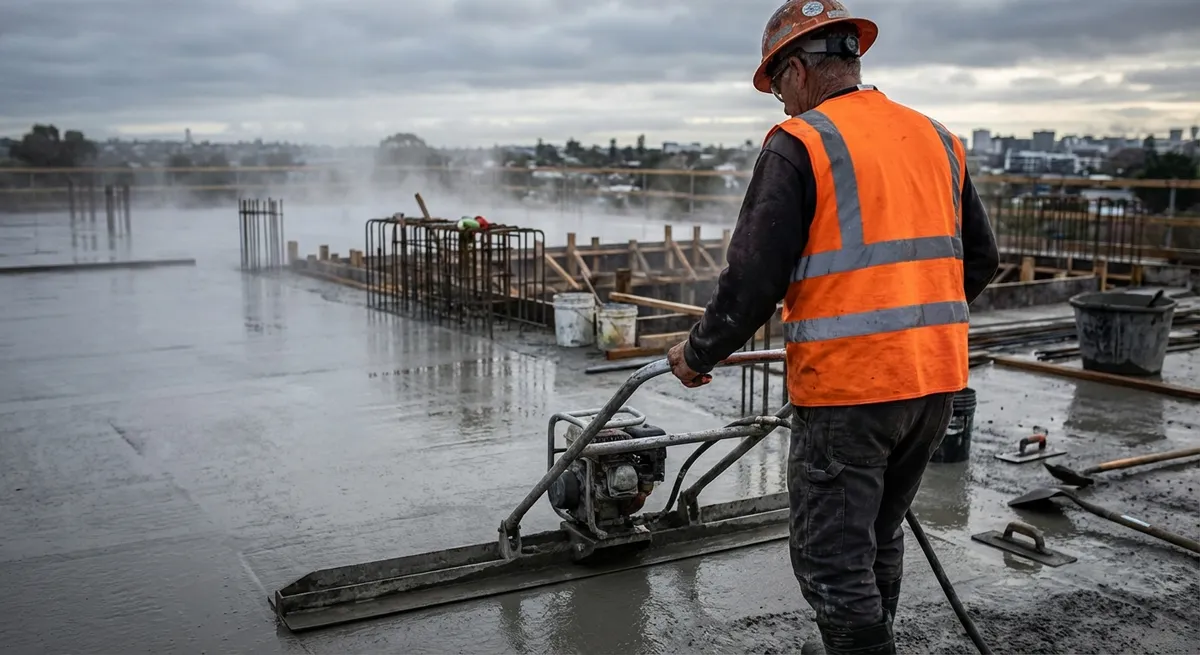
This guide walks through five expert-level practices that reliably improve strength, finish quality, and service life. Each tip includes practical how-to direction you can apply on your next pour.
1. Design the Mix for the Jobsite, Not Just the Plans
A structurally correct mix on paper can still perform poorly if it ignores real jobsite conditions. Professionals treat mix design as a tool they adjust, not a fixed rule they endure.
First, match strength and exposure to the environment. A standard 3,000–3,500 psi mix might work for interior slabs, but exterior flatwork in a freeze-thaw climate with de-icing salts often calls for 4,000 psi and air entrainment. Tell your ready-mix supplier exactly how and where the concrete will be used: slab thickness, reinforcement, expected loads, freeze-thaw exposure, and use of de-icing salts.
Second, control the water-cement ratio instead of chasing workability with a hose. High water content weakens concrete, increases shrinkage, and encourages cracking. If you need a more fluid mix, request a plasticizer or water-reducing admixture rather than adding water on site. Ask the plant for the designed water-cement ratio and confirm acceptable on-site adjustments before the truck rolls.
Third, consider aggregate size and slump relative to your placement method. For congested reinforcement or tight formwork, smaller aggregate (such as 3/8") can flow more easily and reduce voids. For hand-placed flatwork, a moderate slump (often in the 4–5 inch range for many exterior slabs, per project specs) provides workability without excessive bleed water.
On DIY projects using bagged concrete, read the technical data sheet—not just the front of the bag. Many products specify exact water per bag in quarts or liters. Measure it. A simple marked bucket for consistent water addition will improve quality more than almost any other single change a homeowner can make.
2. Prepare the Base So the Concrete Has Something Solid to Work With
Most early slab problems start well before the truck arrives. A well-compacted, stable base does more to prevent settlement cracks and surface failures than any finishing trick.
Begin by removing all organic material, soft soil, and loose fill. Sod, roots, and topsoil will decompose and settle, even under thick slab sections. Excavate to design depth, allowing for your base material and slab thickness. For example, a typical residential exterior slab might use 4" of compacted gravel plus a 4" slab (always follow local code or engineer’s design).
Install a granular base (often crushed stone or gravel) that drains and compacts well. Wet the base lightly if it’s dry, then compact it in lifts—usually 2–4 inches at a time—using a plate compactor or jumping jack, not just body weight or a hand tamper on larger areas. Check density by walking across it: if your foot leaves noticeable impressions, it’s not compacted adequately.
Check and set slopes before forming. Exterior slabs typically slope away from buildings at about 1/8" to 1/4" per foot for drainage (confirm local code and design). Pull string lines or use a laser level to set grade consistently. It’s much easier to adjust gravel than wet concrete.
For slabs on grade in colder climates, consider insulation and frost protection details from your designer or local building code. Inadequate base depth or missing frost protection can lead to heaving and cracking, even when the concrete itself is done correctly.
3. Control the Clock: Timing Your Place, Finish, and Cure
Knowing what to do with concrete is only half the battle; knowing when to do it is equally important. Professionals control the timeline instead of letting heat, sun, and schedules dictate every move.
Before the pour, stage tools and materials where they’re needed: screeds, bull floats, hand trowels, chairs for reinforcement, curing compound, water sprayer or hose, and jointing tools. Walk the placement sequence with your crew or helpers. Decide entry points, direction of screeding, and where trucks or wheelbarrows will travel.
During placement, strike a balance between speed and consolidation. Place the concrete close to its final location to avoid excessive rehandling. Use internal vibrators according to manufacturer guidance for deeper sections, and avoid over-vibrating thin slabs which can segregate aggregate. For DIY flatwork, tap forms and use a shovel or rake to work the mix into corners and around rebar or wire mesh.
Timing the finishing steps is crucial:
- Initial strike-off (screeding) should happen immediately after placement in each section, bringing the slab to approximate grade.
- Bull floating follows to embed large aggregate and level the surface. Stop before bleed water appears.
- Waiting period: Let bleed water rise and evaporate. Do not trowel or broom while water is still on the surface; this traps water, weakens the top layer, and leads to scaling or dusting.
- Final finishing (troweling or brooming) begins once the surface has set enough to support weight with only slight indentation.
In hot, dry, or windy conditions, reduce evaporation. Lightly dampen the subgrade before placement (without leaving standing water), use windbreaks or sunshades when possible, and consider using an evaporation retarder spray on the surface before final finishing. Coordinate with the ready-mix supplier to avoid long delays between trucks; stagger arrival times to maintain a workable schedule.
4. Reinforcement and Joints: Guide Where the Cracks Happen
Concrete will crack; your job is to decide where and how. Effective reinforcement and properly placed joints turn random, ugly cracks into controlled, functional ones.
Reinforcement (rebar or welded wire fabric) and fibers are not interchangeable. Rebar and mesh primarily control crack width and support loads, especially in structural or heavily loaded slabs. Fibers help reduce plastic shrinkage cracking and improve impact resistance but are not a stand-alone replacement for structural reinforcement where it’s required.
Keep steel in the correct position. Rebar chairs or supports are mandatory on anything more than a simple homeowner pad. Laying mesh directly on the subgrade and “pulling it up” during the pour almost always results in steel staying too low. For typical slabs on grade, reinforcement belongs in the upper third to middle of the slab depth, according to design.
Plan contraction (control) joints before forming. Typical joint spacing guidelines for unreinforced slabs often fall around 24–36 times the slab thickness in inches (for example, a 4" slab might have joints spaced about 8–12 feet), but follow your engineer’s details and local standards. Joints can be formed with pre-molded strips or saw-cut after placement.
If you’re saw-cutting joints, timing is critical. Cut too early and the surface ravels; too late and the slab will develop random cracks before you guide them. Many contractors aim to cut within 4–12 hours after finishing, depending on mix, weather, and equipment. Target a depth of at least one-quarter of the slab thickness unless your engineer specifies otherwise.
Include isolation joints where the slab meets fixed elements such as foundations, columns, or existing concrete. Compressible material (like foam or fiber board) prevents the slab from being locked in and reduces stress from differential movement. Properly detailed joints are one of the most cost-effective ways to improve long-term performance.
5. Cure Like It Matters—Because It Does
Curing is where many otherwise good concrete jobs quietly fail. The first seven days after placement largely determine the long-term strength and durability of the slab. Proper curing controls moisture loss and temperature so hydration can continue.
Immediately after final finishing, protect the surface from rapid drying. Common methods include:
- Water curing: Light ponding, soaker hoses, or continuous gentle misting that keeps the surface uniformly damp without erosion.
- Wet coverings: Burlap, curing blankets, or other absorbent materials kept wet and in full contact with the surface.
- Curing compounds: Spray-applied liquid membranes designed to meet applicable standards (such as ASTM C309 for many conventional curing compounds).
Choose a curing strategy based on climate, use, and project specs. In hot or windy conditions, a combination of wet coverings and curing compound may be appropriate. For decorative surfaces, check compatibility so curing products don’t interfere with sealers, coatings, or stains.
Maintain curing for at least the minimum duration recommended by code or project documents—commonly 7 days for many standard mixes, longer for high-performance concrete or adverse conditions. Avoid heavy loads, impact, or concentrated point loads on young concrete. Early-age abuse leaves permanent damage that no sealer or overlay will truly fix.
Temperature control is another critical piece. In cold weather, use insulated blankets or other protection to prevent freezing of the concrete during its early strength gain period. If the concrete freezes before reaching adequate strength, its long-term durability is permanently compromised. In hot weather, cool the subgrade, shade the work area if possible, and use cooler mix water or schedule early morning pours.
For both professionals and serious DIY builders, the habit that separates reliable results from “good enough” is treating curing as part of the job, not an optional extra. Plan it, budget for it, and assign responsibility for it—just like any other task in the pour sequence.
Conclusion
Concrete failures rarely come from a single catastrophic mistake; they usually grow from small, avoidable shortcuts. Designing the mix to match the jobsite, preparing a stable base, controlling the timing of placement and finishing, guiding where cracks form, and curing with intention will dramatically raise the standard of your work.
Whether you’re managing crews or placing a slab behind your own house, these practices turn concrete from a gamble into a predictable system. Treat each step as non-negotiable, and you’ll see fewer callbacks, cleaner surfaces, and slabs that keep doing their job long after the forms are stripped and the tools are put away.
Sources
- [American Concrete Institute (ACI) – Concrete Slab Finishing Problems](https://www.concrete.org/tools/frequentlyaskedquestions.aspx?faqid=641) - Practical guidance from ACI on common slab issues and how to avoid them
- [Portland Cement Association – Concrete Basics](https://www.cement.org/learn/concrete-technology/concrete-construction/concrete-basics) - Overview of concrete materials, mix design, placing, finishing, and curing
- [National Ready Mixed Concrete Association – CIP 11: Curing In-Place Concrete](https://www.nrmca.org/wp-content/uploads/2020/11/CIP11.pdf) - Technical details and field recommendations for effective curing practices
- [U.S. Federal Highway Administration – Concrete Pavement Field Reference](https://www.fhwa.dot.gov/pavement/concrete/pccpfieldref.cfm) - Field-oriented best practices for concrete pavements, joints, and curing
- [Concrete Construction (ForConstructionPros) – Jointing Concrete for Cracks Control](https://www.forconstructionpros.com/concrete/article/10094739/jointing-concrete) - Discussion of joint spacing, timing, and techniques to manage cracking