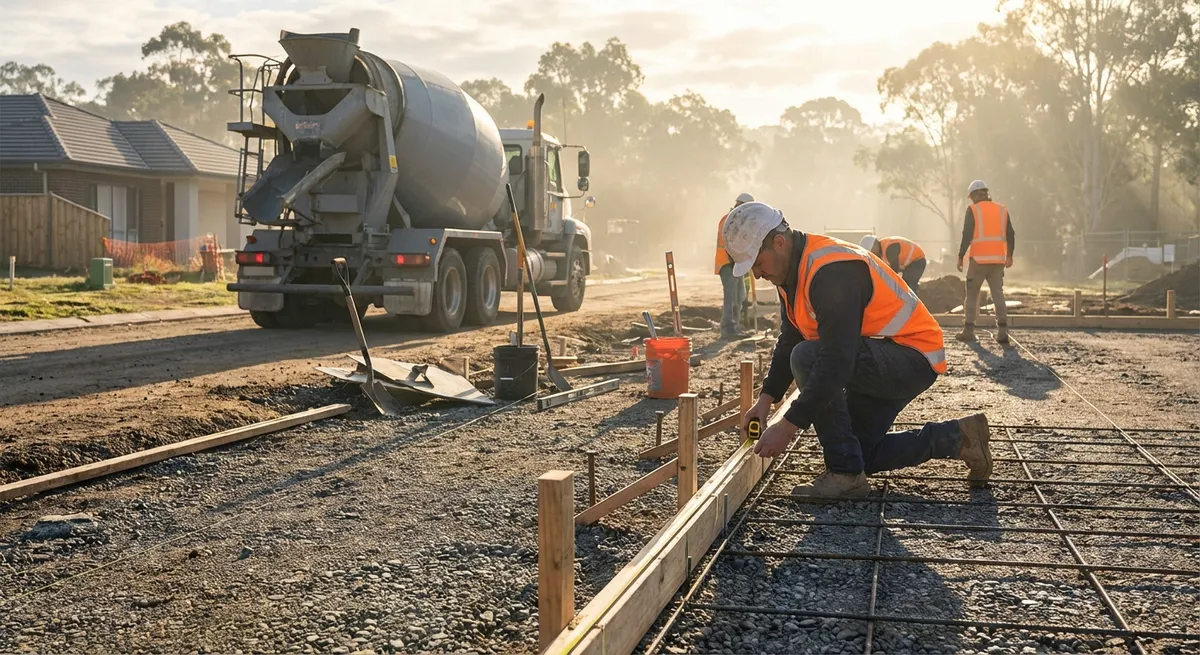
This guide focuses on the often-overlooked phase before the pour—where most problems are either prevented or quietly built in. These five expert tips will help you tighten up your process, reduce callbacks, and get more consistent results on every job.
Know Your Load, Use the Right Mix
Concrete is not one-size-fits-all. Selecting the right mix is the foundation for long-term performance.
For structural or high-load applications—garage slabs, driveways for trucks, patios with heavy outdoor kitchens—start by clarifying:
- Expected live loads (vehicles, equipment, people)
- Exposure (freeze-thaw cycles, deicing salts, standing water, chemicals)
- Local code requirements and minimum compressive strength
Then match the mix to the job:
- General slabs and sidewalks: Typically 3,000–3,500 psi is the baseline, but colder climates and exterior slabs often benefit from 4,000 psi with air entrainment for freeze-thaw resistance.
- Driveways and garage slabs: Commonly 4,000 psi or higher, especially where vehicles are heavier or soils are questionable.
- Wet or chemically exposed areas: Consider lower water–cement ratio and possibly supplementary cementitious materials (SCMs) like fly ash or slag for improved durability.
For bagged mixes, read the label for:
- Compressive strength rating (psi)
- Recommended thickness range
- Admixture compatibility (if you’re adding plasticizers, accelerators, etc.)
On ready-mix orders:
- Communicate clearly with the producer: intended use, slab thickness, placement conditions, any finishing requirements.
- Avoid “watering down” the truck on site. If workability is an issue, ask for a mix with a water-reducing admixture rather than adding uncontrolled water.
The key is to design the slab around the load and exposure, not just what’s convenient to order or stock.
Build a Base That Drains and Doesn’t Move
A strong slab on a weak base is a short-term win and a long-term problem. Settlement cracks, heaving, and uneven surfaces usually trace back to what’s below the concrete.
Focus on three fundamentals:
Subgrade stability
- Strip organic material (topsoil, roots, sod) down to stable soil. - In soft or loose areas, compact in lifts (typically 4–6 inches at a time) with a plate compactor or jumping jack. - If the soil is highly expansive or prone to saturation, consider replacing the top layer with road base or well-graded aggregate.
Granular base material
- Use crushed stone or gravel (often 3/4" minus or similar road base) rather than round pea gravel, which doesn’t interlock as well. - Typical base depths range from 4 inches for light-use walkways to 6–12 inches for driveways or poorly drained soils. - Compact thoroughly; uncompacted base is a primary cause of differential settlement.
Drainage planning
- Establish a consistent slope away from structures—commonly 1/8" to 1/4" per foot for exterior slabs. - Avoid trapping water behind forms or against foundation walls; add French drains or swales where necessary. - For interior slabs on grade, make sure there’s a strategy for vapor and water management (vapor barrier, capillary break, or both, depending on use and climate).
Professionals treat base preparation like structural work, not just “grading.” Every minute spent checking compaction and slope is less time dealing with callbacks and repairs.
Formwork That Holds Shape (and Your Schedule)
Formwork is more than temporary lumber—it’s the mold that defines elevation, edge quality, and drainage. Sloppy formwork guarantees rework, no matter how good the concrete mix is.
A practical approach to better forms:
- Pick the right materials
- Straight 2x lumber or purpose-made form boards for crisp lines.
- Stakes that won’t bend under load—steel form stakes or heavy-duty wood stakes for small jobs.
- Screws instead of nails whenever possible; they’re easier to adjust and remove without damage.
- Lock in elevations early
- Use a laser level or builder’s level to set top-of-form elevations, not just eyeballing from existing grade.
- Mark “top of slab” on stakes so everyone knows the target height.
- Double-check slopes across the entire run, especially for long driveways and patios.
- Brace against pressure
- Add diagonal braces on the outside of forms for taller pours or where the subgrade drops away.
- Tighten board joints to prevent paste leakage; use form tape or foam backer rod on critical architectural edges if necessary.
- For corners and transitions, use extra stakes and blocking to prevent “bulging” under load.
- Think about removal and re-use
- Plan access for stripping forms without prying against fresh edges.
- Oil or form-release the inside faces where appropriate (and allowed by spec) to keep edges clean and protect the lumber.
The quality of your forms is exactly the quality of your finished edges. Clean lines, consistent heights, and correct slopes all come from disciplined formwork, not last-minute tweaks during the pour.
Reinforcement That Works With the Slab, Not Against It
Reinforcement doesn’t stop concrete from cracking—it controls where and how it cracks. Poorly placed reinforcement is almost as bad as none at all.
Key practices that pay off:
- Choose the right reinforcement method
- For typical slabs: welded wire reinforcement (WWR) or deformed rebar for load transfer and crack control.
- For interior and some light-duty slabs: synthetic or steel fibers can be added to the mix for distributed crack control, especially where traditional reinforcement placement is challenging.
- For structural or code-governed elements: follow engineered plans—bar sizes, spacing, and lap lengths are not optional.
- Put reinforcement in the correct zone
- For slabs on grade, reinforcement usually belongs in the upper third to middle of the slab depth, not on the bottom.
- Use chairs, dobies, or supports to keep steel elevated during placement.
- Avoid walking reinforcement flat onto the subgrade as the pour progresses; it defeats the purpose.
- Coordinate with joint layout
- Plan contraction joints (sawn or tooled) to align with rebar patterns where possible.
- Avoid creating unplanned “restraints” where reinforcement crosses expected crack or joint locations without accommodation.
- For load transfer across joints, use properly sized dowels or load-transfer devices rather than improvised solutions.
- Respect cover requirements
- Maintain minimum cover from the surface and edges to protect reinforcement from corrosion (typically 1.5"–2" in slabs on grade, but confirm with local codes and project specs).
Taking reinforcement seriously is one of the most significant differences between casual concrete work and professional-grade results.
Plan Finishing and Curing Before the Truck Arrives
Most failures in appearance and durability come from rushed finishing and neglected curing. The solution is to plan the entire sequence before the first yard hits the chute.
Start with a clear finishing strategy:
- Match tools to the surface goal
- Broom finishes for traction on driveways and sidewalks.
- Steel trowel or power trowel only on interior, non-air-entrained slabs where a hard, dense surface is required.
- Decorative textures or stamps require timed passes—have enough crew and tools on site before pouring.
- Control bleed water and timing
- Do not start finishing while bleed water is still on the surface; trapping it weakens the top layer and invites scaling and dusting.
- Use a bull float early to embed aggregate and bring up paste—but avoid overworking the surface.
Then lock in curing logistics:
- Choose a curing method that fits the job
- Wet curing with coverings (wet burlap, curing blankets, or plastic sheeting) for slabs needing maximum durability and reduced cracking.
- Spray-applied curing compounds where coverings are impractical or aesthetics demand it—ensure compatibility with any future coatings or sealers.
- In hot or windy conditions, consider evaporation retarders to reduce plastic shrinkage cracking.
- Manage environment and timing
- Avoid pouring on extremely hot, cold, or windy days without a plan: wind breaks, sunshades, heaters, or cold-weather admixtures as required.
- Maintain moisture for at least the first 7 days for most structural performance targets; longer is better in many environments, especially for exterior slabs.
- Protect fresh concrete from rapid temperature swings and early loading—no vehicles until strength and curing targets are met.
When finishing and curing are treated as part of the structural process—not just cosmetic steps—your slabs stay stronger, flatter, and better-looking years down the line.
Conclusion
Concrete rewards the builders who respect what happens before the pour. When you choose the right mix, build a stable base, tighten up formwork, place reinforcement correctly, and plan finishing and curing in advance, you shift from “hoping it turns out” to reliably delivering durable, low-maintenance slabs.
For both professionals and serious DIY builders, the most cost-effective upgrades in concrete work are usually in planning and preparation—not in more expensive products. Set up the job with intention, and the concrete will do exactly what it’s designed to do.
Sources
- [Portland Cement Association – Concrete Basics](https://www.cement.org/learn/concrete-technology/concrete-construction/concrete-basics) - Overview of fundamental concrete properties, mix design, and construction practices
- [American Concrete Institute (ACI) – Concrete in Practice: Selecting Durable Concrete](https://www.concrete.org/tools/concreteinpractice.aspx) - Practical guidance on selecting mixes and detailing concrete for durability in different exposures
- [National Ready Mixed Concrete Association – Concrete Driveways](https://www.nrmca.org/application/driveways/) - Best practices for base prep, mix selection, and placing exterior slabs and driveways
- [U.S. General Services Administration – Concrete Slab Construction Guide](https://www.gsa.gov/technical-procedures/concrete-slab-construction) - Technical recommendations for subgrade, reinforcement, joints, and curing for slabs on grade
- [Cement Association of Canada – Placing and Finishing Concrete](https://www.cement.ca/concrete-basics/placing-finishing-concrete/) - Step-by-step practices for placing, finishing, and curing concrete in field conditions