Match the Mix to the Application, Not Just the Bag Label
Many projects fail before the first shovel of concrete is mixed because the wrong product or proportions are selected.
For structural work—footings, slabs that carry vehicles, retaining walls—compressive strength and durability matter more than convenience. Look for mixes rated at least 3,000–4,000 psi for typical residential slabs and footings, and verify they comply with ASTM C94 (ready-mix) or ASTM C387 (bagged) equivalents where applicable. For exterior flatwork in freeze–thaw climates, air-entrained mixes are often critical to reduce scaling and spalling.
Non-structural work, like fence post bases or small pads for light equipment, can often use general-purpose bagged mixes, but even then, strength class and exposure conditions matter. For hot, dry climates, consider mixes with supplementary cementitious materials like fly ash or slag cement, which can improve workability and long-term durability. If you’re ordering ready-mix, communicate exposure conditions (freeze–thaw, deicing salts, marine, sulfates in soil) and performance targets (strength at 28 days, slump, air content) so the producer can design an appropriate mix instead of defaulting to a generic recipe.
For DIYers using bagged concrete, resist the temptation to “improve” the mix with random additives. Follow manufacturer water limits, and only add fibers, accelerators, or bonding agents that are specifically approved for that product. When in doubt, consult the product’s technical data sheet (TDS), not just what’s printed on the front of the bag.
Control Water and Slump Like a Specification, Not a Suggestion
Excess water is one of the most common causes of weak, crack-prone concrete. The water–cement ratio (w/c) largely controls ultimate strength and permeability: more water makes placement easier in the short term but creates a weaker, more porous paste in the long term.
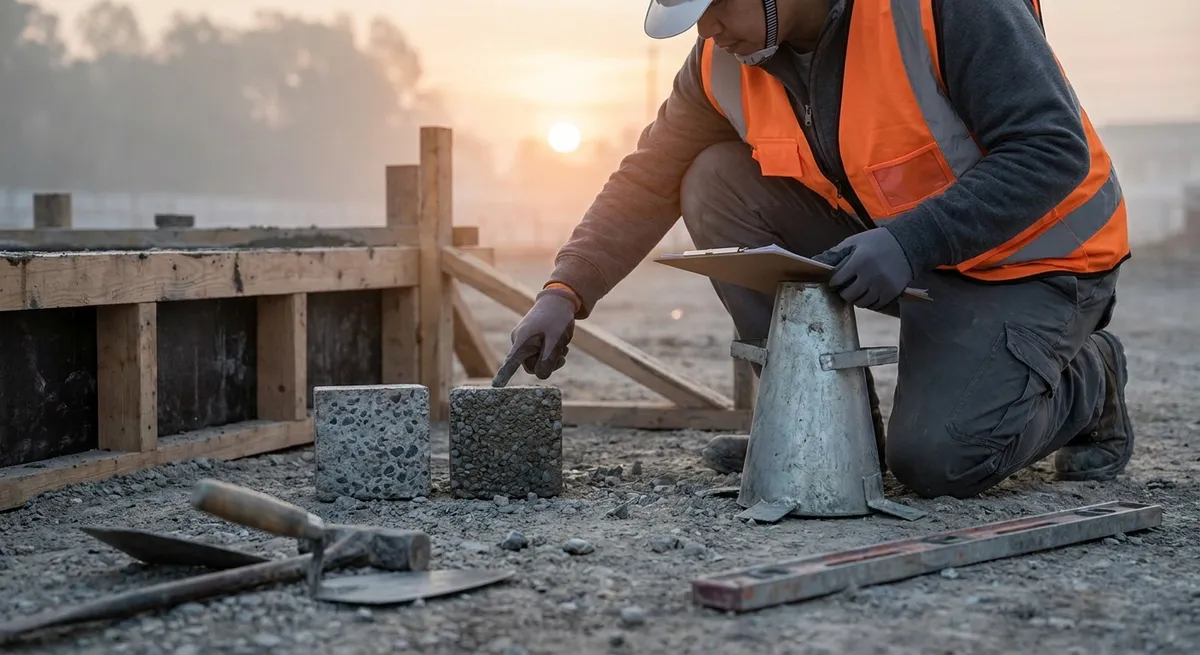
On site, treat the allowed water range as a non-negotiable spec. For ready-mix, the delivery ticket should state target slump (for example, 3–4 inches for formed work, 4–5 inches for typical slabs) and maximum water addition. Use a slump cone test (ASTM C143) on critical pours to verify you’re not over-watering. If you need higher workability without sacrificing strength, ask your supplier about water-reducing admixtures or mid-range/high-range plasticizers rather than adding water from a hose.
When hand-mixing bagged concrete, measure water—do not eyeball it. Start with the manufacturer’s minimum recommended water per bag, mix thoroughly, and slowly add small amounts until the mix is plastic and workable but still holds its shape when formed into a ball. The surface should appear cohesive, not soupy or shiny with bleed water. If you’re placing on a hot, windy day, cool the mixing water and shade the work area rather than increasing water to gain time; extra water at the wrong moment can cost you both strength and finish quality.
Prepare and Form the Base So the Concrete Can Actually Perform
Even a well-designed mix will crack and settle if the base is poorly prepared. Good concrete work begins with soil and subbase that provide consistent support, proper drainage, and control over movement.
Excavate to the correct depth, removing all organic material, soft spots, and uncompacted fill. In most slab-on-grade applications, place a well-graded granular base (such as compacted crushed stone) and compact it in thin lifts with a plate compactor. Aim for uniform compaction across the entire area; isolated “soft” zones will telegraph as differential settlement or cracking.
Formwork should be rigid, square, and correctly braced so it doesn’t bow under load pressure. Check elevations with a laser level or builder’s level, not just a bubble level, especially on larger pours. Provide for proper drainage by sloping exterior slabs away from structures—commonly 1/8 to 1/4 inch per foot depending on use—so water does not pond against foundations.
For slabs and large flatwork, plan for control joints before you pour. Joints control where concrete cracks by creating weakened planes. As a rule of thumb, keep joint spacing in feet less than two to three times the slab thickness in inches (for a 4-inch slab, joints every 8–12 feet), and aim for roughly square panels rather than long, thin rectangles. Either form joints with preplaced strips or saw-cut them within 6–18 hours of placement, depending on conditions and mix design.
Place and Finish with Timing, Not Just Technique, in Mind
How and when you place and finish concrete often matters more than how “skilled” your trowel work looks. Working the surface at the wrong time can trap water, weaken the top layer, and invite scaling and dusting.
When placing, deposit concrete as close as possible to its final position to minimize segregation. Avoid dumping large piles and dragging them long distances with a rake, which can separate coarse aggregate from paste. Use a come-along or concrete rake designed to move, not “comb,” the mix. Once placed, consolidate by rodding or using a vibrator on thicker sections or walls to eliminate voids and honeycombing.
Initial strike-off with a screed should establish the slab plane. After screeding, use a bull float to embed larger aggregate and bring up a paste layer, but don’t overwork it. Wait until bleed water—moisture rising to the surface—has completely evaporated before troweling or edging. Working bleed water back into the surface dilutes the paste and increases the risk of scaling, dusting, and reduced surface strength.
For exterior flatwork, steel trowel finishes can be too dense and slippery, and may exacerbate freeze–thaw damage. A broom finish, applied perpendicular to the direction of traffic, gives better traction and drainage. In hot, dry, or windy weather, anticipate faster set times and have enough labor, tools, and finishing aids (like evaporation retarders and fogging sprayers) ready so you’re not forced into rushed, late finishing that can damage the surface.
Protect the Concrete After the Pour: Curing Is Part of the Work, Not an Afterthought
Concrete doesn’t “dry”—it hardens through hydration, a chemical reaction between cement and water that continues for weeks and even months. Proper curing keeps the internal moisture and temperature within the right range so that hydration can proceed and the concrete achieves its designed strength and durability.
For slabs and exposed surfaces, maintain moisture for at least the first 7 days on standard mixes, and longer (up to 14 days) for high-performance or low w/c ratio concretes, unless the mix design or specifications say otherwise. Common curing methods include continuous wet curing (soaker hoses, wet burlap, or saturated coverings), curing compounds (liquid membrane-forming products), or a combination. In many residential applications, a curing compound sprayed immediately after final finishing is a practical solution, but verify compatibility with planned sealers or coatings.
Temperature control also matters. In cold weather, protect fresh concrete from freezing until it reaches sufficient strength (often at least 500 psi) by using insulated blankets, heated enclosures, or warm mix materials. In hot weather, prevent rapid moisture loss and thermal cracking by shading forms, using cool mixing water, and applying evaporation retardants before finishing. Avoid placing concrete on frozen subgrades or when rapid temperature swings are expected; this can lead to reduced bond, scaling, and early cracking.
Remember that “walkable” does not mean “fully cured.” While light foot traffic may be acceptable after 24–48 hours for many small projects, heavy loads, vehicles, or structural loads should only be applied after the concrete has reached its specified design strength—commonly measured at 7 and 28 days via cylinder tests on professional projects. For DIY work, follow the manufacturer’s or engineer’s recommendations and err on the side of caution before loading new concrete.
Conclusion
Reliable concrete work is less about tricks and more about disciplined control: choosing a mix that fits the environment and load, managing water and slump, building a stable base, placing and finishing at the right time, and protecting the slab while it gains strength. Professionals and serious DIY builders who treat these steps as non-negotiable parts of the job consistently deliver concrete that performs, instead of concrete that becomes a recurring repair. If you plan each pour with these principles in mind, your projects are far more likely to stay solid, straight, and serviceable for the long haul.
Sources
- Portland Cement Association – Concrete Basics - Overview of mix design, placement, finishing, and curing fundamentals
- American Concrete Institute – Guide to Concrete Practice - Technical guidance and FAQs on field practices, standards, and problem prevention
- U.S. Department of Transportation – Concrete Pavement Field Reference - Practical field recommendations on slump, curing, joints, and durability in roadway applications
- National Ready Mixed Concrete Association – Hot Weather Concreting - Best practices for managing heat, evaporation, and workability on hot-weather pours
- Cement Concrete & Aggregates Australia – Curing of Concrete - Detailed technical guide on curing methods, durations, and their effect on long-term performance