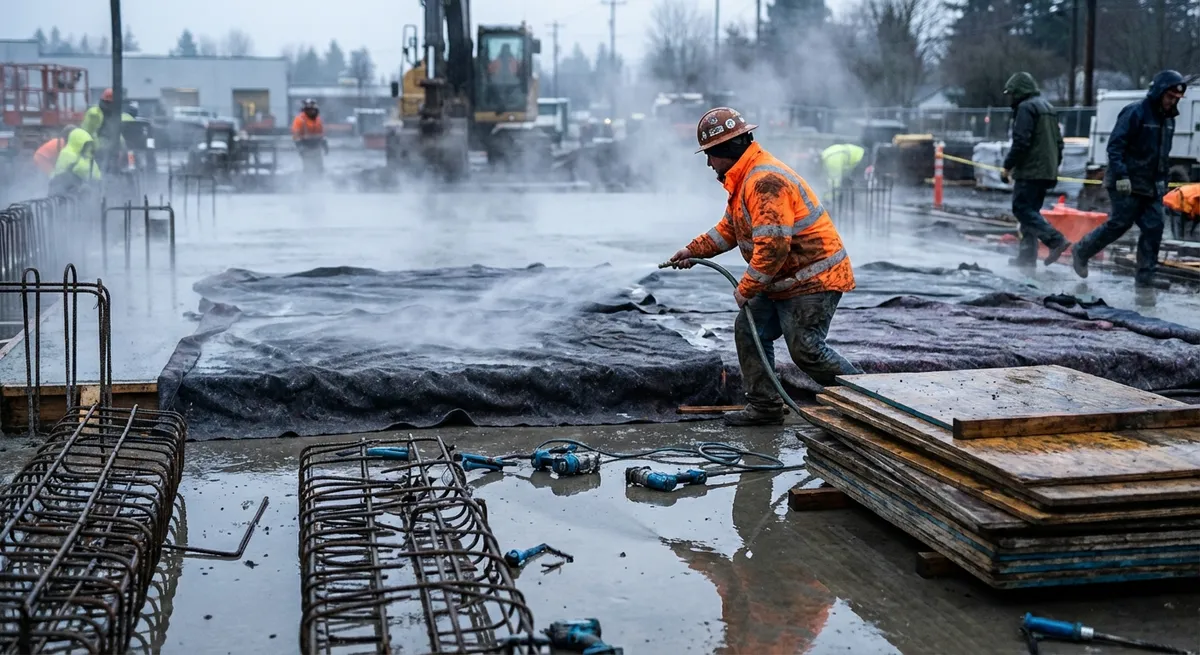
This guide focuses on practical, field-tested curing techniques you can apply on real jobs: driveways, slabs, pads, footings, and structural work. The goal is simple—give your concrete the time, moisture, and protection it needs to reach the strength you’re paying for.
Why Curing Matters More Than Most People Think
Curing is not just “waiting for it to dry.” It’s a controlled process that allows cement hydration to continue long enough for the concrete to reach its designed strength and durability.
When curing is done well, you get:
- Higher compressive strength
- Improved surface hardness and abrasion resistance
- Better resistance to freeze-thaw cycles and deicing salts
- Reduced cracking and curling
- Longer service life with fewer repairs
Poor curing usually shows up as:
- Dusty, weak surfaces that abrade quickly
- Random cracking—not just shrinkage joints
- Flaking or scaling under freeze-thaw or traffic
- Premature surface wear on driveways, patios, and shop floors
The concrete mix design matters, but on many projects, curing practice has more impact on long-term performance than adding another 500 PSI to the spec.
Tip 1: Plan Curing Before the First Truck Arrives
Effective curing starts in the planning phase, not after the finishers load up their tools.
Key steps to lock in before the pour:
- Know your exposure conditions.
Is this slab in direct sun, open wind, or partial shade? Hot, dry, and windy conditions dramatically increase evaporation and shrinkage cracking risks.
- Choose your curing method in advance.
- Water curing (soaker hoses, sprinklers, ponding, wet burlap)
- Curing compounds (spray-applied, membrane-forming)
- Covering (plastic sheeting, curing blankets)
Common field options include:
On many jobs, you’ll use a combination.
- Stage materials where you need them.
- Roll out and pre-cut plastic sheeting or curing blankets.
- Have curing compound loaded in a properly sized sprayer.
- Keep clean, damp burlap or geotextile covers ready and protected from contamination.
- Coordinate labor and timing.
Somebody must be responsible for curing right after finishing—not “when we get to it.” Make it a defined task, not a vague intention.
When curing logistics are set up like any other critical operation, you avoid the common “we poured a great slab and then the wind ruined it” story.
Tip 2: Control Early Moisture Loss, Especially in the First 24 Hours
The first 24 hours after finishing are the most critical for moisture control. Rapid moisture loss at this stage leads to plastic shrinkage cracking and weak surface zones.
Practical tactics to reduce evaporation:
- Use evaporation retarders when conditions demand it.
In hot, windy, or low-humidity conditions, a spray-on evaporation retarder can help keep the surface workable and reduce cracking during finishing. This is not a curing compound but a temporary aid used during placement and finishing.
- Adjust your timing, not just your tools.
When possible, schedule pours in the early morning or late afternoon rather than in peak mid-day sun. For DIY projects, this single decision can dramatically reduce early cracking.
- Windbreaks and shade can be worth the hassle.
- Temporary windbreaks (tarps, plywood sheets, jobsite fencing) can reduce evaporation.
- Use shade cloth rather than opaque tarps when you still need light and airflow around the work area.
- Do not start aggressive water curing too early.
Spraying concrete with water before it has gained initial set can damage the surface, cause laitance, or wash out paste. Start direct water curing only after the surface has hardened enough to resist erosion.
The goal is to keep the surface from drying out too quickly, without disturbing the finish or weakening the top layer.
Tip 3: Choose the Right Curing Method for the Job
Different concrete elements and site conditions call for different curing strategies. No single method is right for every job.
For slabs on grade (driveways, patios, garage floors):
- Curing compounds:
- Ideal when water curing is impractical or inconsistent.
- Apply uniformly as soon as finishing is complete and the surface sheen is gone.
- Use a high-quality, membrane-forming ASTM-compliant product.
- Be aware that some curing compounds may interfere with later coatings or adhesives; choose accordingly.
- Plastic sheeting:
- Use light-colored or white plastic in hot weather to limit heat buildup.
- Lay it carefully to avoid marking the surface; use soft, distributed weights along edges.
- Overlap seams and seal where possible to maintain a humid environment.
- Wet coverings (burlap, fabric):
- Saturate burlap before placing to avoid pulling moisture from the surface.
- Keep coverings continuously damp; avoid cycles of drying and wetting.
For vertical elements (walls, columns, footings):
- Formwork as curing aid:
- Leaving forms in place as long as feasible helps retain moisture.
- After stripping forms, immediately apply curing compound or wet coverings.
- Sheet wrapping:
- Wrap columns, pilasters, and exposed edges with wet fabric and cover with plastic to retain moisture.
For cold or hot weather extremes:
- Cold weather:
- Use insulated curing blankets to maintain temperature and moisture.
- Protect concrete from early freezing; follow local code or engineer requirements.
- Hot weather:
- Combine shade, evaporation retarders, and early application of curing compounds or coverings.
- In severe heat, some crews lightly mist the air above the slab (not directly on fresh surfaces) to improve local humidity.
The best curing method is the one that your crew can maintain consistently for the full required period—partial curing is only marginally better than no curing.
Tip 4: Respect the Curing Timeline—Strength Takes Time, Not Just Hardness
Concrete can feel hard underfoot long before it’s ready for real loads. Curing time is about chemical reaction time, not just surface hardness.
Key timing practices:
- Treat 7 days as a minimum target, not a suggestion.
- Many standard mixes are specified with the assumption of at least 7 days of effective curing.
- For maximum durability, especially in harsh climates or critical structures, 14 days or more is often recommended.
- Understand strength gain over time:
- Concrete gains significant strength in the first 7 days, but continues to gain for weeks.
- Early loading (vehicles, heavy equipment, point loads) can cause microcracking that may not be obvious immediately.
- Stagger access and loading:
- For driveways and garage slabs, keep passenger vehicles off for at least 7 days and heavy trucks off longer, following engineer or supplier guidance.
- For shop floors, delay racks, lifts, and concentrated loads until specified curing and strength milestones are met.
- Monitor temperature when strength is critical:
- In cold weather, curing slows significantly; you may need longer protection and delayed loading.
- Insulation, heated enclosures, or supplemental heat may be required on structural work.
Hands-on rule: if the schedule is tight, work with your ready-mix supplier or engineer to confirm realistic loading timelines based on mix design, ambient conditions, and curing methods. Guessing usually leads to conservative placement or costly damage.
Tip 5: Protect the Surface From Damage While Curing
Even if moisture and time are controlled, surface abuse during curing can undo the benefits.
Practical protection strategies:
- Prevent foot traffic as long as possible.
Set clear boundaries with tape, cones, signage, and fencing. On residential work, proactively communicate with owners and neighbors about access limits.
- Use boards for unavoidable early access.
When trades must cross a slab (for example, framing or mechanical work on a tight schedule), lay down clean plywood sheets to distribute loads and reduce point pressure.
- Control staining and contamination.
- Keep oils, fuels, curing compounds not rated for that surface, and construction chemicals away from fresh concrete.
- Protect slab areas where later finishes (coatings, sealers, adhesives) will be applied; contaminants can cause bond failures.
- Avoid aggressive cleaning during early curing.
- Do not pressure wash young concrete.
- Postpone acid etching or mechanical surface prep until the slab has reached adequate maturity and followed manufacturer guidelines.
- Document curing for critical work.
On commercial or structural jobs, photograph curing setups and note dates and methods. This can help verify compliance with specs and diagnose future issues if they arise.
Proper curing is not just moisture and time—it’s also about minimizing physical and chemical damage while the concrete is gaining strength.
Conclusion
Curing is one of the least glamorous parts of concrete work, but it has an outsized impact on whether your slab, wall, or footing performs as intended. By planning curing before the pour, controlling early moisture loss, matching methods to conditions, respecting realistic timelines, and protecting the surface from damage, you convert a routine pour into a durable, long-lasting structure.
For both seasoned construction professionals and dedicated DIY builders, treating curing as a priority instead of an afterthought is one of the simplest ways to prevent callbacks, reduce future repairs, and deliver concrete work that holds up to real-world use.
Sources
- Portland Cement Association – Concrete Curing - Technical overview of curing methods, timing, and field considerations
- American Concrete Institute (ACI) – Guide to Curing Concrete (ACI 308R) Summary - Professional guidance on best practices for curing, moisture control, and performance
- U.S. Department of Transportation – FHWA Concrete Curing Practices - Federal-level recommendations and research on curing for durability and strength development
- National Ready Mixed Concrete Association – CIP 11: Curing In-Place Concrete - Practical, jobsite-focused curing instructions and troubleshooting tips
- Cement Concrete & Aggregates Australia – Curing of Concrete - Field-oriented guidance on curing methods, environmental effects, and performance outcomes