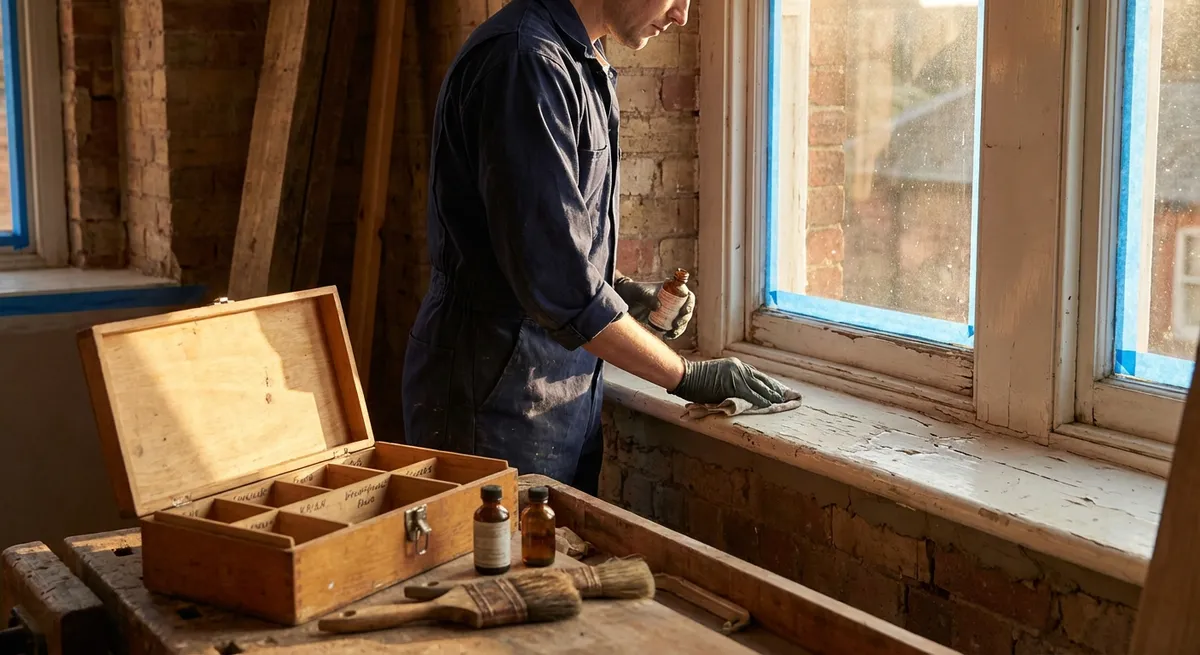
Tip 1: Diagnose the Surface, Not Just the Damage
Before picking up a trowel or tube of adhesive, confirm exactly what you’re bonding to and what’s causing the problem.
Spend a few minutes on organized inspection:
- Identify the substrate: Is it concrete, clay brick, CMU, natural stone, plaster, gypsum board, wood, or a composite material? Each has different porosity and bond behavior.
- Check for movement: Hairline cracks that open and close seasonally, hollow-sounding areas, or doors that stick may indicate structural or moisture movement that a simple patch can’t fix alone.
- Look for contamination: Paints, sealers, curing compounds, efflorescence, oils, and mold all interfere with bond. Run a simple water drop test—if water beads or runs off without darkening the surface, there’s likely a sealer, oil, or dense finish to address.
- Evaluate moisture: Darkened concrete, musty smell, or visible dampness signal that moisture control should be part of the repair plan. Bonding products to a wet or vapor-active surface without considering this usually leads to debonding or blistering.
- Check soundness: Tap with a hammer handle or screwdriver. Hollow sounds, crumbling edges, or material that powders under light scraping should be removed back to solid substrate.
Base your repair approach on what the surface tells you. In many cases, properly cutting back to firm material and addressing moisture or movement does more for long-term durability than any “high-strength” repair product.
Tip 2: Remove Weak Material and Contaminants Completely
Adhesion is only as strong as what you’re bonding to. Leaving a thin layer of loose, dusty, or contaminated material is one of the most common reasons repairs fail.
Use a systematic removal process:
- Cut back to solid: For concrete and masonry, chip or grind until you reach hard, sound material that doesn’t crumble or flake under firm screwdriver pressure. Feathering onto weak edges just creates future failure lines.
- Strip failing coatings: Loose paint, poorly bonded patch compounds, soft caulk, and flaking sealers must go. Use a sharp scraper, heat gun (where appropriate), or chemical stripper rated for the substrate, always following the manufacturer’s safety guidelines and using proper PPE.
- Degrease thoroughly: On garage floors, shop slabs, or older masonry with oil/grease stains, use a concrete-safe degreaser. Scrub mechanically (stiff nylon brush or floor machine) and rinse until rinse water runs clear and no oily sheen remains.
- Handle mold and organic growth: On damp masonry or siding, remove growth with a brush and a cleaner formulated for mold/mildew. Rinse thoroughly and allow to dry. Avoid simply painting or patching over organic growth—it will continue to compromise the bond.
- Vacuum, don’t just sweep: After mechanical removal, vacuum dust with a shop vac fitted with a fine filter or HEPA filter. Dust left on the surface acts like tiny ball bearings between new material and substrate.
Treat this step as non-negotiable. Any time saved by cutting corners on removal usually shows up later in callbacks, peeling, or re-cracking.
Tip 3: Create the Right Profile for the Repair Material
A clean surface isn’t automatically a bondable surface. Most mortars, patching compounds, and adhesives need a specific texture—or “profile”—to lock in mechanically as well as chemically.
Match the surface profile to the repair material:
- Cement-based mortars and patches: These bond best to surfaces that are clean, sound, and slightly rough. Light mechanical abrasion (wire brushing, rubbing stone, or grinding) creates tooth. Avoid glass-smooth troweled concrete if you want long-term bond.
- Thin epoxy or polyurethane repairs: These are more sensitive to surface prep. Follow manufacturer requirements for minimum surface profile—often achieved by grinding or shot-blasting on concrete. The goal is consistent micro-roughness, not deep grooves.
- Tile and stone resets: Remove old thinset or adhesive entirely down to a stable, flat, and roughened substrate. A thin skim of old adhesive left in place can create high spots that weaken the bond or cause rocking.
- Interior joint and skim repairs: For joint compounds on drywall, feather back previous coatings and scuff sand glossy paint. You want a keyed-in transition that doesn’t show a hard edge under new finishes.
- Metal bonding (anchors, epoxy repairs): Clean to bright metal where required, remove rust scale, and roughen shiny surfaces with sandpaper or a wire wheel according to the product data sheet.
Think of profile as the “hidden fastener” of every repair. If your surface looks and feels like it could hold paint or glue without peeling, you’re on the right track; if it’s glossy, polished, or chalky, you’re not ready yet.
Tip 4: Control Moisture and Temperature Before You Mix Anything
Bond performance and curing are heavily influenced by the environment. Even the best-prepared surface won’t save a repair done in the wrong moisture or temperature conditions.
Establish workable conditions first:
- Check for standing water: Remove all standing water from cracks, holes, and patch areas. Slightly damp is often acceptable—or preferred—for cementitious materials, but visible water usually is not.
- Saturate, then surface-dry porous masonry: For many cement-based repairs, pre-dampen very dry, porous concrete or masonry so it doesn’t suck water out of the fresh mix too quickly. Bring it to a saturated-surface-dry (SSD) condition: damp, but with no visible film of water.
- Respect temperature ranges: Most repair materials list a minimum and maximum application temperature (for both air and substrate). Working below or above those ranges can slow cure times dramatically, weaken bond, or cause thermal shock.
- Watch fast temperature swings: Direct sun on dark masonry or concrete can raise surface temperatures much higher than the air reading. Shade or cool the area when needed, and avoid placing patches on hot, rapidly heating surfaces if the product data warns against it.
- Don’t trap active moisture: If a wall or slab shows continuous moisture movement, consider breathable repair options or additional drainage/venting measures instead of dense, vapor-blocking repairs that may blister or debond.
Planning around weather and substrate conditions is part of the repair—not an afterthought. If conditions are outside the recommended range for your product, wait or alter the environment before proceeding.
Tip 5: Use Primers and Bonding Agents as Designed—Not as Insurance
Primers and bonding agents can greatly improve adhesion, but only when they’re matched properly to both the substrate and the repair material. Using them as a catch-all “insurance policy” without reading the technical data often causes the problems they were meant to prevent.
Apply them deliberately:
- Confirm compatibility: Use only the primer or bonding agent recommended by the manufacturer of your repair product. Mixing brands or types (e.g., PVA where an acrylic or epoxy is specified) can weaken the system.
- Follow open times precisely: Many bonding agents are designed to be tacky, not wet, at the time of placement. Others must dry completely first. Observe the specified recoat or overlay window; applying too soon or too late can drastically reduce bond.
- Avoid over-application: Thick puddles or runs of primer can form a weak intermediary layer. Apply in the film thickness specified—usually a uniform, thin coat. Remove excess from corners and low spots.
- Don’t substitute watered-down adhesive: Using diluted wood glue or general-purpose adhesives as a “bonding agent” on masonry is a common shortcut that leads to peeling and soft interfaces. Stick to products rated and tested for your application.
- Recognize when primer isn’t needed: Some modern repair mortars and adhesives are formulated for direct application to clean, SSD substrates without additional bonding agents. Adding extra, unapproved primers can actually reduce performance.
Treat bonding agents and primers as part of a system, not a universal fix. If the data sheet calls for one, use it correctly; if it doesn’t, focus on excellent mechanical cleaning and proper moisture control instead.
Conclusion
Successful repairs start long before you open a bag of mix or cut a cartridge tip. By diagnosing the surface condition, removing weak and contaminated material, creating the right profile, controlling moisture and temperature, and using primers as part of a defined system, you dramatically improve the odds that your work stays put. These habits don’t require exotic tools—just disciplined prep and attention to what the substrate is telling you.
Whether you’re a seasoned contractor or a careful homeowner, building these surface-prep practices into every repair means spending less time redoing work and more time moving projects forward confidently.
Sources
- Portland Cement Association – Concrete Repair Overview - Technical guidance on sound concrete removal, bonding, and repair practices
- U.S. General Services Administration – Building Façade Repair Guide - Practical procedures for evaluating and preparing masonry surfaces
- Simpson Strong-Tie – Surface Preparation for Repair Mortars - Manufacturer recommendations on cleaning, profiling, and priming substrates before repair
- Sika – Principles of Concrete Repair - Overview of substrate assessment, pre-treatment, and environmental conditions for durable repairs
- National Ready Mixed Concrete Association – CIP 35: Testing for Strength of Concrete - Background on how curing conditions and surface moisture affect concrete performance