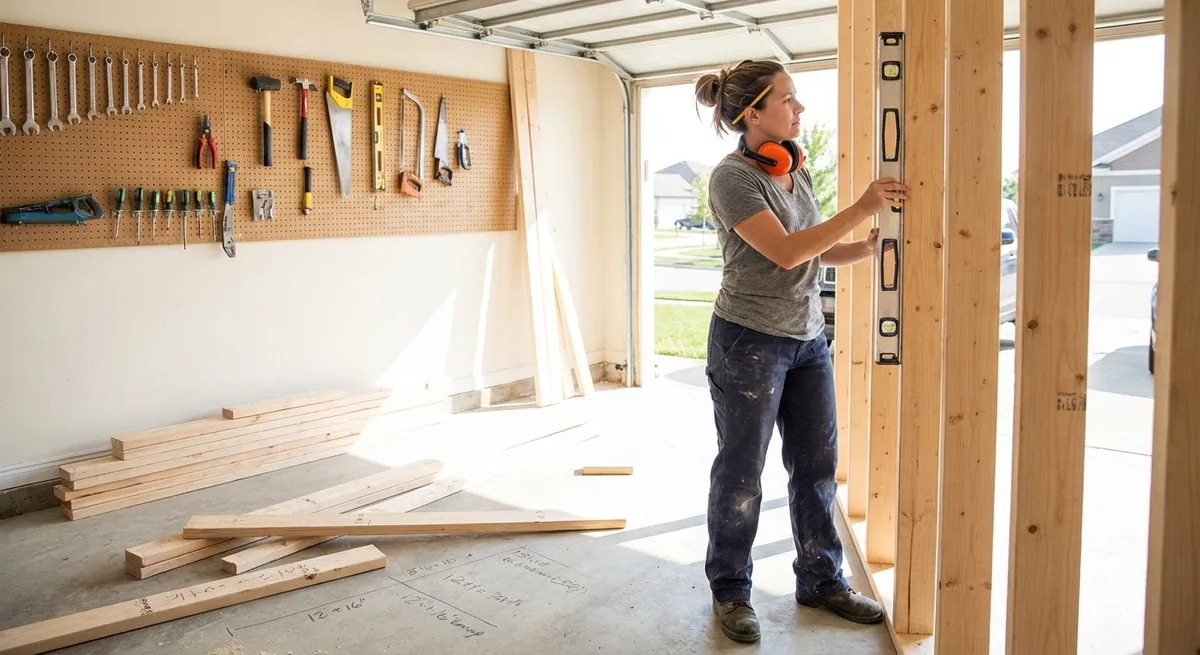
Below are five field-tested habits that contractors use every day, translated into practical steps you can apply to almost any DIY build—whether you’re framing a wall, laying pavers, or installing cabinets.
Habit 1: Turn a Rough Idea into a Buildable Scope
Professionals don’t start with “I want a deck.” They start with a scope: what gets built, how it ties into existing structures, and where the limits are. A clear scope protects your time, money, and sanity.
How to translate this on a DIY project:
- Define the use, not just the look. Instead of “new workbench,” write: “Workbench that supports 300+ lbs, fits a 6' wall, and has clamp-friendly edges.” Function guides your material choices and construction details.
- Set a boundary for the first phase. If you’re redoing a room, your first phase might be “flooring and baseboards only,” not “whole-room makeover.” Professionals phase work to keep it manageable and to preserve livable space.
- List constraints before you sketch. Measure door widths, ceiling heights, existing electrical and plumbing, and any fixed obstacles. Constraints force realistic design decisions and prevent mid-project redesigns.
- Capture decisions in writing. A one-page “mini scope” with dimensions, materials, finish level, and must-haves will keep you from drifting into extras you didn’t budget for.
- Do a quick feasibility check. For any new-to-you task, confirm you have (or can rent) the tools, and verify your structure can support the change (e.g., confirm load-bearing questions before removing walls, or check slab thickness before heavy anchors).
When in doubt, scale the first version of your project down. Pros frequently start with a smaller test area (a single bay of shelving, a short run of pavers) to validate their assumptions before committing to full scale.
Habit 2: Measure and Mark Like Everything Is Going in Front of an Inspector
Construction work is built on accurate layout. Most visible “DIY mistakes”—crooked cabinets, out-of-square patios, gapped trim—start with sloppy measuring and marking, not bad tools or poor luck.
Practical steps to upgrade your layout work:
- Use a dedicated layout kit. Keep a tape measure, pencil, fine-tip marker, chalk line, carpenter’s square, and torpedo level in a single pouch or box that follows you around the project. Pros don’t waste time hunting for layout tools.
- Establish a reference line or plane first. For floors, pop a level reference line around the room. For walls, choose a single “control” wall to measure from. Every other line, cut, or layout mark should reference that original benchmark.
- Work from fixed points, not from “where it looks right.” Lay out flooring from the straightest wall, not the most visible one. Start tile from a centered reference line, not from a corner that may be out of square.
- Mark for the next person—future you. Use consistent symbols: X for waste cutoffs, arrows for orientation, rectangles for boxes or fixtures, and notes with dimensions. Label studs, joists, and centerlines so you don’t have to remeasure.
- Double-check critical measurements using two methods. Confirm a long measurement by measuring from both ends, or compare diagonal measurements to confirm square when framing or laying out rectangles.
Adopting this mentality doesn’t slow you down; it speeds you up long-term because you remove surprises at installation time.
Habit 3: Break Each Task into a Repeatable Micro-Process
Professionals are fast and accurate because they do the same small sequence over and over: mark, cut, test fit, adjust, install. That micro-process is what keeps quality consistent across a whole job.
How to build repeatable sequences into your DIY work:
- Identify the “unit” you’re repeating. It might be a fence panel, a cabinet box, a paver, or a section of trim. Decide the exact steps required to complete one unit from start to finish.
- Run a slow first cycle. Do the first unit deliberately, documenting each step: tools used, sequence, and any adjustments. That first piece becomes the standard for everything that follows.
- Use physical templates and jigs. Pros rarely “freehand” repeated cuts. For recurring angles or hole locations, make a simple jig from scrap that sets the position for your saw, drill, or router.
- Standardize your checks. For example, every framing bay gets checked for plumb and width; every tile row gets checked for straightness against a string line; every cabinet gets checked for level side-to-side and front-to-back.
- Triage imperfections early. If the third or fourth unit no longer matches your first, stop and find out why—dull blade, warped stock, layout shift—before the error compounds across 20 pieces.
Treat each “unit” of the build like a quality sample off a production line. If it wouldn’t pass, don’t keep cloning it.
Habit 4: Pre-Plan Fastening and Structural Support
Strong, durable building isn’t just about which screws or anchors you use—it’s about where they go, how many you use, and what they’re bearing on. Professionals think about the load path and fastening pattern before they cut a single piece.
Borrow this mindset for sturdier DIY builds:
- Decide how loads move through your project. Ask: Where is the weight or force coming from? (People standing, doors swinging, wind, stored items.) Where must that load end up? (Slab, foundation, wall studs, joists.) Then ensure each step in between is solid and continuous.
- Select fasteners based on material and exposure. Use appropriate screws or anchors rated for:
- The base material (wood, concrete, block, metal)
- The environment (interior vs. exterior, corrosion resistance)
- The load (shear vs. pull-out strength)
- Pre-locate your fasteners. Lightly mark where each screw or anchor will go:
- Fasteners from different directions should not collide
- Edge distances should meet manufacturer or code guidance
- Spacing should be consistent and aligned
- Use pilot holes and depth control. Especially in hardwood, masonry, or when working near edges, drill pilot holes sized to the fastener shank (not the threads). For anchors, drill to specified depth and clean out dust for full strength.
- Respect manufacturer instructions as minimum standards. For structural elements (joist hangers, ledger boards, anchors), follow the exact nail size, screw type, or pattern specified. Those details are engineered for real loads, not suggestions.
Whenever possible, assume someone may lean, pull, or hang from anything you build. If it wouldn’t be safe as a grab point, it’s not robust enough yet.
Habit 5: Stage the Work Area Like You’re Sharing It with Other Trades
On professional jobsites, space, access, and safety are shared. Materials are staged so trades don’t trip over each other or damage each other’s work. DIY projects benefit from the same discipline—especially in tight garages, basements, or active living spaces.
Steps to run a “job-ready” workspace at home:
- Set up three clear zones:
- Clean zone: Where finished items are stored and where you walk with clean shoes (e.g., inside the house).
- Work zone: Where cutting, fastening, and assembly happen.
- Dirty zone: Where you store dusty tools, mix materials, or cut masonry/metal.
- Control the flow of materials. Keep raw stock near the entry, then move it through cutting and assembly stations toward the clean zone. Avoid carrying long pieces back and forth through finished spaces.
- Protect surfaces like they’ll be inspected. Use drop cloths, cardboard sheets, edge protectors, and painter’s tape on floors, countertops, and stair treads. Pros budget for protection because it’s cheaper than repair.
- Schedule noisy and dusty operations. Group cutting, grinding, and sanding into blocks of time. Set up dust collection or at least a fan directing dust away from living areas, and use proper respiratory protection.
- End each work session with a 10–15 minute reset. Put fasteners back into labeled containers, coil cords and hoses, empty dust bags, stack offcuts by size (keep the useful ones), and sweep. This is exactly what keeps pros productive the next morning.
A well-staged work area reduces mistakes, protects your home, and makes it far easier to pick a project back up—even if it’s been a week since you last touched it.
Conclusion
The best DIY results don’t come from buying the most expensive tools; they come from adopting professional habits: clear scope, disciplined layout, repeatable processes, planned fastening, and a controlled workspace. These practices are simple but powerful—they reduce guesswork, keep projects moving, and help you build with the kind of confidence you see on a well-run jobsite.
Treat your next project as a small construction job, not just a weekend experiment. Plan it like a pro, build it with consistent checks, and finish it in a space that supports safe, accurate work. Over time, these habits compound—your projects get cleaner, stronger, and more satisfying to complete.
Sources
- [U.S. Occupational Safety and Health Administration (OSHA) – Construction Industry](https://www.osha.gov/construction) – Guidance on safe work practices, jobsite organization, and tool use that can inform safer DIY setups.
- [The Family Handyman – Carpentry Basics: How to Use a Tape Measure](https://www.familyhandyman.com/project/how-to-use-a-tape-measure/) – Practical layout and measuring tips widely used by both DIYers and professionals.
- [Simpson Strong-Tie – Residential Construction Connectors Catalog](https://www.strongtie.com/resources/literature/residential-construction-connectors-catalog) – Manufacturer documentation on load paths, connectors, and fastening patterns for stronger builds.
- [Fine Homebuilding – Layout and Framing Articles](https://www.finehomebuilding.com/category/framing) – Detailed, field-tested techniques for framing, layout, and structural planning relevant to serious DIYers.
- [University of Missouri Extension – Home Maintenance and Improvement](https://extension.missouri.edu/programs/home-maintenance-and-improvement) – Educational resources on planning, executing, and maintaining residential projects with best-practice guidance.