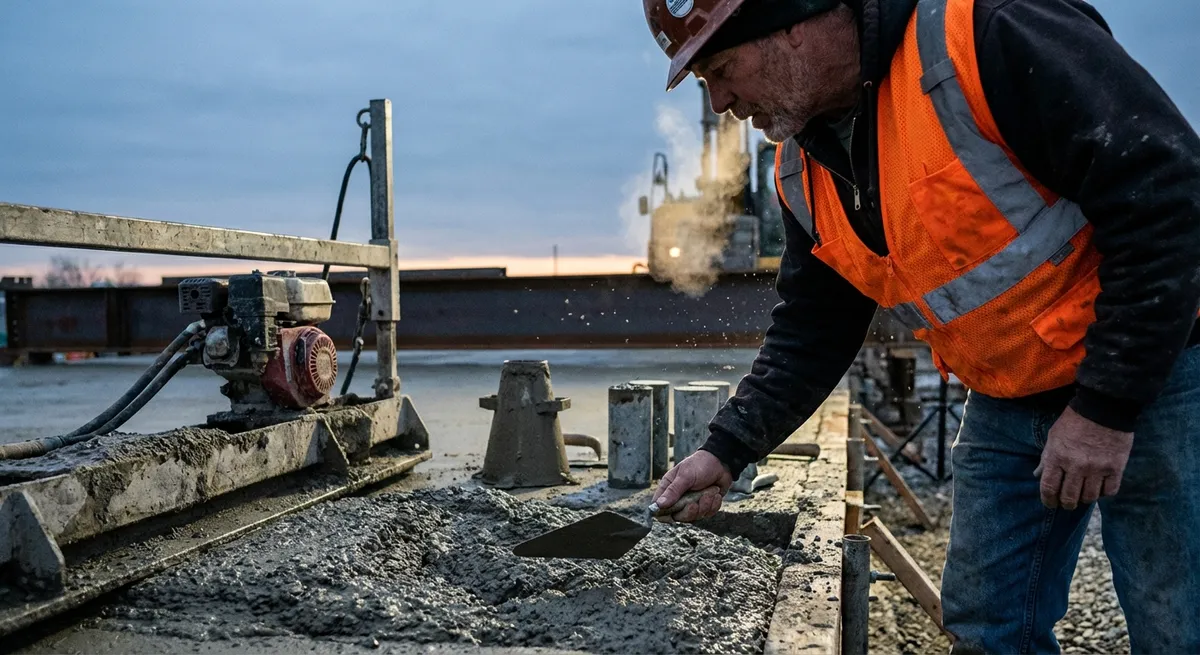
This guide focuses on practical, repeatable habits that help both professionals and serious DIY builders get more durable, predictable results from every pour—whether you’re placing a small slab or working on a larger project.
Understand What You’re Building Before You Touch the Mix
Concrete is not “one-size-fits-all.” The way you mix, place, and cure should be driven by what the concrete actually has to do for the next 20–50 years.
Start by writing down three things: the load it will carry, the environment it will live in, and how thick it can realistically be. A garage slab that will see vehicle loads in a freeze–thaw climate calls for a different mix and reinforcement strategy than a patio in a mild climate. Review local building code requirements for minimum thickness, compressive strength (psi), and reinforcement for your specific use—driveways, walkways, steps, or foundations.
Next, align your materials with those requirements. For ready-mix, that means specifying strength (e.g., 3,500 psi vs. 4,000 psi), slump range, air content (often 5–7% for freeze–thaw), and aggregate size. For bagged mixes, choose products labeled clearly for your application (e.g., high-strength structural vs. general-purpose). If you’re in a region with de-icing salts or coastal exposure, consider mixes with lower water–cement ratios and added durability features like supplementary cementitious materials (SCMs).
Finally, adjust your schedule to the concrete’s demands. Higher-strength, lower-slump mixes may place and finish differently and set faster or slower depending on temperature. Planning the crew size, tools, and working sequence around your exact slab size and access points ensures you’re not rushing critical steps like bull-floating or saw-cutting joints.
Control Water Like It’s a Structural Component (Because It Is)
Extra water is the cheapest way to ruin a good concrete mix. Every unnecessary gallon added for “workability” reduces strength and increases the chance of shrinkage cracking and surface dusting.
Start with the designed water–cement ratio. For most slabs, that’s around 0.45–0.50 by weight; higher durability work often aims lower. With ready-mix deliveries, confirm the batch ticket and avoid water additions at the site unless absolutely necessary. If workability is an issue, request or specify a plasticizer (water-reducing admixture) rather than dumping in more water. Many modern admixtures significantly increase slump without weakening the cured concrete.
For bagged concrete, measure water precisely. Use the manufacturer’s recommended range and start at the low end, gradually adding small amounts while mixing thoroughly. A uniform, workable mix is better achieved by good mixing time and consistent agitation than by chasing an overly fluid consistency. Aim for a mix that holds its shape when heaped but is still workable under the trowel or shovel.
Pay attention to environmental moisture as well. Saturated subgrades and forms can affect the effective water content at the interface with the slab. Dampen dry subbases and wood forms before placement so they don’t steal water from the mix, but avoid standing water. This simple step helps ensure a more consistent surface and reduces the risk of weak, dusty top layers.
Build a Subbase and Reinforcement System That Matches the Load
Concrete is only as good as what it’s sitting on and what’s inside it. Even a perfectly mixed and cured slab will crack or settle if the support is inconsistent or under-designed.
Start with the subgrade. Strip organic material, soft pockets, and loose fill. For slabs-on-grade, place a well-graded granular base (such as compacted gravel or crushed stone) and compact in thin lifts using a plate compactor. Focus on uniform support, not just “hard spots”—differential support is what leads to curling and uneven settlement. For thicker structural elements or frost-prone areas, follow local code for depth below frost line and drainage considerations.
When reinforcement is required or advisable (and it usually is for anything beyond the smallest pads), match the system to the slab’s role. Welded wire fabric (WWF), deformed rebar, or fiber reinforcement each have specific use cases. Rebar and properly placed WWF help control crack width and improve load-carrying behavior; fibers help reduce plastic shrinkage cracking and improve toughness, but they do not replace structural steel where it’s required.
The most common mistake is leaving reinforcement on the ground. Place rebar on proper chairs or supports so it ends up in the correct depth range—typically in the lower third to mid-depth of the slab, depending on design. Tie intersections securely, especially in driveways and slabs that will see point loads. During placement, watch for reinforcement shifting or being walked down to the base, and correct it on the spot rather than after the fact.
Time Your Finishing and Jointing to the Concrete, Not Your Watch
The surface of the slab tells you when it’s ready for each step. Rushing or delaying finishing and joint cutting can lock in problems that only show up weeks or months later.
Right after placement, strike off (screed) the concrete to the correct elevation and immediately bull-float to embed larger aggregate and bring up a consistent paste. This should happen while the concrete is still fairly plastic but no longer soupy. Avoid overworking the surface at this stage—too much troweling or floating early can trap bleed water and lead to scaling, dusting, or delamination.
Never finish while bleed water is present. This is a critical habit. Allow bleed water to evaporate naturally; do not sprinkle dry cement or use water to “help” the finish. Wait until the surface dark sheen fades and the concrete begins to support weight with only light indentation under finger pressure before starting steel trowel finishing (for smooth surfaces) or broom finishing (for exterior, slip-resistant surfaces).
Jointing is equally time-sensitive. Control joints should generally be cut to a depth of at least one-quarter of the slab thickness and spaced according to thickness and geometry (often 2–3 times the slab thickness in feet, but follow code and design guidance). For saw-cut joints, cut as soon as the concrete is firm enough to prevent raveling of the edges, yet early enough that shrinkage stresses haven’t already formed uncontrolled cracks. On hot or windy days, that window may be much earlier than expected; plan labor and equipment accordingly.
Treat Curing as a Structural Operation, Not Cosmetic Aftercare
Curing isn’t about looks—it directly affects strength, durability, crack resistance, and surface performance. A well-cured slab can outperform a poorly cured slab even if both were placed with the same mix design.
Concrete gains strength by hydration, a chemical reaction that requires moisture and time. Without proper curing, the surface dries out too quickly, leading to reduced strength, increased shrinkage, and higher permeability. As soon as finishing is complete and the surface can support it, begin curing methods appropriate for the job. These include curing compounds (film-forming liquids sprayed on), wet curing (covering with wet burlap, mats, or plastic sheeting), or continuous water spray or ponding for some structural elements.
For slabs exposed to the elements, curing for at least 7 days is a practical minimum, with longer periods (up to 14 days or more) beneficial for high-performance or high-strength concrete. In hot, dry, or windy conditions, curing should start earlier and be more aggressive to combat rapid evaporation. In cold conditions, protect the concrete from freezing and extreme temperature swings, using insulated blankets or heated enclosures where necessary.
Plan the curing method before the pour. Have curing compound, water sources, coverings, and protection from traffic ready on-site. Communicate to everyone involved—owners, other trades, and helpers—that no one drives, parks, or stacks materials on the slab until it reaches adequate strength, often 7 days for light use and 28 days for full design strength, unless your engineer or product documentation indicates otherwise.
Conclusion
Long-lasting concrete isn’t the result of one “trick”; it comes from a chain of disciplined decisions from design through curing. When you understand the demands on the slab, control water like a structural element, build a solid base and reinforcement layout, time your finishing to the concrete itself, and treat curing as part of the structural work, you stack the odds in your favor.
For both professionals and serious DIY builders, these habits turn a high-risk material into a predictable one. Concrete will always move, shrink, and respond to its environment—but with the right practices, it does so in ways you’ve planned for instead of in ways that surprise you later.
Sources
- [Portland Cement Association – Concrete Slab Surface Defects: Causes, Prevention, Repair](https://www.cement.org/learn/concrete-technology/durability/concrete-slab-surface-defects-causes-prevention-repair) – Technical guidance on common slab problems and how to avoid them
- [American Concrete Institute (ACI) – Concrete In Practice: CIP 11 Curing In-Place Concrete (PDF)](https://www.concrete.org/portals/0/files/pdf/cip_11.pdf) – Practical explanation of curing methods, timing, and their impact on performance
- [U.S. General Services Administration – Concrete Floor Slabs on Grade Subjected to Heavy Loads (PDF)](https://www.gsa.gov/cdnstatic/Concrete_Floor_Slabs_on_Grade_Subjected_to_Heavy_Loads_R2.pdf) – Detailed treatment of subbase, reinforcement, and jointing for slabs under load
- [National Ready Mixed Concrete Association – CIP 8 Discrepancies in Yield](https://www.nrmca.org/wp-content/uploads/2024/01/CIP8.pdf) – Discusses mixture proportioning, water content, and site adjustments to ready-mix
- [U.S. Department of Transportation, FHWA – Concrete Pavement Field Reference: Pre-Paving Activities, Placement, and Curing (PDF)](https://www.fhwa.dot.gov/pavement/concrete/pubs/07027/07027.pdf) – Field-focused best practices for placement, finishing, and curing in transportation concrete work